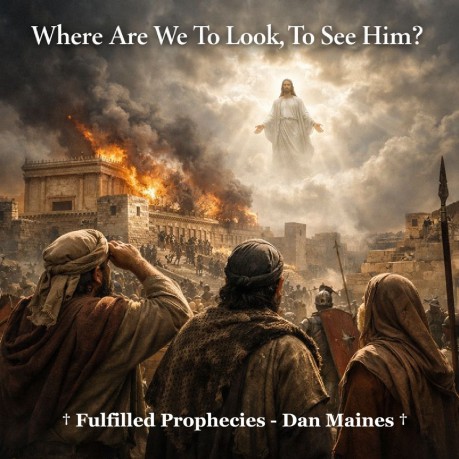
Where
Are We To Look, To See Him? Introduction Where are we to look, to see Him? † Scripture
defines knowing God as something that comes by revelation, not by
searching outwardly (2 Corinthians 4:6). 2 Corinthians 4:6
For God, who said, "Light shall shine out of darkness," is
the One who has shone in our hearts to give the Light of the
knowledge of the glory of God in the face of Christ. † Paul
explicitly says God shines in our hearts, identifying the location of
revelation (2 Corinthians 4:6). Galatians 1:15-16
But when He who had set me apart even from my mother's womb and
called me through His grace was pleased to reveal His Son in me so
that I might preach Him among the Gentiles, I did not immediately
consult with flesh and blood, † Paul plainly
states Christ was revealed in him, not externally to him (Galatians
1:16). 2 Thessalonians 1:10
when He comes to be glorified among His saints on that day, and to be
marveled at among all who have believed-because our testimony to you
was believed. † The verse
defines where Christ is glorified, in His saints (2 Thessalonians
1:10). 2 Peter 1:19
And so we have the prophetic word made more sure, to which you do
well to pay attention as to a lamp shining in a dark place, until the
day dawns and the morning star arises in your hearts. † Peter
directs believers to the prophetic word, not to signs or observation
(2 Peter 1:19). † Peter names
the Morning Star without defining it here, so Scripture must
interpret Scripture (2 Peter 1:19). Revelation 1:12
Then I turned to see the voice that was speaking with me. And after
turning I saw seven golden lampstands; † John turned
to see a voice, not a physical descent (Revelation 1:12). Zechariah 2:10
Shout for joy and rejoice, daughter of Zion; for behold I am coming
and I will dwell in your midst," declares the Lord.
† The promise
focuses on God dwelling with His people (Zechariah 2:10). John 14:19-20
After a little while, the world no longer is going to see Me, but you
are going to see Me; because I live, you also will live. On that day
you will know that I am in My Father, and you are in Me, and I in
you. † Jesus
contrasts the world's inability to see with the disciples' ability
(John 14:19). Luke 17:22
And He said to the disciples, "The days will come when you will
long to see one of the days of the Son of Man, and you will not see
it. † Jesus
directly denies observation as the means of recognizing the Kingdom
(Luke 17:20). Matthew 16:17
And Jesus said to him, "Blessed are you, Simon Barjona, because
flesh and blood did not reveal this to you, but My Father who is in
heaven. † Revelation
is attributed to God alone (Matthew 16:17). 1 Corinthians 2:9-10 "Things
which eye has not seen and ear has not heard, For to us
God revealed them through the Spirit; for the Spirit searches all
things, even the depths of God.
† Paul
contrasts human senses with divine revelation (1 Corinthians
2:9-10). Revelation 1:7
Behold, He
is coming with the clouds, and every eye will see Him, even
those who pierced Him; and all the tribes of the earth will mourn
over Him. So it is to be. Amen. † Cloud
language is consistently associated with divine judgment (Isaiah
19:1). Hosea 8:1 Put the trumpet to your lips! † Hosea ties
judgment directly to covenant violation (Hosea 8:1). † Scripture
itself identifies the Jerusalem temple as the focal point of covenant
judgment, which is why prophecy centers on its destruction. Deuteronomy 28:37
And you will become an object of horror, a song of mockery, and an
object of taunting among all the peoples where the Lord
drives you. † Moses warned
Israel of this consequence (Deuteronomy 28:15, 37). Deuteronomy 29:24-25
All the nations will say, 'Why has the Lord
done all this to this land? Why this great outburst of anger?' Then
people will say, 'It is because they abandoned the covenant of the
Lord, the God of their
fathers, which He made with them when He brought them out of the land
of Egypt. † Moses
foretold future inquiry into Israel's destruction (Deuteronomy
29:24). Acts 1:11
and they said, "Men of Galilee, why do you stand looking into
the sky? This Jesus, who has been taken up from you into heaven, will
come in the same way as you have watched Him go into heaven." † The angels
correct the disciples for standing and looking (Acts 1:11). 2 Corinthians 5:16
Therefore from now on we recognize no one by the flesh; even though
we have known Christ by the flesh, yet now we know Him in this way no
longer. † Paul states
a change in how Christ is known (2 Corinthians 5:16). Hebrews 9:28
so Christ also, having been offered once to bear the sins of many,
will appear a second time for salvation without reference to sin, to
those who eagerly await Him. † The
appearance is limited to those awaiting Him (Hebrews 9:28). Colossians 1:26-27
that is, the mystery which had been hidden from the past ages and
generations, but now has been revealed to His saints, to whom God
willed to make known what the wealth of the glory of this mystery
among the Gentiles is, the mystery that is Christ in you, the hope of
glory. † Paul says
the mystery has now been manifested (Colossians 1:26). Historical References † Origen
taught Christ comes continually through revelation to believers
(Origen, Commentary on Matthew). How It Applies To Us
Today † Believers
live by revealed truth, not visible signs (2 Corinthians 5:7). Q and A Appendix Q
Where are we told to look in order to understand Christ's coming. Q
What does Scripture mean when it says every eye will see Him. Q
Who is the Morning Star in 2 Peter 1:19. Q
Where does the Morning Star rise according to Peter. Q
How did Paul say Christ is revealed. Q
What did Jesus say about seeing Him after His departure. Q
How does Scripture identify the target of covenant judgment. Q
Why is prophecy centered on the destruction of the temple. Q
Did the apostles expect revelation or spectacle. Q
What is the foundation of the church according to Jesus. † This is the fulfilled
perspective we proclaim at Fulfilled Prophecies † Source Index †
Share on Facebook
By Dan Maines
Where
He is?
For God, who said, "Light shall shine out of
darkness," where?
In our hearts to give the Light of the
knowledge of the glory of God in the face of Christ.
†
The Bible consistently places understanding in what God reveals, not
in what man observes (Matthew 11:27).
†
The question of seeing Christ is answered by where God shines His
light (Ephesians 1:17-18).
†
The comparison to creation shows this knowledge is an act of God, not
human discovery (Genesis 1:3; 2 Corinthians 4:6).
†
Knowledge of God is tied to Christ Himself, not signs or phenomena
(John 1:18).
†
This verse defines how God reveals Himself, by illumination
(Ephesians 1:18).
†
He contrasts revelation with information received from men (Galatians
1:12).
†
Flesh and blood are excluded as sources of understanding (Matthew
16:17).
†
Apostolic authority rests on revelation, not tradition (1 Corinthians
2:12).
†
Belief is the condition given for admiration of His glory (John
11:40).
†
Paul ties Christ's coming to glorification, not to visible movement
(Colossians 1:27).
†
Faith is the means by which His glory is known (Hebrews 11:6).
†
Scripture is described as a lamp that gives guidance (Psalm
119:105).
†
The verse explicitly says the Morning Star rises in your hearts (2
Peter 1:19).
†
Peter emphasizes paying attention, not watching events (2 Peter
1:19).
†
Understanding is the result of Scripture being opened (Luke 24:45).
†
Jesus explicitly identifies Himself as the Morning Star, removing all
ambiguity about the identity (Revelation 22:16).
†
The title Morning Star was already associated with the Messiah in
prophetic expectation (Numbers 24:17).
†
Christ promised to give the Morning Star to believers, showing shared
participation in His life and victory (Revelation 2:28).
†
Peter's statement that the Morning Star rises in your hearts aligns
with Christ being revealed within believers, not observed externally
(Colossians 1:27; 2 Corinthians 4:6).
†
Christ is seen in the midst of the lampstands, identified as churches
(Revelation 1:20).
†
The vision places Christ among His people (Matthew 18:20).
†
The imagery is symbolic, not photographic (Revelation 1:1).
†
Scripture defines God's coming by covenant presence (Exodus 29:45).
†
Dwelling language points to relational nearness (Leviticus
26:11-12).
†
This promise aligns with later teaching of indwelling (John 14:23).
†
The knowing described is relational knowledge (John 17:3).
†
Mutual indwelling is stated explicitly (John 14:20).
†
Life is given as the reason for this knowing (John 14:19).
†
Visibility is contrasted with understanding (Luke 17:21).
†
The Kingdom is defined spiritually (Romans 14:17).
†
Christ rules by truth, not spectacle (John 18:36).
†
Human ability is excluded (1 Corinthians 2:14).
†
The statement explains how Peter knew, not what he saw (John 6:44).
†
This revelation becomes the foundation of the church (Matthew 16:18).
And
which have not entered the human heart,
All
that God has prepared for those who love Him."
†
The text says these things have been revealed (1 Corinthians 2:10).
†
Revelation is the Spirit's work (John 16:13).
†
Knowledge is received, not imagined (Ephesians 3:3-5).
†
The reference to those who pierced Him places the event within that
generation (Matthew 23:35-36).
†
The tribes of the land mourning matches covenant judgment language
(Zechariah 12:10-14).
†
John presents this as imminent fulfillment (Revelation 1:1).
†
Seeing Him does not require physical sight, Scripture often uses
seeing to mean recognizing the reality and effects of God's action,
especially since Jesus said the world would see Him no more (John
14:19; Luke 21:20).
Like
an eagle the enemy comes against the house of the Lord,
Because
they have violated My covenant
And rebelled against My Law.
†
The eagle imagery is used for invading armies (Deuteronomy 28:49).
†
The house of the Lord is identified as the covenant center under
judgment (Jeremiah 7:14).
†
This judgment is covenantal, not random or global (Leviticus
26:14-16).
†
Jeremiah identifies the house of the Lord as the temple in Jerusalem,
the place where God caused His name to dwell (Jeremiah 7:2, 7:14).
†
God explicitly says He will do to that house what He did to Shiloh,
which was historically destroyed, showing this is a physical,
covenantal judgment on a sanctuary (Jeremiah 7:12-14).
†
Jesus directly applies Jeremiah's temple judgment language to His own
generation when condemning the Jerusalem temple (Matthew 21:13;
Matthew 23:38).
†
Jesus then foretells the temple's destruction within that generation,
confirming both the target and the timing of the judgment (Matthew
24:1-2, 34).
†
The Roman destruction of the temple in AD 70 matches Jeremiah's
warning and Jesus' prophecy, showing Hosea's house of the Lord
judgment culminated there (Luke 21:20-22).
†
The judgment is public and historical (Deuteronomy 29:24-25).
†
The curse applies to covenant breakers (Leviticus 26:14-16).
†
Jesus affirmed this same accountability (Luke 21:22).
†
The answer given is covenant abandonment (Deuteronomy 29:25).
†
Scripture itself explains the judgment (Jeremiah 22:8-9).
†
This framework governs later prophecy (Daniel 9:11).
†
The verse speaks of manner, not geography (Acts 1:11).
†
Scripture interprets this coming through Danielic imagery (Daniel
7:13).
†
Jesus had already taught fulfillment of Scripture was the key (Luke
24:44).
†
Knowing according to the flesh has ended (Romans 7:6).
†
Faith defines present relationship (Galatians 2:20).
†
Spiritual knowing replaces physical familiarity (John 20:29).
†
The focus is salvation, not sacrifice (Hebrews 10:12).
†
The contrast is between sin bearing and completion (Hebrews 7:27).
†
The context is priestly fulfillment (Hebrews 9:24).
†
The content of the mystery is Christ in you (Colossians 1:27).
†
Glory is tied to indwelling (2 Corinthians 3:18).
†
This fulfills covenant promises (Ezekiel 36:27).
†
He emphasized illumination by the Word (Origen, Homilies on Luke).
†
Eusebius recorded early Christian understanding of fulfilled judgment
(Eusebius, Ecclesiastical History).
†
Christ is known through relationship (John 17:3).
†
Faith remains the means of knowing Christ (Hebrews 11:6).
†
The church stands on revealed Christ (Matthew 16:18).
A
Scripture tells believers to pay attention to the prophetic word,
which brings understanding as God opens it (2 Peter 1:19; Luke
24:45).
A
Scripture often uses seeing to mean recognizing the reality and
effects of God's actions, especially in judgment, not physical sight,
and Jesus said the world would see Him no more (John 14:19;
Revelation 1:7; Luke 21:20).
A
Jesus identifies Himself plainly as the Morning Star, leaving no
ambiguity about the identity (Revelation 22:16; Numbers 24:17).
A
Peter says the Morning Star rises in your hearts, showing this is an
inward revelation, not an outward event (2 Peter 1:19; 2 Corinthians
4:6).
A
Paul said God reveals His Son in us, not to us externally, and that
this knowledge comes by revelation, not flesh and blood (Galatians
1:16; Matthew 16:17).
A
Jesus said the world would see Him no more, but believers would see
Him through knowing and union with Him (John 14:19-20).
A
Scripture identifies the house of the Lord, the Jerusalem temple, as
the covenant center under judgment (Jeremiah 7:2, 7:14; Matthew
23:38).
A
Because the temple was the covenant center, and Scripture ties
covenant judgment to that house within a defined generation (Jeremiah
7:12-14; Matthew 24:1-2, 34).
A
The apostles taught that understanding comes through revelation by
the Spirit, not through visible signs (1 Corinthians 2:10; Hebrews
11:6).
A
The church is built on revealed knowledge of who Christ is, not on
observation or physical evidence (Matthew 16:17-18).
©
Fulfilled Prophecies - Dan Maines.
Links