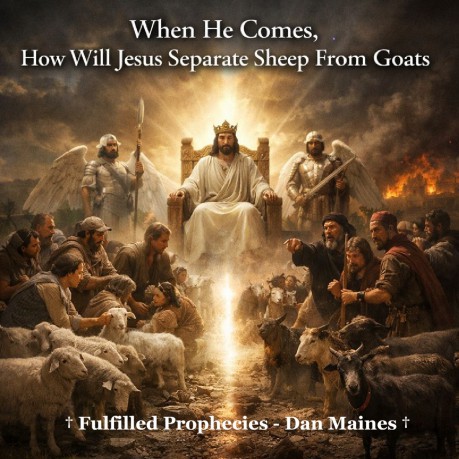
When
He Comes, How Will Jesus Separate Sheep From Goats Introduction † When
He comes, how will Jesus separate sheeps from goats, saints from
sinners? Matthew
25:31-33 † Jesus
is describing a coming in judgment, not a physical descent to earth.
(Isaiah 19:1; Matthew 24:30)
Matthew
25:34-40 † Sheep
are identified by their response to Christ as revealed in their
treatment of His brethren. (Matthew 10:40-42; Matthew 12:49-50)
Matthew
25:41-46 † Goats
represent those who rejected Christ and His messengers. (Matthew
23:37-38; John 15:18-20) John
5:28-29 † John
5 speaks of two outcomes, life and judgment. (John 5:24; John 3:18) John
5:24-25 Truly, truly, I
say to you, a time is coming and even now has arrived, when the dead
will hear the voice of the Son of God, and those who hear will live.
† John
5 speaks of two outcomes, life and judgment. (John 3:36; John
12:48) Revelation
21:7-8 † Revelation
presents the same covenant separation. (Revelation 2:7; Revelation
3:5) Revelation
22:14-15 † Revelation
presents the same covenant separation. (Revelation 7:14; Revelation
19:8) Historical
References † Josephus
documented the covenant judgment on Jerusalem in AD 70. (Matthew
23:36-38; Luke 21:20-24) How
It Applies To Us Today † We
aren't waiting for a future separation. (John 5:24; Colossians
1:13) Q
And A Appendix Q
Was
the sheep and goat separation future? Q
What
defines eternal life? Q
Is
Revelation about physical locations? Q
How
do we know Matthew 25 shares the same timing as Matthew 24? Q
Did
Jesus say this separation would happen in His lifetime? Q
If
this was fulfilled, why do people still talk about a future
separation? Q
Does
fulfilled separation mean there is no accountability today? Q
How
does this view honor the authority of Jesus? † This
is the fulfilled perspective we proclaim at Fulfilled Prophecies † Source
Index † Matthew
25:31-46; John 5:24-25, 28-29; Revelation 21:7-8; Revelation
22:14-15
By Dan Maines
†
Many
assume this refers to a future end of time sorting of bodies.
†
Jesus,
however, located this separation within His own generation and tied
it to covenant judgment.
†
Scripture
consistently shows this separation already took place through
judgment, not through a future physical division of humanity.
"But
when the Son of Man comes in His glory, and all the angels with Him,
then He will sit on His glorious throne. And all the nations will be
gathered before Him; and He will separate them from one another, just
as the shepherd separates the sheep from the goats; and He will put
the sheep on His right, but the goats on the left.
†
All
the nations refers to covenantally accountable peoples, not every
human who ever lived. (Matthew 10:5-6; Matthew 23:34-36)
†
The
separation is functional and covenantal, not biological. (John 3:18;
John 3:36)
†
Matthew
25 is a continuation of the same discourse that began in Matthew 24,
spoken to the same audience, about the same coming, within the same
time frame. (Matthew 24:1-3; Matthew 24:30-34)
†
Since
Matthew 24 explicitly limits fulfillment to that generation, the
separation in Matthew 25 cannot be pushed beyond it. (Matthew 24:34;
Matthew 16:27-28)
"Then
the King will say to those on His right, 'Come, you who are blessed
of My Father, inherit the kingdom prepared for you from the
foundation of the world. For I was hungry, and you gave Me something
to eat; I was thirsty, and you gave Me something to drink; I was a
stranger, and you invited Me in; naked, and you clothed Me; I was
sick, and you visited Me; I was in prison, and you came to Me.' Then
the righteous will answer Him, 'Lord, when did we see You hungry, and
feed You, or thirsty, and give You something to drink? And when did
we see You as a stranger, and invite You in, or naked, and clothe
You? And when did we see You sick, or in prison, and come to You?'
And the King will answer and say to them, 'Truly I say to you, to the
extent that you did it for one of the least of these brothers or
sisters of Mine, you did it for Me.'
†
This
is covenant faithfulness, not works based salvation. (Ephesians
2:8-10; Titus 3:5)
†
These
actions reflect allegiance to Jesus during His earthly ministry and
the apostolic era. (Acts 9:4-5; 1 John 4:20-21)
"Then
He will also say to those on His left, 'Depart from Me, you accursed
people, into the eternal fire which has been prepared for the devil
and his angels; for I was hungry, and you gave Me nothing to eat; I
was thirsty, and you gave Me nothing to drink; I was a stranger, and
you did not invite Me in; naked, and you did not clothe Me; sick, and
in prison, and you did not visit Me.' Then they themselves also will
answer, 'Lord, when did we see You hungry, or thirsty, or as a
stranger, or naked, or sick, or in prison, and did not take care of
You?' Then He will answer them, 'Truly I say to you, to the extent
that you did not do it for one of the least of these, you did not do
it for Me, either.' These will go away into eternal punishment, but
the righteous into eternal life."
†
Eternal
punishment describes covenant removal, not endless conscious torment.
(Daniel 9:26-27; Hebrews 8:13)
†
Eternal
life describes covenant inheritance in the established kingdom. (John
5:24; Colossians 1:13)
Do
not be amazed at this; for a time is coming when all who are in the
tombs will hear His voice, and will come out: those who did the good
deeds to a resurrection of life, those who committed the bad deeds to
a resurrection of judgment.
†
Jesus
said this hour was coming and already present. (John 5:25; 1 John
2:18)
†
Resurrection
language describes covenant transition, not physical resurrection of
corpses. (Ephesians 2:1-6; Colossians 2:12-13)
"Truly,
truly, I say to you, the one who hears My word, and believes Him who
sent Me, has eternal life, and does not come into judgment, but has
passed out of death into life.
†
Jesus
said this hour was coming and already present. (Luke 17:20-21;
Matthew 12:28)
†
Resurrection
language describes covenant transition, not physical resurrection of
corpses. (Romans 6:4; 2 Corinthians 5:17)
The
one who overcomes will inherit these things, and I will be his God
and he will be My son. But for the cowardly, and unbelieving, and
abominable, and murderers, and sexually immoral persons, and
sorcerers, and idolaters, and all liars, their part will be in the
lake that burns with fire and brimstone, which is the second death."
†
Overcomers
inherit life, rejecters remain outside. (Revelation 3:12; Hebrews
10:38-39)
†
This
is covenant status, not geography. (Hebrews 12:22-24; Ephesians
2:19-22)
Blessed
are those who wash their robes, so that they will have the right to
the tree of life, and may enter the city by the gates. Outside are
the dogs, the sorcerers, the sexually immoral persons, the murderers,
the idolaters, and everyone who loves and practices lying.
†
Overcomers
inherit life, rejecters remain outside. (John 10:27-28; 1 John
5:4-5)
†
This
is covenant status, not geography. (Isaiah 35:8-10; Galatians 4:26)
†
Eusebius
connected Jesus' judgment parables to first century fulfillment.
(Matthew 24:1-3; Matthew 24:34)
†
Clement
of Alexandria taught life and death as relational to Christ. (John
17:3; 1 John 5:11-12)
†
Irenaeus
spoke of judgment and inheritance as realities tied to Christ's
reign, not postponed to the end of world history. (Daniel 7:13-14;
Psalm 110:1)
†
Lactantius
described the destruction of Jerusalem as divine judgment validating
Christ's words and authority. (Matthew 24:2; Luke 19:43-44)
†
In
Christ, we've already passed from death into life. (John 5:24;
Ephesians 2:4-6)
†
Our
confidence is rooted in fulfilled judgment and established kingdom.
(Hebrews 12:28; Matthew 16:27-28)
†
Because
the separation is fulfilled, we live free from fear driven religion
and rest in the completed work of Christ. (Romans 8:1; Hebrews
10:14)
†
Our
calling isn't to await judgment, but to walk faithfully as those
already counted among the righteous. (Titus 2:11-14; 1 John 4:17-18)
A
No,
it was fulfilled through covenant judgment in the first century,
Matthew 25; John 5:24-25.
A
Faith
in Christ and covenant inclusion, John 5:24.
A
No,
it describes covenant access and exclusion, Revelation 21:7-8;
Revelation 22:14-15.
A
Because
Jesus never changed the subject, the audience, or the time
indicators, and Matthew 24 ends with this generation while Matthew 25
continues the same teaching, Matthew 24:34; Matthew 25:1.
A
Yes.
Jesus repeatedly tied judgment and coming language to that
generation, Matthew 16:27-28; Matthew 24:34; John 5:25.
A
Because
later traditions disconnected Jesus' words from their first century
audience and timing, despite clear statements of nearness and
imminence, Matthew 10:23; James 5:8-9.
A
No.
Accountability remains, but not through covenant judgment. Believers
live under grace and discipline, not condemnation, Romans 8:1;
Hebrews 12:6.
A
It
takes His time statements seriously and affirms that everything He
said would happen did happen, Matthew 24:35; John 19:30.
©
Fulfilled Prophecies - Dan Maines.
†
Josephus;
Eusebius; Clement of Alexandria; Irenaeus; Lactantius
Links