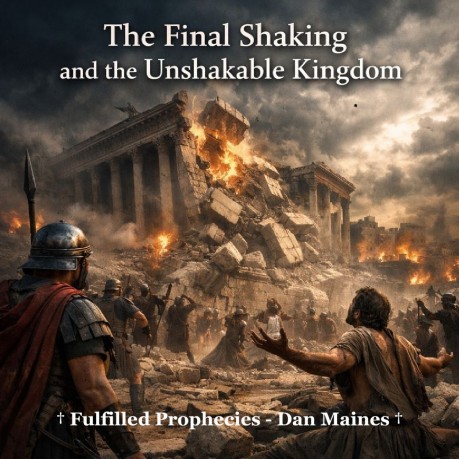
The Final Shaking and the
Unshakable Kingdom Introduction † The text itself tells us what the shaking
means, so we don't have to speculate (Luke 24:44). Haggai 2:6 For this is what the LORD of armies says, Once more, in a little
while, I am going to shake the heavens and the earth, the sea also
and the dry land. † Hebrews is directly quoting Haggai, not
redefining the language (Hebrews 12:26). Hebrews 12:26-27 And His voice shook the earth then, but now He has promised,
saying, Yet once more I will shake not only the earth, but also the
heaven. † The phrase Yet once more is the interpretive
key (Haggai 2:6). Hebrews 12:28 Therefore, since we receive a kingdom which cannot be shaken,
let's show gratitude, by which we may offer to God an acceptable
service with reverence and awe. † The original audience was already receiving
the unshakable kingdom (Daniel 7:14). Earlier Shakings in Scripture † Yes, there were earlier shakings, the flood,
the exiles, empires rising and falling (Genesis 6:13; Isaiah 13:13;
Daniel 2:21). Matthew 24:1-2 Jesus left the temple area and was going on His way when His
disciples came up to point out the temple buildings to Him. † Jesus identified the object of judgment as
the temple system itself (Matthew 23:38). Hebrews 9:8-10 The Holy Spirit is signifying this, that the way into the holy
place has not yet been disclosed while the first tabernacle is still
standing, † Hebrews ties the entire sacrificial system to
the standing of the first tabernacle (Hebrews 10:1). Hebrews 8:13 When He said, A new covenant, He has made the first obsolete. But
whatever is becoming obsolete and growing old is about to disappear. † Hebrews confirms timing (Hebrews 10:37). Hebrews 10:37 For yet in a very little while, He who is coming will come, and
will not delay. † Hebrews places the fulfillment within a very
little while (James 5:8-9). Historical References † Josephus recorded the complete destruction of
the temple in AD 70, noting sacrifices and priestly functions ceased
permanently (Josephus, Wars 6.4.5). How It Applies To Us Today † We aren't waiting for the kingdom, we're
living in it (Daniel 7:14). Q & A Appendix Q Was the shaking about natural disasters or the
end of the planet? Q Were there shakings before this one? Q What specifically was removed? Q What remains today? Q If the shaking removed the old covenant, is the
Law still binding today? Q Does this mean judgment is over and God no
longer judges? † This is the fulfilled perspective we proclaim at
Fulfilled Prophecies † Source Index † Haggai 2:6; Hebrews 12:26-28; Hebrews 9:8-10;
Hebrews 8:13; Hebrews 10:37; Matthew 24:1-2
By Dan Maines
†
Scripture doesn't leave this subject open to imagination or modern
theory. Hebrews explains the meaning directly, and when we let the
text speak, the confusion disappears (Hebrews 8:13).
†
Many assume the shaking language in Scripture refers to the planet,
future disasters, or recurring cycles of judgment (Isaiah 24:1-6).
†
Hebrews corrects that assumption by defining the shaking as
covenantal, not geological (Haggai 2:6).
†
This post follows the text where it leads, allowing Scripture,
history, and fulfillment to testify together (Luke 24:44).
†
The phrase Once more already carried finality in the Old Testament
context (Haggai 2:7).
† Haggai places the
shaking within a limited time frame, a little while, not thousands of
years later (Malachi 4:1).
This expression, Yet once more, denotes the removing of
those things which can be shaken, as of created things, so that those
things which cannot be shaken may remain.
† Hebrews tells us exactly
what it signifies, the removing of what can be shaken so that what
cannot be shaken would remain (Hebrews 8:13).
†
This isn't symbolic of repeated judgments or endless cycles (Daniel
2:44).
† Yet once more marks a final,
decisive act, not another cycle (Matthew 24:34).
†
The contrast is between created things and remaining things, pointing
to covenant structures, not the physical planet (Hebrews 9:1-10).
†
The shaking is defined as removal (Hebrews 8:13).
†
Whatever was shaken was removed permanently (Matthew 21:43).
† This
wasn't a promise for distant generations, it was a present reality
unfolding in their lifetime (Hebrews 10:37).
†
You can't receive an unshakable kingdom unless the shakable one is
being removed (Matthew 21:43).
† This
establishes a clear covenant transition from the old to the new (2
Corinthians 3:11).
† But none of those events
removed the old covenant system (Exodus 29:42-44).
†
The flood didn't remove the law (Genesis 9:1-7).
†
The exiles didn't end sacrifices (Ezra 3:2-6).
†
Roman occupation didn't stop the temple (John 2:20).
†
Hebrews distinguishes this shaking as Yet once more, meaning final
and decisive (Matthew 24:34).
And
He responded and said to them, Do you not see all these things? Truly
I say to you, not one stone here will be left upon another, which
will not be torn down.
†
This destruction wasn't partial or symbolic, it was total (Luke
21:6).
† Once the temple fell, sacrifices
ceased permanently, genealogies vanished, priestly authority ended,
and the old covenant administration was gone (Hebrews 9:8-9).
which is a symbol for the present time. Accordingly
both gifts and sacrifices are offered which cannot perfect the
conscience of the worshiper,
since they relate only to food and
drink and various washings, regulations for the body imposed until a
time of reformation.
†
These ordinances were imposed until a time of reformation, not
forever (Galatians 3:24-25).
† Once the
temple was removed, the system tied to it had no covenantal standing
(Matthew 21:43).
†
The old covenant was near vanishing when Hebrews was written (2
Corinthians 3:11).
† AD 70 completed what
Hebrews described as imminent (Matthew 24:34).
† This eliminates
any future-based interpretation of the shaking (Matthew 16:27-28).
†
The audience expectation matches the historical outcome (Luke 21:22).
†
Eusebius testified that the judgment Jesus foretold fell upon that
generation (Eusebius, Ecclesiastical History 3.7).
†
Irenaeus affirmed that the old order passed away as the new covenant
stood established in Christ (Irenaeus, Against Heresies 4.33).
† Our faith isn't
built on shakable systems, buildings, rituals, or genealogies
(Hebrews 9:9-10).
† We've received an
unshakable kingdom that can't be removed (Luke 17:20-21).
†
This gives confidence, stability, and assurance rooted in Christ's
finished work (Colossians 2:10).
A No. Hebrews 12:27 defines
the shaking as the removal of covenantal things.
A
Yes, but Hebrews calls this one Yet once more, meaning final and
decisive (Matthew 24:34).
A
The old covenant system, including the temple, priesthood,
sacrifices, and covenant authority (Hebrews 8:13; Hebrews 9:8-10;
Matthew 24:1-2).
A An
unshakable kingdom received through Christ (Daniel 7:14).
A No. Scripture says
the Law served as a tutor until Christ, and once faith came, that
tutor was no longer in force (Galatians 3:24-25; Romans 7:4-6).
A No. Covenant judgment was
fulfilled in AD 70, but God still judges righteousness and
unrighteousness through Christ under the new covenant (Acts 17:30-31;
John 5:22).
© Fulfilled Prophecies - Dan
Maines.
†
Josephus, Wars of the Jews Book 6; Eusebius, Ecclesiastical History;
Irenaeus, Against Heresies
Links