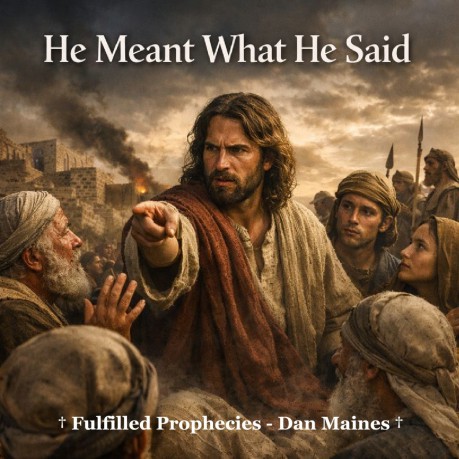
He Meant What He Said Introduction † Jesus wasn't vague or mysterious when He
spoke about timing. Matthew 16:27-28 † Jesus tied His coming in glory to the
lifetime of some standing before Him. Matthew 24:34 † Jesus defined the time frame clearly, this
generation. Mark 1:15 † At hand means near, not distant. Luke 21:22 † All things written refers to prophetic
judgment tied to Jerusalem. Revelation 1:1-3 † Shortly and at hand can't mean thousands of
years later. James 5:8-9 † James spoke to first century believers under
persecution. Historical References † Eusebius recorded that the words of Jesus
were fulfilled in the destruction of Jerusalem. How It Applies To Us Today † We can trust Jesus' words without redefining
them. Q & A Appendex Q Did Jesus ever say His coming would be delayed
for thousands of years? Q Does this mean God failed to keep His
promises? Q Why do many believe it's still future? Q Were the apostles mistaken about the nearness
of fulfillment? Q Does fulfilled timing remove the hope of
believers today? Q If prophecy is fulfilled, why does Scripture
still matter today? † This is the fulfilled perspective we proclaim at
Fulfilled Prophecies † Source Index † Matthew 16:27-28; Matthew 24:34; Mark 1:15;
Luke 21:22; Revelation 1:1-3; James 5:8-9
By Dan Maines
† He was addressing real
people who were standing in the middle of a covenant transition.
†
If His words about time didn't mean what they said, then His
authority is called into question.
† This
sermon examines Jesus' time statements to show His faithfulness, not
delay.
† Jesus consistently tied His
authority to the truthfulness of His words, not to future
reinterpretation.
† The credibility of the
gospel stands or falls on whether Jesus meant what He said when He
said it.
For the Son of Man is going
to come in the glory of His Father with His angels, and will then
repay each person according to his deeds.
Truly I say to you,
there are some of those who are standing here who will not taste
death until they see the Son of Man coming in His kingdom.
† He
didn't say all, but some, meaning a near generational fulfillment.
†
This can't be pushed thousands of years into the future without
emptying His words of meaning.
† His audience
understood Him as speaking about events they'd live to see.
†
The phrase standing here anchors the promise to a living audience,
not symbolic hearers.
† The assurance
depended on Jesus' credibility, not on future theological systems.
†
A delayed fulfillment would've turned this promise into a false hope.
Truly I say to you, this
generation will not pass away until all these things take place.
† He didn't redefine generation,
His listeners already knew what it meant.
†
Every sign He listed was anchored to that generation's lifespan.
†
To delay fulfillment is to accuse Jesus of error, which Scripture
never allows.
† The word all leaves no room
for partial or postponed fulfillment.
† Jesus
placed the burden of understanding on His hearers, not on distant
readers.
† Fulfillment within that generation
confirms His prophetic authority.
and saying, The time is fulfilled,
and the kingdom of God is at hand, repent and believe in the gospel.
†
Jesus announced fulfillment, not postponement.
†
The Kingdom wasn't delayed, it was arriving in their lifetime.
†
Repentance was urgent because the covenant change was imminent.
†
Fulfilled time language establishes expectation, not speculation.
†
The call to repent loses urgency if fulfillment is pushed far away.
†
Jesus framed the Kingdom as present reality, not future anticipation.
because these are days of
vengeance, so that all things which are written will be fulfilled.
† Jesus said
these days were then present, not future centuries away.
†
Vengeance was covenantal, not global annihilation.
†
Fulfillment was the point, not delay.
† Jesus
identified these events as the resolution of written prophecy.
†
The phrase all things confirms completion, not continuation.
†
This statement settles the question of prophetic timing.
The Revelation of Jesus
Christ, which God gave Him to show His bond-servants the things which
must soon take place, and He sent and communicated it by His angel to
His bond-servant John,
who testified to the word of God and to
the testimony of Jesus Christ, even to all that he saw.
Blessed
is the one who reads and those who hear the words of the prophecy,
and keep the things which are written in it, for the time is near.
† The blessing depended on
nearness, not delay.
† John wrote to living
churches facing imminent events.
† A
postponed Revelation would've been meaningless to its original
readers.
† The urgency of obedience confirms
the nearness of fulfillment.
† Revelation
addressed covenant judgment, not modern speculation.
†
Time statements frame the entire book from beginning to end.
You too be patient, strengthen
your hearts, for the coming of the Lord is near.
Do not
complain, brothers and sisters, against one another, so that you
yourselves may not be judged, behold, the Judge is standing right at
the door.
† The Judge standing at the door
implies immediate expectation.
† This wasn't
symbolic patience for future generations.
†
It was assurance for believers living in the final days of the old
covenant.
† The imagery of the door indicates
imminence, not distance.
† James echoed
Jesus' own time statements without reinterpretation.
†
The comfort rested in nearness, not delay.
†
Josephus documented the signs, judgments, and tribulation matching
Jesus' warnings.
† Clement of Alexandria
spoke of the end of the old order within the apostolic age.
†
Tacitus described the catastrophic events surrounding Jerusalem in
the first century.
† These writers didn't
expect fulfillment thousands of years later.
†
Their testimony aligns with the time statements of Scripture.
† God keeps covenant promises on time,
not on delay.
† We're not waiting for
fulfillment, we're living in it.
† Our faith
rests in completed redemption, not future fear.
†
This brings peace, confidence, and assurance in Christ.
†
Fulfillment shifts our focus from speculation to faithful living.
†
We live as heirs of a finished work.
A No. He consistently
used near time statements, Matthew 16:28; Matthew 24:34; Mark 1:15.
A No. Scripture shows fulfillment
within the stated time frame, Luke 21:22; Revelation 1:1-3.
A
Later traditions redefined time statements, not Scripture itself.
A No. They repeated Jesus' time
statements under inspiration, James 5:8-9; 1 Peter 4:7; Hebrews
10:37.
A No. Fulfillment establishes
our hope on a finished work, not an unfinished promise, Hebrews 9:26;
Colossians 2:10.
A Because fulfilled
prophecy confirms God's faithfulness and anchors our faith in truth
already accomplished, Romans 15:4; 2 Timothy 3:16.
© Fulfilled Prophecies - Dan
Maines.
†
Josephus, Wars of the Jews
† Eusebius,
Ecclesiastical History
† Clement of
Alexandria
† Tacitus, Histories
Links