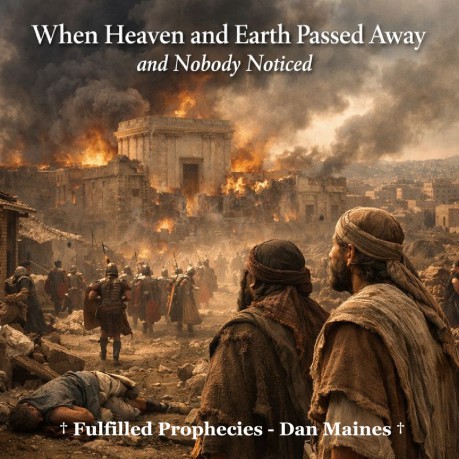
When Heaven and Earth Passed
Away and Nobody Noticed Introduction Matthew 24:35 † Jesus contrasts heaven and earth with His
words, showing one system would end while another would remain
(Hebrews 8:13). Hebrews 12:26-28 † The writer explains the shaking as removal of
what was made, not annihilation of the cosmos (Haggai 2:6-7). 2 Corinthians 5:17 † Paul uses the same passing away language for
covenant identity, not physical existence (Ephesians 2:15). Revelation 21:1 † John describes covenant replacement, not
planetary destruction (Isaiah 65:17). Historical References How It Applies To Us Today Q & A Appendix Q If heaven and earth passed away, why is the
world still here? Q Does this mean Revelation is fulfilled? Q Why didn't anyone notice it happened? Q Does this mean nothing changed physically in
the world? Q If heaven and earth passed away, does that mean
the law passed away too? Q Are believers today living in the new heaven
and new earth? † This is the fulfilled perspective we proclaim at
Fulfilled Prophecies † Source Index † Matthew 24:35; Hebrews 12:26-28; 2
Corinthians 5:17; Revelation 21:1; Isaiah 51:15-16; Isaiah 65:17;
Isaiah 57:20-21; Haggai 2:6-7; Hebrews 8:13
By Dan Maines
† Most
people were taught that if heaven and earth ever passed away, it
would be loud, visible, and catastrophic (Isaiah 51:15-16).
†
Scripture says it happened, yet history records no cosmic collapse,
no end of the planet, no disappearance of humanity (Luke 21:22).
†
The problem isn't the Bible, it's the assumption that heaven and
earth meant the physical universe (Isaiah 65:17).
†
Once we see that heaven and earth were covenantal terms, everything
clicks, prophecy, fulfillment, and why Scripture still works today
(Hebrews 12:27).
† This passage doesn't ask
us to deny reality, it asks us to correct our definitions (Luke
17:20-21).
Heaven and earth will pass
away, but My words will not pass away.
† If heaven and earth meant
the physical universe, His words would outlast creation itself, which
contradicts Scripture elsewhere (2 Corinthians 5:17).
†
Jesus spoke this in a judgment context about that generation, not
about the end of time (Matthew 24:34).
† His
words didn't merely survive the transition, they replaced what passed
away (Hebrews 12:27).
And His voice shook the
earth then, but now He has promised, saying, Yet once more I will
shake not only the earth, but also the heaven.
This expression,
Yet once more, denotes the removing of those things which can be
shaken, as of created things, so that those things which cannot be
shaken may remain.
Therefore, since we receive a kingdom which
cannot be shaken, let us show gratitude, by which we may offer to God
an acceptable service with reverence and awe.
†
The contrast is between the shakable covenant and the unshakable
kingdom (Hebrews 8:13).
† They were already
receiving that kingdom, proving this wasn't future to us (Hebrews
12:28).
† What was removed could not coexist
with what remained (Galatians 4:24-26).
Therefore if anyone is in
Christ, this person is a new creation, the old things passed away,
behold, new things have come.
†
The old things were covenantal status, law identity, and separation
(Colossians 2:14).
† The new creation existed
while the physical world remained unchanged (Romans 7:4-6).
†
New creation doesn't require a new planet, it requires a new covenant
standing (Hebrews 10:9).
Then I saw a new heaven and
a new earth, for the first heaven and the first earth passed away,
and there is no longer any sea.
† The
sea consistently represents separation and chaos, not literal oceans
disappearing (Isaiah 57:20-21).
† The New
Jerusalem immediately follows, defined as God dwelling with His
people, not people leaving the earth (Revelation 21:3).
†
If the first heaven and earth had not passed away, we wouldn't be
fully in the body of Christ, because the old covenant would still be
standing (Ephesians 2:15-16).
† Two covenant
heavens and earths cannot exist at the same time (Hebrews 8:13).
†
Early Christians understood heaven and earth in covenantal terms
drawn from the prophets (Isaiah 51:15-16).
†
Eusebius wrote of the destruction of Jerusalem as the end of the old
order promised by Christ (Matthew 24:2).
†
Josephus documented the total collapse of the temple system,
priesthood, and sacrifices in AD 70 (Hebrews 10:9).
†
The destruction of Jerusalem in AD 70 marked the public, historical
end of the old heaven and earth system Jesus and the prophets spoke
about (Luke 21:20-22).
† These writers
recorded fulfillment, not expectation of a future cosmic end (Luke
21:32).
†
We're not waiting for heaven and earth to pass away, we're living in
what replaced them (Hebrews 12:28).
† We
don't live under a system that can be shaken, we've received an
unshakable kingdom (Ephesians 2:18).
†
Scripture still works because it wasn't written for a failed future,
it was written for a fulfilled transition (Matthew 24:35).
†
Faith today isn't anticipation, it's confidence in what Christ
already finished (John 19:30).
† Our identity
is settled, our access is complete, and our standing isn't
provisional (Romans 8:1).
A Because heaven and earth
referred to the covenant order, not the planet. Matthew 24:35,
Hebrews 12:26-28.
A
Yes. Revelation 21 shows the new covenant reality replacing the old,
fulfilled in Christ and confirmed in history.
A
Because covenantal transitions don't make headlines, but they change
everything spiritually. Luke 17:20-21.
A Physical creation remained, but
covenant access, identity, and authority changed permanently. Hebrews
12:27, 2 Corinthians 5:17.
A Yes. The law was
part of the old covenant heaven and earth, and it passed away with
that system. Hebrews 8:13, Romans 10:4.
A Yes. Believers live in the new
covenant reality where God dwells with His people now, not in a
future age. Revelation 21:3, Ephesians 2:22.
© Fulfilled Prophecies - Dan
Maines.
†
Josephus, Wars of the Jews, Book 6; Eusebius, Ecclesiastical History,
Book 3
Links