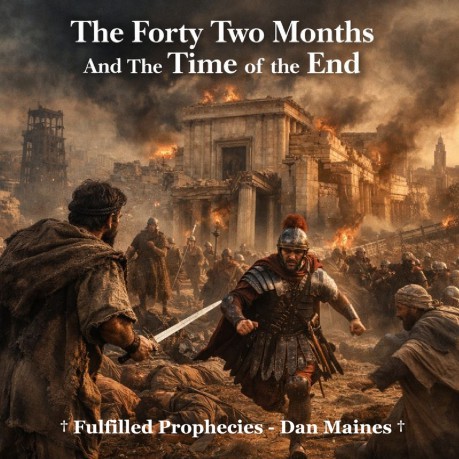
The
Forty Two Months And The Time Of The End Introduction † Bible
prophecy always defines its own time frame, audience, and fulfillment
when Scripture is allowed to speak for itself (Isaiah 46:9-10). Revelation 11:1 Then there was given to me a measuring
rod like a staff; and someone said, "Get up and measure the
temple of God and the altar, and those who worship in it.
† Measuring is
covenant language used to mark what belongs to God and what is
preserved (Ezekiel 40:3-5). Revelation 11:2
Leave out the courtyard which is outside the temple and do not
measure it, because it has been given to the nations; and they will
trample the holy city for forty-two months. † The
umeasured court represents Old Covenant Jerusalem, now excluded from
God's covenant protection (Matthew 23:38). Daniel 12:6
And someone said to the man dressed in linen, who was above the
waters of the stream, "How long will it be until the end of
these wonders?" † Daniel's
question is about duration, not speculation (Habakkuk 2:3). Daniel 12:7
And I heard the man dressed in linen, who was above the waters of the
stream, as he raised his right hand and his left toward heaven, and
swore by Him who lives forever that it would be for a time, times,
and half a time; and as soon as they finish smashing the power of the
holy people, all these events will be completed. † Time, times,
and a half equals three and a half years, matching the forty two
months (Revelation 13:5). Daniel 12:9
And he said, "Go your way, Daniel, for these words will be kept
secret and sealed up until the end time.
† Sealing
indicates delayed fulfillment, not mystery (Isaiah 29:11). Revelation 1:1 The Revelation of Jesus Christ, which
God gave Him to show to His bond-servants, the things which must soon
take place; and He sent and communicated it by His angel to His
bond-servant John,
† Shortly
always means soon in time, never distant (Romans 16:20). Revelation 1:3
Blessed is the one who reads, and those who hear the words of the
prophecy and keep the things which are written in it; for the time is
near. † At hand
means near enough to respond to (Mark 1:15). Revelation 22:10 And he said to me, "Do not seal up
the words of the prophecy of this book, for the time is near.
† John is told
the opposite of Daniel because the fulfillment window has arrived
(Daniel 8:26). Historical References † Josephus
records the Roman siege beginning in AD 67 and ending in AD 70 (Wars
of the Jews, Book 5-6). How It Applies To Us
Today † God's word
is reliable and fulfilled exactly as promised (Joshua 21:45). Q & A Appendix Q
What are the forty two months? Q
Is this the end of the physical world? Q
Why does Revelation emphasize urgency? Q
Why is the forty two months repeated in Scripture? Q
Why does futurism persist? Q
Does Daniel connect the forty two months to resurrection language? Q
Why did Jesus say all things would be fulfilled in that generation? † This is the fulfilled
perspective we proclaim at Fulfilled Prophecies † Source Index † Matthew
21:43; Matthew 23:38; Luke 21:20-24; Hebrews 8:13
By Dan Maines
†
The forty two months are not symbolic of an undefined future, they
are a measured period tied to covenant judgment (Luke 21:22).
†
The fulfilled perspective recognizes these events as the close of the
Old Covenant age, not the end of the physical world (Hebrews 8:13).
†
Scripture never leaves fulfillment open ended, God always attaches
His promises and judgments to a defined generation (Deuteronomy
32:29).
†
The forty two months serve as a chronological anchor, preventing
speculative interpretation (Numbers 14:34).
†
God measures worshippers, not stones, showing this is a people
centered temple (1 Corinthians 3:16).
†
This separates the true covenant dwelling from what is about to be
judged (Hebrews 12:22-23).
†
Measuring also implies ownership, what God measures belongs to Him
and is preserved through judgment (Zechariah 2:1-5).
†
The focus on worshippers confirms a spiritual house, not a physical
building (1 Peter 2:5).
†
Being given to the nations fulfills Jesus' warning of Gentile
trampling (Luke 21:24).
†
The forty two months establishes a limited, defined judgment period
(Daniel 7:25).
†
Trampling language is consistently used in Scripture for covenant
judgment upon Jerusalem (Isaiah 63:18).
†
This trampling fulfills Jesus' prophecy that Jerusalem would fall by
the sword and be led captive (Luke 19:43-44).
†
The wonders concern covenant judgment, not cosmic destruction (Isaiah
10:22-23).
†
Scripture demands a measurable fulfillment period (Ecclesiastes
3:1).
†
Daniel's question establishes that the end would be recognizable, not
vague or symbolic (Amos 3:7).
†
God does not answer with mystery, but with a precise time period
(Daniel 12:7).
†
The shattering of the holy people refers to covenant authority, not
ethnic extinction (Matthew 21:43).
†
All these things being finished defines covenant completion (Luke
21:32).
†
The oath sworn by the heavenly figure emphasizes certainty, not
conditional delay (Hebrews 6:17).
†
Covenant power was shattered when the Temple, priesthood, and
sacrifices ended permanently (Hebrews 10:11-18).
†
Time of the end refers to the end of an age, not the end of time
(Matthew 24:3).
†
Revelation later removes this seal because fulfillment had drawn near
(Revelation 22:10).
†
Sealing preserves the prophecy until its appointed season (Isaiah
8:16).
†
Revelation's unsealing proves Daniel's timeline had matured
(Revelation 5:1-5).
†
The original audience was expected to recognize the urgency (James
5:8).
†
This language is incompatible with a distant future fulfillment
(Hebrews 10:37).
†
The phrase must shortly come to pass removes all possibility of delay
(Philippians 4:5).
†
Prophetic imminence was meant to prepare, not confuse, the original
audience (1 Peter 4:7).
†
The blessing assumes immediate relevance (Luke 11:28).
†
Delay theology empties the warning of meaning (Luke 12:40).
†
A distant fulfillment would nullify both warning and blessing
(Matthew 24:25).
†
This confirms continuity between Daniel and Revelation (Matthew
24:15).
†
The forty two months were already unfolding in history.
†
The command not to seal confirms the prophecy was actionable
(Revelation 22:6).
†
This mirrors Jesus' warnings given before Jerusalem's fall (Matthew
24:33).
†
Tacitus confirms Jerusalem's destruction under Roman authority
(Histories 5.13).
†
Eusebius states the church understood these prophecies as fulfilled
in that generation (Ecclesiastical History 3.5).
†
Josephus records famine, internal division, and Roman encirclement
exactly as Jesus described (Luke 21:20).
†
Early Christians fled Jerusalem before its fall, preserving the
faithful remnant (Matthew 24:16).
†
We live in the completed New Covenant reality (Hebrews 9:15).
†
Fear based futurism is replaced with confidence in fulfilled truth
(John 19:30).
†
Fulfilled prophecy strengthens confidence in every promise God has
made (2 Corinthians 1:20).
†
The kingdom we've received cannot be shaken (Hebrews 12:28).
A
The three and a half year period of Jerusalem's siege (Daniel 7:25).
A
No, it is the end of the Old Covenant age (Hebrews 8:13).
A
Because the events were imminent for the first century audience (Luke
21:32).
A
To lock the prophecy into history and prevent reinterpretation (2
Corinthians 13:1).
A
Because fulfilled prophecy removes fear based control structures
(Jeremiah 23:16).
A
Yes. Daniel places resurrection imagery at the close of the time,
times, and a half, showing covenant transition rather than physical
graves opening (Daniel 12:1-2; Ezekiel 37:12-14).
A
Because Daniel's sealed prophecy was reaching completion in their
lifetime, not a future age (Matthew 24:34; Luke 21:22).
©
Fulfilled Prophecies - Dan Maines.
†
Josephus, Wars of the Jews, Book 5-6; Tacitus, Histories 5.13;
Eusebius, Ecclesiastical History 3.5
Links