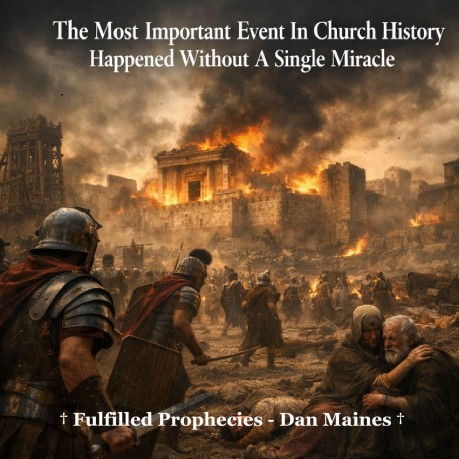
The
Most Important Event In Church History Happened Without A Single
Miracle Introduction † Scripture
shows miracles at the beginning of covenant transitions, not at their
conclusion. Hebrews
2:3-4 † The text
places signs and wonders at the confirmation stage of the gospel
message.
1 Corinthians 13:8-10 † Paul teaches
that miraculous gifts were temporary and partial. Matthew
24:2 † Jesus
foretold the destruction of the temple without promising miraculous
signs to accompany it. Luke 21:20 † The sign
given is historical and visible, not supernatural. Hebrews
8:13 † The Old
Covenant was rendered obsolete when the New Covenant was
established. Historical References † Josephus
records the destruction of Jerusalem in detail and never mentions
apostles or miracles. How It Applies To Us
Today † We don't
need signs to validate a finished covenant. Q & A Appendix Q
Why were there no miracles during AD 70 Q
Does the absence of miracles mean God stopped working Q
Why do people expect signs during judgment Q
Why would God allow the most important covenant event to occur
without miracles † This is the fulfilled
perspective we proclaim at Fulfilled Prophecies † Source Index † Hebrews
2:3-4; 1 Corinthians 13:8-10; Matthew 24:2; Luke 21:20; Hebrews
8:13
By Dan Maines
†
Signs and wonders authenticated the gospel while the Old Covenant was
still standing.
†
AD 70 was the most decisive covenantal event in church history, yet
it occurred without a single recorded miracle.
†
No apostles are shown healing, no tongues are mentioned, no signs are
recorded.
†
That silence is intentional and decisive.
how will
we escape if we neglect so great a salvation? After it was at first
spoken through the Lord, it was confirmed to us by those who heard,
God also testifying with them, both by signs and wonders, and by
various miracles and by gifts of the Holy Spirit according to His own
will.
†
Miracles functioned to authenticate the message during the transition
period.
†
There is no statement here that miracles accompany covenant removal
or judgment.
†
Once the message was confirmed, the purpose of signs was complete.
Love
never fails; but if there are gifts of prophecy, they will be done
away with; if there are tongues, they will cease; if there is
knowledge, it will be done away with. For we know in part and
prophesy in part; but when the perfect comes, the partial will be
done away with.
†
These gifts belonged to an incomplete covenantal state.
†
The perfect refers to covenantal completion, not the end of the
physical world.
†
With completion, the partial means were removed.
But He
responded and said to them, "Do you not see all these things?
Truly I say to you, not one stone here will be left upon another,
which will not be torn down."
†
There is no instruction for apostles to perform wonders during its
fall.
†
The judgment was decreed and unavoidable.
†
Fulfillment required execution, not spectacle.
"But
when you see Jerusalem surrounded by armies, then recognize that her
desolation is near.
†
Roman armies, not angels, carried out the judgment.
†
God used ordinary means to accomplish a covenantal end.
†
This confirms the transition was legal and historical.
When He
said, "A new covenant," He has made the first obsolete. But
whatever is becoming obsolete and growing old is about to disappear.
†
Hebrews describes it as already aging while still functioning
outwardly.
†
AD 70 did not make it obsolete, it removed it from history.
†
The disappearance was final and irreversible.
†
Tacitus describes the fall as political and catastrophic, not
supernatural.
†
Eusebius confirms the church fled Jerusalem and witnessed its
destruction without miraculous intervention.
†
Suetonius records omens and portents surrounding Roman emperors, yet
records no miraculous signs connected to Jerusalem's fall.
†
The historical silence matches the scriptural pattern.
†
Faith rests on fulfillment, not spectacle.
†
God's greatest covenantal act occurred quietly and decisively.
†
Nothing is missing, nothing is pending, nothing is delayed.
A
Because miracles authenticate beginnings, not endings, Hebrews 2:3-4.
A
No, it means His covenant work was completed, Hebrews 8:13.
A
Because modern theology confuses inauguration with fulfillment, 1
Corinthians 13:8-10.
A
Because judgment does not need authentication, only execution,
Matthew 24:2; Luke 21:20; Hebrews 8:13.
©
Fulfilled Prophecies - Dan Maines.
†
Josephus, Wars of the Jews, Book 6
†
Tacitus, Histories 5
†
Eusebius, Ecclesiastical History Book 3
†
Suetonius, The Twelve Caesars
Links