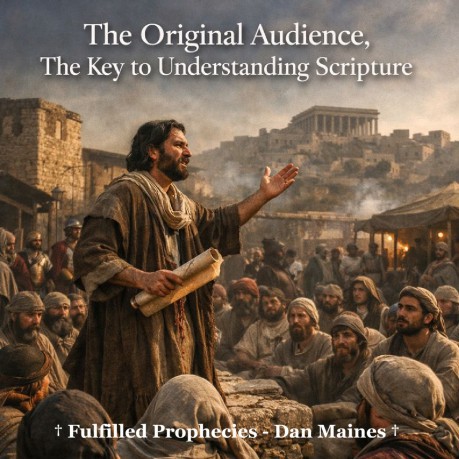
The Original Audience, The
Key to Understanding Scripture Introduction † Brothers and sisters in Christ, as a
Preterist and student of fulfilled prophecy, I want to take a moment
to highlight a foundational principle that must guide our
interpretation of the Word of God: Audience Relevance. Without this
lens, we risk distorting the truth and applying promises or judgments
where they were never intended. † Let me walk you through this critical truth
using Scripture and reason, step by step: The Original Audience Matters † Always ask yourself: "What did it mean
to the first century disciples?" This is not just a helpful
question, it is essential. It does not matter what we think a verse
means today unless we first understand what it meant then. Matthew 24:34 Truly I say to you, this generation will not pass away until all
these things take place. † Jesus was not speaking ambiguously. He
addressed that generation, not ours. Audience relevance tells us
Jesus was speaking directly to His listeners. Hebrews 1:1-2 God, after He spoke long ago to the fathers in the prophets in
many portions and in many ways, in these last days has spoken to us
in His Son... † Notice who us is. The author of Hebrews is
saying they were in the last days. Not us. The original recipients
were experiencing the climax of the ages. Scripture Was Not Written To Us † One of the biggest missteps in modern
Christianity is treating the Bible like a direct letter to the 21st
century. Let's be clear: the Bible is for us, but it was not written
to us. Romans 15:4 For whatever was written in earlier times was written for our
instruction, so that through perseverance and the encouragement of
the Scriptures we might have hope. † Paul confirms it was written for our benefit,
but not to us. Revelation 1:4 John to the seven churches that are in Asia Minor. † When John wrote Revelation, he was writing to
seven literal churches in Asia Minor. They were real churches dealing
with real persecution. He was not cryptically writing to a distant
generation 2,000 years later. We're Reading Someone
Else's Mail † When you open the New Testament, you're
reading correspondence between apostles and early Christian
communities. The issues, questions, and warnings were specific to
their circumstances. 1 Corinthians 1:2 To the church of God which is in Corinth... † Paul is not writing to a church in modern
America. He's writing to Corinth, and everything he says must first
be understood in that historical context. Philippians 1:1 To all the saints in Christ Jesus who are in Philippi... † Again, an audience in a specific city, at a
specific time, under specific pressures. "Here's What This Scripture Means To Me", A
Dangerous Statement † In modern Christianity, people often say,
"Here's what this Scripture means to me." But the only
biblical truth at that point is: It does not matter what it means to
you, unless you understand what it meant to them. 2 Peter 1:20-21 But know this first of all, that no prophecy of Scripture becomes
a matter of someone's own interpretation, for no prophecy was ever
made by an act of human will... † Meaning is not personal. It is rooted in what
God meant, and what it meant to the people to whom it was written. Time Statements Were Not Elastic † Scripture is full of time indicators: "the
time is near", "this generation", "about to",
"at hand". These phrases were meant for the original
audience. Revelation 1:1 The Revelation of Jesus Christ... to show His bond servants the
things which must soon take place. † If that didn't mean soon for them, then the
text is meaningless. James 5:8-9 You too be patient, strengthen your hearts, for the coming of the
Lord is near. Do not complain... behold, the Judge is standing right
at the door. † That urgency was for them, not for us 2,000
years later. Why This Matters
† We must rightly divide the Word of truth, and
that begins by respecting who it was written to and why. The truth
is, there is not one book in the Bible that was written to someone
living today. † That may be a shocking statement, but it is
honest. The Bible was written to others, but for us. It reveals God's
character, redemptive plan, and the fulfillment of His promises. † So next time you hear, "Here's what this
verse means to me", remember: What matters is what it meant to
them. That is where Bible truth is found. Only after understanding
that can we apply it faithfully to our own lives today. † Amen. Historical References † Josephus records the first century judgment
on Jerusalem as an event that fell upon that generation, confirming
the historical setting assumed by Jesus and the apostles. How It Applies To Us Today † Interpretation must always come before
application, otherwise Scripture is reshaped by personal experience
instead of divine intent. Q And A Appendix Q Why does audience relevance matter so much Q Can Scripture still apply to us today Q Why does audience relevance protect Scripture
from error Q Does audience relevance deny inspiration Q Why do futurist interpretations struggle with
time statements Q Can fulfilled prophecy still build faith
today Q Is this approach new or modern Q Why do people resist this way of reading
Scripture Q If prophecy was fulfilled, why do believers
still die Q Does fulfillment mean nothing is future † This is the fulfilled perspective we proclaim at
Fulfilled Prophecies † Source Index † Matthew 24:34; Hebrews 1:1-2; Romans 15:4;
Revelation 1:1, 4; 1 Corinthians 1:2; Philippians 1:1; 2 Peter
1:20-21; James 5:8-9
By Dan Maines
† Scripture
was delivered into real covenantal situations, not abstract
theological debates centuries removed from the writers.
†
Ignoring audience relevance leads directly to futurism, speculation,
and broken timelines.
†
The Bible interprets itself best when read in its historical and
covenantal setting.
† This approach does not
diminish Scripture, it protects it.
†
Meaning is anchored in authorial intent, not modern application.
†
The apostles never expected their words to bypass their original
hearers.
†
The disciples asked questions rooted in their covenant world, and
Jesus answered them plainly.
† Redefining
generation removes the credibility of Christ's words.
†
The contrast is between Old Covenant revelation and New Covenant
fulfillment.
† The phrase last days is
covenantal, not cosmic.
† Confusing application with
interpretation creates doctrinal error.
† The
authority of Scripture depends on honoring its original recipients.
† Instruction flows forward,
not backward.
† Hope is grounded in fulfilled
promises, not postponed ones.
† Revelation
opens by naming its audience, which must govern interpretation.
†
Ignoring this leads to speculative end time systems.
† Epistles are
situational documents, not generic prophecy charts.
†
Understanding the mail requires knowing the sender and the recipient.
†
Corinth's problems shaped Paul's instruction.
†
Removing context produces false doctrine.
†
Philippi was a Roman colony with unique political realities.
†
Paul's encouragement addresses those lived conditions.
†
Personal meaning cannot override divine intent.
†
Scripture is not subjective.
†
Prophecy unfolds according to God's timetable, not ours.
†
The Spirit guided the message and its fulfillment.
† Language has meaning, especially
time language.
† Stretching time statements
empties them of truth.
† Soon is defined by the
writer, not modern theology.
† God doesn't
mislead His servants.
† James wrote to suffering
believers awaiting covenant vindication.
†
Near means near.
† Fulfillment confirms
Scripture, it does not diminish it.
† God
kept His word exactly as promised.
†
The faithfulness of God is proven in history.
†
Fulfilled prophecy strengthens trust.
†
Application follows interpretation.
† Truth
precedes relevance.
†
Eusebius explicitly states that the calamities foretold by Christ
came upon the Jews of that time, not a distant future people.
†
Clement of Alexandria understood the apostolic age as the transition
point between the old covenant order and the realized new covenant in
Christ.
† Because God
fulfilled His word exactly as spoken, our faith today rests on
certainty, not speculation.
† Living in
fulfillment frees believers from fear driven theology and anchors us
in completed redemption.
A
Because it preserves the truth of Scripture and prevents distortion
A
Yes, but application must come after understanding original meaning
A Because it anchors meaning to what
God actually said to real people in real covenant circumstances
A
No, it affirms inspiration by respecting how and when God chose to
speak
A Because they detach words
like near, soon, and this generation from their original audience
A Yes, fulfillment proves God keeps His
word exactly as spoken
A
No, early Christians understood prophecy through fulfillment, not
delay
A Because tradition often feels safer
than letting the text speak for itself
A Because fulfillment addressed
covenant death and separation, not biological mortality
A
No, it means redemption is complete and our future is lived out
within what Christ already accomplished
© Fulfilled Prophecies - Dan
Maines.
† Josephus, Eusebius,
Clement of Alexandria
Links