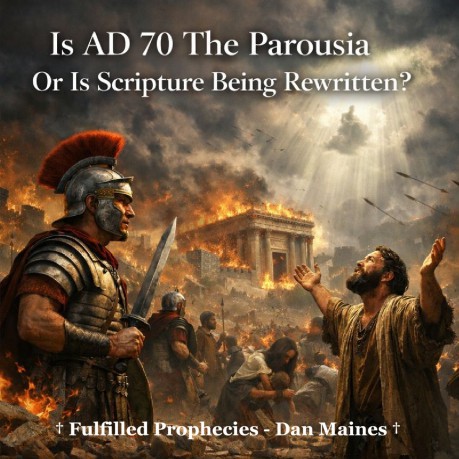
Is AD 70 The Parousia Or Is
Scripture Being Rewritten? Introduction † The claims presented argue that the fulfilled
perspective depends on spiritualizing Scripture, denies a future
physical resurrection, redefines the Parousia, and ignores texts such
as 2 Peter 3, 1 Corinthians 15, Romans 8, and Hebrews 9. Matthew 24:34 † Jesus placed the fulfillment of all the
things He described within the lifespan of that generation. † The Greek word parousia means presence or
coming and does not require a physical descent to the earth. Matthew 16:27-28 "Truly I say to you, there are some of those who are standing
here who will not taste death until they see the Son of Man coming in
His kingdom." † Jesus anchored His coming within the lifetime
of some standing before Him. 1 Peter 4:7 † Peter spoke to living believers and declared
the end was at hand, not distant. Revelation
1:1-3 † John explicitly stated the events would
shortly come to pass. 2 Peter 3:10-13
Since all these things are to be destroyed in this way, what sort of
people ought you to be in holy conduct and godliness, looking for and
hastening the coming of the day of God, because of which the heavens
will be destroyed by burning, and the elements will melt with intense
heat! But according to His promise we are looking for new heavens and
a new earth, in which righteousness dwells. † Peter wrote to first century believers who
were actively looking for and desiring this event. † Peter ties this judgment to the last days of
that generation, 2 Peter 3:1-2. Isaiah 19:1 Behold, the Lord is
riding on a swift cloud and is about to come to Egypt; † This is covenant judgment language, not a
literal descent of God from the sky.
1 Corinthians 15:51-54 † Paul stated that not all would sleep, placing
fulfillment within his own generation. † Jesus was raised as the life-giving Spirit, 1
Corinthians 15:45.
Romans 8:18-23 † The creation refers to humanity under Adamic
and Mosaic bondage.
Hebrews 12:26-28 † Heaven and earth are defined here as covenant
structures that can be removed. Hebrews
9:27-28 † Hebrews was written to Old Covenant believers
awaiting covenant deliverance. Historical References † Josephus documented the signs, famine, war,
and destruction of Jerusalem. How It Applies To Us Today † We live in the fully established New
Covenant. Q & A Appendix Q Does the fulfilled perspective deny
resurrection? Q Does AD 70 replace the cross? Q Is this interpretation spiritualizing
Scripture? Q If AD 70 fulfilled these prophecies, why does
physical death still exist? Q Did Jesus physically return in AD 70? Q Does Revelation 21 describe the end of the
physical universe? Q Why did early believers expect these events
soon if they were thousands of years away? Q How does Hebrews 9:27 fit the fulfilled
perspective if judgment already happened? † This is the fulfilled perspective we proclaim at
Fulfilled Prophecies † Source Index † Matthew 16:27-28; Matthew 24:34; 1 Peter 4:7;
Revelation 1:1-3; 2 Peter 3:10-13; Isaiah 19:1; 1 Corinthians
15:45-54; Romans 8:18-23; Hebrews 9:27-28; Hebrews 12:26-28
By Dan Maines
†
This post allows Scripture to define its own language, time
statements, and covenant context without importing later theological
assumptions.
† The issue is not the authority
of Scripture, but whether Scripture is allowed to interpret itself
within its original audience and timeframe.
Truly
I say to you, this generation will not pass away until all these
things take place.
†
Any interpretation that moves fulfillment thousands of years forward
contradicts Jesus' explicit time marker.
†
There is no textual distinction made between a Parousia and the
Parousia in the discourse itself.
†
Scripture consistently uses coming language for covenant judgment,
Isaiah 19:1; Micah 1:3-4; Psalm 18:7-15.
† AD
70 fulfilled every warning Jesus gave, Jerusalem destroyed, the
temple removed, and the Old Covenant age ended.
For
the Son of Man is going to come in the glory of His Father with His
angels, and will then repay
every person according to his deeds.
† A future
interpretation empties Jesus' words of their meaning.
†
This judgment language follows Old Testament covenant judgment
patterns, not a planet-ending event.
The
end of all things is near; therefore, be of sound judgment and sober
spirit for the purpose of prayer.
† This
statement loses all meaning if fulfillment is postponed thousands of
years.
† The end in view is the Old Covenant
world, not the end of the physical universe.
The Revelation of Jesus Christ, which God gave
Him to show to His bond-servants, the things which must soon take
place; and He sent and communicated it by His angel to His
bond-servant John, who testified to the word of God and to the
testimony of Jesus Christ, everything that he saw. Blessed is the one
who reads, and those who hear the words of the prophecy and keep the
things which are written in it; for the time is near .
† The time being at
hand rules out a distant future fulfillment.
†
Revelation opens and closes with imminence language that cannot be
redefined.
But the day of the Lord will
come like a thief, in which the heavens will pass away with a roar
and the elements will be destroyed with intense heat, and the earth
and its works will be discovered.
†
The language mirrors Old Testament covenant collapse imagery, Isaiah
13; Isaiah 34; Deuteronomy 32.
† The word
elements is stoicheia, used by Paul for covenantal principles,
Galatians 4:3; Colossians 2:20.
† The
comparison to Noah is about certainty of judgment, not identical
mechanics.
† The flood ended a world, the
fire ended the Old Covenant world centered on the temple.
The pronouncement concerning
Egypt:
The idols
of Egypt will tremble at His presence,
And the heart of the
Egyptians will melt within them.
†
Scripture itself defines coming language symbolically.
†
This establishes the biblical pattern Jesus and the apostles
followed.
Behold, I am telling you
a mystery; we will not all sleep, but we will all be changed, in a
moment, in the twinkling of an eye, at the last trumpet; for the
trumpet will sound, and the dead will be raised imperishable, and we
will be changed. For this perishable must put on the imperishable,
and this mortal must put on immortality. But when this
perishable puts on the imperishable, and this mortal puts on
immortality, then will come about the saying that is written: "Death
has been swallowed up in victory.
† The
contrast is covenant death versus covenant life, not bodies leaving
graves.
† Death here is separation under the
law, Hosea 13:14.
† Paul states flesh and
blood cannot inherit the kingdom of God, 1 Corinthians 15:50.
†
A literal flesh resurrection contradicts Paul's own explanation.
For I consider that the
sufferings of this present time are not worthy to be compared
with the glory that is to be revealed to us. For the eagerly awaiting
creation waits for the revealing of the sons and daughters of
God. For the creation was subjected to futility, not willingly, but
because of Him who subjected it, in hope that the creation
itself also will be set free from its slavery to corruption into the
freedom of the glory of the children of God. For we know that the
whole creation groans and suffers the pains of childbirth together
until now. And not only that, but also we ourselves, having
the first fruits of the Spirit, even we ourselves groan within
ourselves, waiting eagerly for our adoption as sons and
daughters, the redemption of our body.
† Paul said this groaning
was happening then, not thousands of years later.
†
The revealing of the sons of God occurred when the Old Covenant veil
was removed.
And His voice shook the earth
then, but now He has promised, saying, "Yet
once more I will shake not only the earth, but
also the heaven." This expression, "Yet once
more," denotes the removing of those things which can be shaken,
as of created things, so that those things which cannot be shaken may
remain. Therefore, since we receive a kingdom which cannot be shaken,
let's show gratitude, by which we may offer to God an acceptable
service with reverence and awe;
† The removal
is contrasted with the unshakable New Covenant kingdom.
†
This directly interprets 2 Peter 3 and Revelation 21.
And just as it is destined for people to die
once, and after this comes judgment, so Christ also, having
been offered once to bear the sins of many, will appear a second time
for salvation without reference to sin, to those who eagerly
await Him.
† The judgment
was covenantal, ending the Levitical system.
†
Salvation here is corporate covenant freedom.
† Tacitus
confirmed the devastation and finality of the Jewish war.
†
Eusebius testified that the early church understood these events as
fulfillment.
† Clement of Alexandria
referenced the judgment upon Jerusalem as a decisive covenant
event.
† Lactantius spoke of Jerusalem's fall
as divine judgment upon the old order.
† Our identity is present in
Christ, not future-based.
† We are not
waiting for resurrection life, we are walking in it now.
A No. It affirms resurrection
exactly as Paul defined it, transformation from covenant death to
covenant life, 1 Corinthians 15:44-46.
A
No. The cross removed sin, AD 70 removed the covenant system that
condemned, Colossians 2:14; Hebrews 12:26-28.
A No. Scripture itself defines its
symbols, timing, and covenant language, Isaiah 19:1; Hebrews
12:26-28; Matthew 24:34.
A Because the death
removed was covenant death, separation from God under the law, not
biological death, Hosea 13:14; Romans 7:6; 2 Corinthians 5:17.
A
No. Scripture never requires a physical descent for covenant
judgment, Isaiah 19:1; Psalm 18:7-15; Matthew 26:64.
A No. Revelation 21
describes covenant restoration, God dwelling with His people, the
removal of Old Covenant death and separation, Isaiah 65:17-19;
Hebrews 12:22-24; Revelation 21:1-4.
A
They did not. The apostles consistently taught imminence, using
phrases like at hand, shortly, and near, Matthew 24:34; Romans
13:11-12; Revelation 1:1-3.
A
Hebrews 9:27 speaks of covenant judgment, not individual postmortem
sentencing. The context is the Old Covenant sacrificial system and
its appointed end. Just as Israel under the law faced covenant death
and judgment, so Christ appeared a second time to bring covenant
salvation to those awaiting Him in that generation, Hebrews 8:13;
Hebrews 9:28; Hebrews 10:37.
© Fulfilled Prophecies - Dan
Maines.
†
Josephus, Wars of the Jews
† Tacitus,
Annals
† Eusebius, Ecclesiastical History
†
Clement of Alexandria
† Lactantius
Links