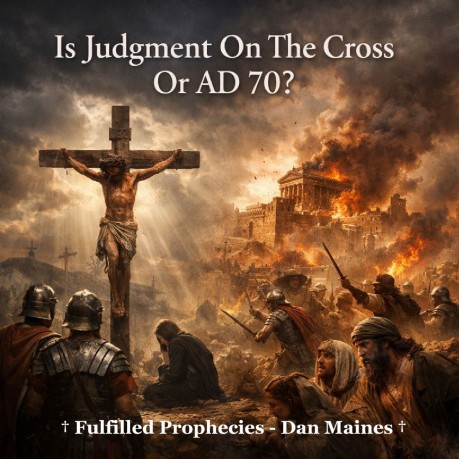
Is Judgment On The Cross Or
AD 70? Introduction † This question only becomes confusing when two
different biblical judgments are merged into one. Isaiah
53:5-6 † This passage defines judgment for sin, not
covenant judgment on a nation. John 19:30 † Finished means fully accomplished, not
partially completed. Romans 8:1 † Paul wrote this decades before AD 70.
Hebrews 9:26-28 † Sin was put away once, not progressively and
not in AD 70. Matthew
23:35-36 † This judgment is directed at a specific
people, not placed on Christ. Matthew 24:34 † Jesus anchors this judgment in a living
generation.
Luke 21:20-24 † This language is national, geographical, and
covenantal. Hebrews 8:13 † The Old Covenant still stood but was nearing
removal.
Hebrews 12:26-28 † This passage defines covenant removal, not
individual judgment after death. Colossians 2:14 † The debt was removed at the cross, not in AD
70. 1 Thessalonians 2:16 † Wrath is described as arriving, not symbolic
or distant. Historical References † Josephus records Jerusalem's destruction as
unparalleled in Jewish history. How It Applies To Us Today † We live free from condemnation because sin
was judged at the cross. Q & A Appendix Q Was sin judged in AD 70? Q What was judged in AD 70? Q Why were both judgments necessary? Q If sin is already judged, why did AD 70 still
happen? Q Do believers get judged at physical death? Q What happens to believers at physical death? Q Then what judgment does Hebrews 9:27 refer
to? Q Is there any judgment left for believers
today? Q Does this teaching remove accountability? † This is the fulfilled perspective we proclaim at
Fulfilled Prophecies † Source Index † Isaiah 53:5-6; John 19:30; Romans 8:1;
Hebrews 9:26-28; Matthew 23:35-36; Matthew 24:34; Luke 21:20-24;
Hebrews 8:13; Hebrews 12:26-28; Colossians 2:14; 1 Thessalonians
2:16
By Dan Maines
†
Scripture itself never does that, and it consistently keeps these
judgments distinct.
† The cross and AD 70 are
both judgments, but they are not the same judgment, they serve
different purposes in redemptive history.
†
When Scripture is allowed to speak for itself, the distinction
becomes unavoidable.
† Scripture speaks of
more than one kind of judgment, and confusing those judgments creates
doctrinal error.
† Judgment for sin and
covenant judgment are never treated as the same event in Scripture.
†
The Bible consistently separates atonement language from vengeance
language, and it applies them to different historical moments.
But He was pierced for our offenses,
He was
crushed for our wrongdoings;
The punishment for our well-being
was laid upon Him,
And by His wounds we are healed.
All
of us, like sheep, have gone astray,
Each of us has turned to
his own way;
But the Lord
has caused the wrongdoing of us all
To fall on Him.
† Iniquity was
laid on the Messiah, not reserved for a later historical event.
†
Sin judgment was substitutionary, complete, and final in Christ.
Therefore
when Jesus had received the sour wine, He said, "It is
finished!" And He bowed His head and gave up His spirit.
† Nothing related to sin
remained unresolved after this declaration.
†
Scripture never suggests sin awaited judgment in AD 70.
Therefore there is now no
condemnation at all for those who are in Christ Jesus.
†
If sin was judged in AD 70, this statement couldn't have been true
when written.
† The absence of condemnation
proves sin judgment was already complete.
Otherwise, He would have needed
to suffer often since the foundation of the world; but now once at
the consummation of the ages He has been revealed to put away sin by
the sacrifice of Himself. And just as it is destined for people to
die once, and after this comes judgment, so Christ also,
having been offered once to bear the sins of many, will appear a
second time for salvation without reference to sin, to those
who eagerly await Him.
† His later appearing is
explicitly separated from bearing sin.
†
Scripture itself forbids assigning sin judgment to AD 70.
†
Atonement language is never used for AD 70, and vengeance language is
never used for the cross.
† The cross is
described in terms of sacrifice, forgiveness, reconciliation, and
peace.
† AD 70 is described in terms of
wrath, vengeance, desolation, and covenant accountability.
so that upon you will fall the guilt of
all the righteous blood shed on earth, from the blood of righteous
Abel to the blood of Zechariah, the son of Berechiah, whom you
murdered between the temple and the altar. Truly I say to you, all
these things will come upon this generation.
† It is future
from the cross and limited to that generation.
†
This is covenant accountability, not atonement.
Truly
I say to you, this generation will not pass away until all these
things take place.
† The cross had already occurred,
so this can't be the same judgment.
† This
confirms a coming historical event.
But when you see Jerusalem
surrounded by armies, then recognize that her desolation is near.
Then those who are in Judea must flee to the mountains, and those who
are inside the city must leave, and those who are in the country must
not enter the city; because these are days of punishment, so that all
things which have been written will be fulfilled. Woe to those women
who are pregnant, and to those who are nursing babies in those days;
for there will be great distress upon the land, and wrath to this
people; and they will fall by the edge of the sword, and will be led
captive into all the nations; and Jerusalem will be trampled
underfoot by the Gentiles until the times of the Gentiles are
fulfilled.
† Armies, captivity, and
desolation do not describe the cross.
† This
is covenant judgment on a people, not judgment for sin.
†
Josephus describes Jerusalem's destruction as the end of the Jewish
age and the collapse of its covenant system.
†
The temple, priesthood, sacrifices, and genealogies were permanently
removed.
† This confirms Jesus' warning as
covenant judgment, not redemptive atonement.
When
He said, "A new covenant," He has made the first
obsolete. But whatever is becoming obsolete and growing old is about
to disappear.
† AD 70 marks its historical
vanishing.
† Forgiveness of sin preceded this
event.
And His voice shook the earth
then, but now He has promised, saying, "Yet
once more I will shake not only the earth, but
also the heaven." This expression, "Yet once
more," denotes the removing of those things which can be shaken,
as of created things, so that those things which cannot be shaken may
remain. Therefore, since we receive a kingdom which cannot be shaken,
let's show gratitude, by which we may offer to God an acceptable
service with reverence and awe;
† The
shaking refers to the removal of the Old Covenant order.
†
What remains is the unshakable New Covenant kingdom.
having
canceled the certificate of debt consisting of decrees against us,
which was hostile to us; and He has taken it out of the way, having
nailed it to the cross.
† Ordinances condemning were dealt with
judicially in Christ.
† This action predates
covenant destruction.
hindering
us from speaking to the Gentiles so that they may be saved; with the
result that they always reach the limit of their sins. But wrath has
come upon them fully.
† This aligns directly with AD 70
judgment.
† Paul distinguishes wrath on
Israel from sin judgment in Christ.
† Tacitus
describes the war as divine judgment against the Jewish nation.
†
Eusebius identifies AD 70 as the fulfillment of Jesus' covenant
warnings.
† We don't fear
covenant wrath because that system no longer exists.
†
Our confidence rests in a finished atonement and a completed covenant
transition.
A
No. Sin was judged at the cross, not in AD 70. Scripture is explicit
that Christ bore sin once for all, Isaiah 53:5-6; Hebrews 9:26;
Romans 8:1.
A
Old Covenant Israel was judged for covenant unfaithfulness and
rejection of the Messiah, Matthew 23:35-36; Luke 21:20-24; Hebrews
8:13.
A
The cross removed sin, AD 70 removed the covenant system that
condemned, Colossians 2:14; 1 Thessalonians 2:16.
A Because AD 70 was not about sin
removal but covenant removal. The Old Covenant system that condemned
had to be taken out of the way, Colossians 2:14; Hebrews 12:26-28.
A
No. Scripture never teaches a post death judgment for those in
Christ. Judgment for sin was already completed at the cross, and
there is now no condemnation for those in Christ, Romans 8:1; John
5:24.
A
Physical death is not a judgment but a transition. Those in Christ
already possess eternal life and do not come into judgment, John
11:25-26; John 5:24; Philippians 1:21-23.
A Hebrews 9:27 speaks covenantally, not
individually. It refers to the Old Covenant order awaiting judgment,
which culminated in AD 70, Hebrews 9:26-28; Hebrews 8:13.
A No judicial judgment remains.
Believers are judged righteous in Christ and live under grace, not
condemnation, Romans 5:1; Romans 8:1; 1 John 4:17.
A
No. It establishes true accountability rooted in life, not fear. We
live unto the Lord because we've been made alive in Christ, not
because we're awaiting judgment, 2 Corinthians 5:15; Colossians
3:1-4.
© Fulfilled Prophecies - Dan
Maines.
† Josephus, Wars of the Jews, Book 6
†
Tacitus, Histories 5
† Eusebius,
Ecclesiastical History, Book 3
Links