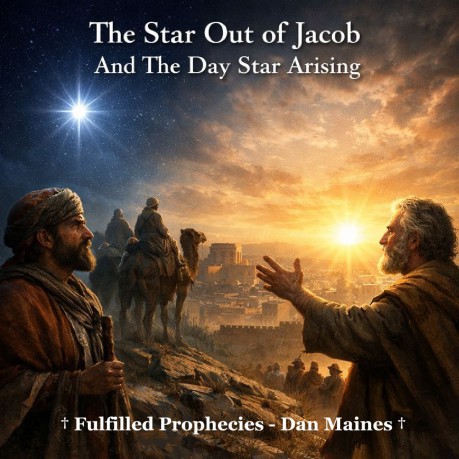
The Star Out of Jacob And The
Day Star Arising Per request, this post
has been formatted
as a study. Requests for topics or verses are welcome.
Introduction † Numbers 24:17 and 2 Peter 1:19 are
covenantally linked prophecies describing the same Messianic reality
from promise to fulfillment. Numbers 24:17 † Balaam clearly distinguishes between his
present time and the coming fulfillment, but he does not place it
outside covenant history. 2 Peter 1:19 † Peter speaks of prophecy being confirmed, not
postponed. Connection Between The Star And The Day Star † The star out of Jacob represents Messiah
promised to Israel under the Old Covenant. Historical References † Josephus records the destruction of Jerusalem
as the decisive end of the Old Covenant order, aligning with
Messianic judgment authority (Wars of the Jews, Book 6). How It Applies To Us Today † We are not waiting for the Day Star, we've
already received its light. Q & A Appendix Q Was Balaam predicting a literal astronomical
star? Q Why does Peter say prophecy was made more
sure? Q What does the Day Star arising in the heart
mean? Q Does this interpretation remove hope for
believers today? Q Is Christ still reigning if prophecy is
fulfilled? Q Why does Balaam say I see him, but not now, I
behold him, but not nigh? Q How do we know the star imagery is covenantal
and not astronomical? Q What does the lamp shining in a dark place
refer to? Q Why does Peter say until the day dawn? Q Is the Day Star rising in the heart connected
to the New Covenant promise? † This is the fulfilled perspective we proclaim at
Fulfilled Prophecies † Source Index † Numbers 24:17; 2 Peter 1:19; Isaiah 60:1-3;
Malachi 4:2; Revelation 22:16; Genesis 49:10; Colossians 1:13;
Matthew 28:18
By Dan Maines
† Balaam spoke
while Israel was still under promise, Peter spoke while fulfillment
was unfolding before his eyes.
† This post
follows the prophetic star from Old Covenant expectation to New
Covenant realization within history.
I
see him, but not now;
I look at him, but not near;
A star
shall appear from Jacob,
A scepter shall rise from Israel,
And
shall smash the forehead of Moab,
And overcome all the sons of
Sheth.
† The star imagery
represents royal authority and divine appointment, not a physical
celestial event.
† The sceptre language
identifies covenant rulership, echoing the promised ruler from Judah
(Genesis 49:10).
† Moab and the sons of
tumult symbolize covenant opposition, not all nations
indiscriminately.
† This prophecy anticipates
Messiah exercising judgment within Israel's covenant world.
†
This same light imagery appears later in Isaiah, showing continuity
in prophetic symbolism rather than a new concept (Isaiah 60:1-3).
And
so we have the prophetic word made more sure, to which
you do well to pay attention as to a lamp shining in a dark place,
until the day dawns and the morning star arises in your hearts.
† The dark place refers to the Old
Covenant age, marked by shadows and anticipation.
†
The day dawning describes covenant transition, not a future physical
catastrophe.
† The Day Star arising in their
hearts shows fulfillment becoming internal and experiential.
†
Peter's exhortation only makes sense if fulfillment was imminent and
accessible to his audience.
† Peter's
language aligns directly with Malachi's promise of covenant light
rising upon God's people (Malachi 4:2).
†
The Day Star represents that same Messiah revealed within the hearts
of New Covenant believers.
† Balaam saw
Messiah externally through prophecy, Peter experienced Him internally
through fulfillment.
† The movement is from
national expectation to covenant realization.
†
The sceptre promised in Numbers is the reign confessed in Peter's
epistle.
† This transition confirms that
prophecy reached its goal before the Old Covenant age ended.
†
The star did not fall from heaven, it rose within the people of the
New Covenant.
† Jesus later identifies
Himself using this same fulfilled imagery, confirming the identity of
the promised star (Revelation 22:16).
†
Eusebius affirms that Christ's kingdom was fully established prior to
Jerusalem's fall (Ecclesiastical History, Book 3).
†
Irenaeus taught that prophecy found its fulfillment in Christ and the
passing away of the former age (Against Heresies, Book 4).
†
Tertullian declared that Christ's light had already spread throughout
the nations in his own day (Apology, Chapter 21).
†
Clement of Alexandria described the gospel age as full illumination,
no longer awaiting prophetic light (Stromata, Book 7).
† Our faith
stands on fulfilled prophecy, not deferred hope.
†
We live in covenant daylight, not Old Covenant shadow.
†
Christ reigns now, and His authority isn't future tense.
†
This understanding stabilizes faith and removes fear driven by
unfulfilled expectation.
A No, the language is symbolic of royal
authority and covenant rulership (Genesis 49:10).
A Because fulfillment was being realized
in Christ and confirmed through covenant events (2 Peter 1:16-19).
A It refers to internal covenant
fulfillment, Christ revealed within believers, not a physical
appearance.
A No, it strengthens hope by
grounding it in completed covenant work (Colossians 1:13).
A Yes, His reign continues because
it was fully established, not postponed (Matthew 28:18).
A Balaam is
acknowledging that Messiah was future to his own time, yet certain
within covenant history, not postponed indefinitely (Numbers 24:17;
Galatians 4:4).
A Scripture consistently
uses star and light imagery for rulers, authority, and covenant
revelation, not literal stars (Isaiah 60:1-3; Daniel 12:3).
A It refers to the prophetic
scriptures functioning during the Old Covenant age, guiding God's
people until fulfillment arrived (2 Peter 1:19; Romans 15:4).
A
Because the Old Covenant age was nearing its end and the New Covenant
reality was coming fully into view for that generation (Hebrews 8:13;
Matthew 24:34).
A Yes, it aligns
with God's promise to write His law on hearts and bring internal
covenant reality rather than external signs (Jeremiah 31:33; 2
Corinthians 3:6).
© Fulfilled Prophecies - Dan
Maines.
† Josephus, Wars of the Jews,
Book 6
† Eusebius, Ecclesiastical History,
Book 3
† Irenaeus, Against Heresies, Book 4
†
Tertullian, Apology, Chapter 21
† Clement of
Alexandria, Stromata, Book 7
Links