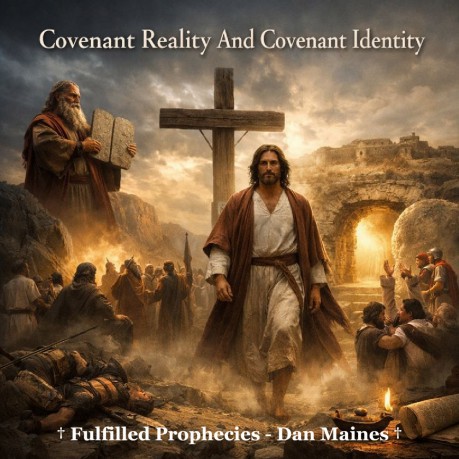
Covenant Reality And Covenant
Identity Introduction † When I use the phrase covenant reality or
covenant identity, I'm talking about how God relates to people based
on covenant standing, not based on biology, geography, or an
afterlife location. 2 Corinthians 3:6-9 who also made us adequate as
servants of a new covenant, not of the letter but of the Spirit; for
the letter kills, but the Spirit gives life.
But if the ministry of death, engraved in letters on stones, came
with glory so that the sons of Israel could not look intently at the
face of Moses because of the glory of his face, fading as it
was, how will the ministry of the Spirit fail to be even more
with glory? For if the ministry of condemnation has glory, much more
does the ministry of righteousness excel in glory.
† Paul doesn't describe death as biological
here, he's defining death as covenantal, tied directly to the Law. Romans 7:9-10
I was once alive apart from the Law; but when the commandment came,
sin came to life, and I died; and this commandment, which was to
result in life, proved to result in death for me; † Paul says he died when the Law came, yet his
body didn't stop breathing. Hebrews 9:9-10
which is a symbol for the present time. Accordingly both gifts
and sacrifices are offered which cannot make the worshiper perfect in
conscience, since they relate only to food, drink, and various
washings, regulations for the body imposed until a time of
reformation. † Under the Old Covenant, people could worship,
pray, and believe, yet their conscience wasn't cleansed. Hebrews 10:19-22
Therefore, brothers and sisters, since we have confidence to
enter the holy place by the blood of Jesus, by a new and living way
which He inaugurated for us through the veil, that is, through
His flesh, and since we have a great priest over the house of
God, let's approach God with a sincere heart in full assurance
of faith, having our hearts sprinkled clean from an evil
conscience and our bodies washed with pure water. † Covenant reality under the New Covenant is
bold access, not restricted access. Ephesians 2:12-13
remember that you were at that time separate from Christ,
excluded from the people of Israel, and strangers to the covenants of
the promise, having no hope and without God in the world. But now in
Christ Jesus you who previously were far away have been brought near
by the blood of Christ. † Being far off wasn't geographical, it was
covenantal. Romans 5:18-19
So then, as through one offense the result was condemnation to all
mankind, so also through one act of righteousness the result was
justification of life to all mankind. For as through the one man's
disobedience the many were made sinners, so also through the
obedience of the One the many will be made righteous. † Adam and Christ are covenant heads, not
biological metaphors. Colossians 2:12-14
having been buried with Him in baptism, in which you were also raised
with Him through faith in the working of God, who raised Him from the
dead. And when you were dead in your wrongdoings and the
uncircumcision of your flesh, He made you alive together with Him,
having forgiven us all our wrongdoings, having canceled the
certificate of debt consisting of decrees against us, which was
hostile to us; and He has taken it out of the way, having nailed it
to the cross. † Resurrection here is directly tied to
forgiveness and removal of the Law. 1 Corinthians 15:54-57
But when this perishable puts on the imperishable, and this mortal
puts on immortality, then will come about the saying that is written:
"Death has been swallowed
up in victory. Where,
O Death, is
your victory? Where,
O Death, is
your sting?" The sting of death is sin, and the power of
sin is the Law; but thanks be to God, who gives us the victory
through our Lord Jesus Christ. † Paul defines the sting of death as sin
empowered by the Law. Historical References † Josephus consistently uses death and life
language to describe Israel's exile and restoration. How It Applies To Us Today † We live from assurance, not fear, because our
covenant standing is settled. Q & A Appendix Q What do you mean by covenant reality or
covenant identity? Q Does this deny physical death? Q Why does Scripture speak of resurrection in
covenant terms? Q Why doesn't Scripture focus on where we go when
we die? Q If covenant death is separation from God, why
do people still physically die? Q Does covenant identity mean everyone is
automatically saved? Q How does judgment fit into covenant reality? Q Why does Paul speak of being already raised
with Christ? Q How does this affect how we read tribulation
passages? Q Why is the Law so central to covenant death
language? † This is the fulfilled perspective we proclaim at
Fulfilled Prophecies † Source Index † 2 Corinthians 3:6-9; Romans 7:9-10; Hebrews
9:9-10; Hebrews 10:19-22; Ephesians 2:12-13; Romans 5:18-19;
Colossians 2:12-14; 1 Corinthians 15:54-57
By Dan Maines
† Scripture consistently
defines relationship with God through covenant, not through physical
condition or future destination.
† Once we
see covenant categories clearly, the Bible stops feeling fragmented
and starts reading as one unified story of death and life, separation
and reconciliation.
†
The Law produced condemnation and separation, which Paul plainly
calls the ministration of death.
† The New
Covenant isn't about bodies changing location, it's about covenant
standing changing from condemnation to righteousness.
† Death here is
separation from God through covenant condemnation, not physical
death.
† This shows covenant reality clearly,
life and death are covenant conditions.
†
Access was limited, sin was remembered, and covenant standing
remained incomplete.
† This wasn't a failure
of faith, it was the limitation of the covenant itself.
† The
problem wasn't distance or location, it was covenant separation.
†
Christ didn't move people to a place, He moved them into full access.
† Nearness is defined by covenant
standing, not physical distance.
† This is
covenant identity shifting from outside to inside.
† Identity is defined
by covenant headship, not genetics.
†
Covenant reality answers the question, who are you under.
† Death
is defined as covenant condemnation, not physical burial.
†
Life comes when the bond of ordinances is removed.
† Victory over death
comes through covenant change, not biological reversal.
†
Death is swallowed when the Law is removed.
†
Eusebius records the transition from Old Covenant Jerusalem to New
Covenant identity centered in Christ.
†
Irenaeus taught recapitulation, showing humanity summed up in Adam
and restored in Christ.
† Second Temple
Jewish literature regularly framed covenant exile as death and
restoration as life.
† Our
confidence isn't based on where we go later, but who we are now in
Christ.
† Covenant identity frees us from
condemnation driven religion.
† We walk
boldly because access isn't partial or conditional anymore.
A It's how God defines
relationship, access, inheritance, and standing through covenant, not
biology or location. Romans 5:18-19.
A
No. Scripture distinguishes physical death from covenant death.
Covenant death is separation through the Law. 2 Corinthians 3:6;
Romans 7:9-10.
A Because resurrection
describes restoration to life and access in Christ after covenant
death. Colossians 2:12-14; 1 Corinthians 15:54-57.
A Because the central question is
covenant standing, whether one is in Adam or in Christ. Ephesians
2:12-13.
A Physical
death continues as part of the mortal condition, but covenant death
ended in Christ. Scripture distinguishes the two. Romans 7:9-10; 2
Corinthians 5:1-8.
A No. Covenant identity is
defined by union with Christ. Those in Christ share covenant life,
those outside remain under condemnation. Romans 8:1; John 3:18.
A
Judgment in Scripture often refers to covenant judgment, the removal
of the Old Covenant system and those clinging to it. Hebrews 9:26-28;
Matthew 23:36.
A Because resurrection language
describes covenant life restored through union with Christ, not a
future biological event. Ephesians 2:5-6; Colossians 3:1-3.
A Tribulation is covenant judgment
tied to the Old Covenant age, not an end of the planet or future
global event. Matthew 24:34; Luke 21:22.
A Because sin gains its power through
the Law, and when the Law is removed, covenant death loses its
authority. 1 Corinthians 15:56; Romans 10:4.
© Fulfilled Prophecies - Dan
Maines.
†
Josephus, Antiquities of the Jews; Eusebius, Ecclesiastical History;
Irenaeus, Against Heresies; Second Temple Jewish Literature
Links