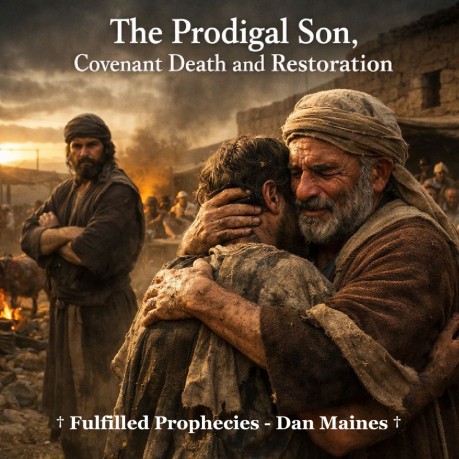
The Prodigal Son, Covenant
Death and Restoration Introduction † This parable was spoken to Pharisees and
scribes who complained that Jesus received sinners and ate with them
(Luke 15:1-2). Luke 15:11-32 Luke 15:11 † Jesus frames this as a family story, pointing
to Israel as a household, not the nations (Luke 15:1-2; Romans
9:4-5). Luke 15:12 † Asking for the inheritance early was a
declaration of relational death, treating the father as if he were
dead (Luke 15:24). Luke 15:13 † The far country represents separation from
covenant fellowship, not distance from heaven (Isaiah 59:2; Ephesians
2:12). Luke 15:14 † Famine is a recurring covenant curse under
the Law (Deuteronomy 28:23-24; Deuteronomy 28:48). Luke 15:15 † Feeding swine signifies uncleanness, showing
complete covenant defilement (Leviticus 11:7-8; Isaiah 65:3-4). Luke 15:16 † The Law could not satisfy or restore life
(Galatians 3:21; Hebrews 10:1). Luke 15:17 † Coming to himself reflects repentance, a
change of covenant understanding (Isaiah 55:7; Ezekiel 18:30-31). Luke 15:18 † Sin against heaven is covenant language, not
spatial language (Daniel 4:26; Psalm 51:4). Luke 15:19 † He expects restoration through works, not
sonship (Galatians 4:9-11; Romans 10:3). Luke 15:20 † The father runs, violating cultural norms,
showing divine initiative (Luke 19:10; Romans 5:8). Luke 15:21 † The son never finishes his hired servant
speech (Luke 15:19-21). Luke 15:22 † The robe signifies restored covenant standing
(Isaiah 61:10; Zechariah 3:3-4). Luke 15:23 † Covenant restoration is celebrated, not
earned (Luke 15:6-7; Romans 5:11). Luke 15:24 † Death here is relational and covenantal, not
biological (Luke 15:24; Ephesians 2:1-5). Luke 15:25 † The elder son represents self righteous
Israel (Luke 15:1-2; Romans 10:2-3). Luke 15:26 † He doesn't know the father's joy (Luke
15:26-27; Luke 15:10). Luke 15:27 † Restoration is complete, not partial (Luke
15:22-24; Romans 8:1). Luke 15:28 † Refusal to enter is self exclusion (Luke
15:28; Matthew 23:13). Luke 15:29 † He views sonship as servitude (Luke 15:29;
Galatians 4:9). Luke 15:30 † He distances himself from his brother (Luke
15:30; Luke 10:29). Luke 15:31 † Covenant privileges were always available
(Romans 3:1-2; Romans 9:4-5). Luke 15:32 † Restoration is necessary, not optional (Luke
15:32; Luke 15:7). Historical References † Josephus records Israel's covenant collapse
and restoration crisis leading to AD 70, Antiquities and Wars. How It Applies To Us Today † Covenant life is relational, not performance
based (John 15:4-5; Romans 5:1). Q & A Appendix Q Was the prodigal physically dead? Q Does this parable teach heaven after death? Q Who is the elder son? Q Why is resurrection language used if no one
physically died? Q Does the father represent God restoring Israel
before judgment? Q Why does the father go out to the elder son
instead of forcing him to enter? Q Is this parable teaching two different ways of
salvation? Q Why does Jesus end the parable without telling
us if the elder son enters? † This is the fulfilled perspective we proclaim at
Fulfilled Prophecies † Source Index † Luke 15:11-32; Deuteronomy 28:15-68; Ezekiel
18:4; Hosea 6:1-2; Isaiah 65:17; Matthew 16:27-28; Romans 10:2-4;
Matthew 23:36; Matthew 24:34; Luke 21:20-24; Matthew 24:15-16; John
5:24; Ephesians 2:1-6; 2 Corinthians 5:18-19; Isaiah 55:7; 1 John
1:9; 1 John 1:3 † Josephus, Antiquities of the Jews; Wars of
the Jews; Eusebius, Ecclesiastical History; Irenaeus, Against
Heresies; Clement of Alexandria, Stromata; Tertullian, On Repentance
By Dan Maines
† It is not about individual
salvation mechanics, but about covenant loss and covenant restoration
within Israel (Luke 15:1-2; Romans 9:4-5).
†
The story explains how those considered dead under the Law were being
restored through grace before AD 70 (Luke 15:24; Matthew 23:36;
Matthew 24:34).
And He said, "A man had two
sons.
† The two sons represent two groups
within Israel, not believers and unbelievers in general (Luke 15:1-2;
Romans 11:1-6).
† This sets the stage for
covenant identity, not geography or heaven (Romans 2:28-29; Romans
9:4-5).
The
younger of them said to his father, 'Father, give me the share of the
estate that is coming to me.' And so he divided his wealth
between them.
† This mirrors Israel
breaking covenant and pursuing life apart from God (Jeremiah 2:13;
Jeremiah 3:6-8).
† The father allows the
request, showing God permitted Israel to walk under the consequences
of the Law (Deuteronomy 28:15; Romans 7:10-11).
And
not many days later, the younger son gathered everything together and
went on a journey to a distant country, and there he squandered his
estate in wild living.
† Riotous living reflects Israel's
history of covenant unfaithfulness (Jeremiah 3:20; Ezekiel 16:15).
†
This is covenant exile language, consistent with the prophets (Hosea
9:3; Isaiah 1:4).
Now
when he had spent everything, a severe famine occurred in that
country, and he began doing without.
†
Spiritual emptiness always follows covenant rebellion (Amos
8:11-12).
† This points to Israel's condition
under the Law before Christ (Romans 7:9-11; Galatians 3:23).
So he
went and hired himself out to one of the citizens of that country,
and he sent him into his fields to feed pigs.
†
This would be especially offensive imagery to Jewish hearers
(Leviticus 11:7-8).
† Jesus is showing how
far covenant Israel had fallen (Isaiah 1:4-6; Jeremiah 2:21).
And
he longed to have his fill of the carob pods that the pigs were
eating, and no one was giving him anything.
† Israel's
leaders offered no true provision for covenant restoration (Ezekiel
34:2-4; Matthew 23:13).
† This reveals the
barrenness of legal righteousness (Romans 10:2-4; Galatians 2:16).
But
when he came to his senses, he said, 'How many of my father's hired
laborers have more than enough bread, but I am dying here from
hunger!
†
He recognizes life is found only in the father's house (Psalm 23:1;
John 6:35).
† This mirrors Israel awakening
through John and Jesus' preaching (Matthew 3:1-2; Mark 1:14-15).
I
will set out and go to my father, and will say to him, "Father,
I have sinned against heaven, and in your sight;
†
Repentance acknowledges broken relationship, not fear of punishment
(Psalm 51:10-12; Isaiah 55:7).
† This matches
the prophetic calls to return to the Lord (Jeremiah 3:12-14; Hosea
14:1-2).
I am
no longer worthy to be called your son; treat me as one of your hired
laborers.
†
This reflects Israel's mindset under the Law (Romans 9:31-32;
Galatians 3:23).
† Grace exceeds his
expectations (Ephesians 2:8-9; Romans 5:20).
So he
set out and came to his father. But when he was still a long way off,
his father saw him and felt compassion for him, and ran and
embraced him and kissed him.
†
Restoration begins before the confession is completed (Luke 15:20; 1
John 4:19).
† This anticipates the gospel of
grace (Ephesians 2:4-5; Titus 3:5).
And
the son said to him, 'Father, I have sinned against heaven and in
your sight; I am no longer worthy to be called your son.'
† Grace interrupts
works based expectations (Romans 4:4-5; Ephesians 2:8-9).
†
Sonship is restored fully (Galatians 4:6-7; John 1:12).
But
the father said to his slaves, 'Quickly bring out the best robe and
put it on him, and put a ring on his finger and sandals on his feet;
† The ring
represents authority and family identity (Genesis 41:42; James
2:2).
† Shoes indicate freedom, not servitude
(Ephesians 6:15; Galatians 5:1).
and
bring the fattened calf, slaughter it, and let's eat and celebrate;
† This
points to fellowship and table communion (Luke 15:2; Acts 2:46).
†
It anticipates the messianic banquet imagery (Isaiah 25:6; Matthew
8:11).
for
this son of mine was dead and has come to life again; he was lost and
has been found.' And they began to celebrate.
†
This verse defines the parable's meaning clearly (Luke 15:24).
†
Resurrection language is used before physical death (Ezekiel
37:11-14; John 5:24).
"Now his older son was in
the field, and when he came and approached the house, he heard music
and dancing.
† He
remains outside the celebration (Luke 15:28; Matthew 23:13).
†
Proximity to the house does not equal participation (Matthew 7:21-23;
Romans 2:17-24).
And
he summoned one of the servants and began inquiring what these
things could be.
† Legalism always
misunderstands grace (Romans 9:31-32; Galatians 5:4).
†
This mirrors Pharisaic confusion (Luke 15:1-2; Matthew 23:23).
And
he said to him, 'Your brother has come, and your father has
slaughtered the fattened calf because he has received him back safe
and sound.'
† The father receives
him as a son, not a probationer (Luke 15:22; Galatians 4:7).
†
This offends the elder son's mindset (Luke 15:28; Luke 18:11-14).
But
he became angry and was not willing to go in; and his father came out
and began pleading with him.
† The father seeks
both sons (Luke 15:28; Luke 15:4-7).
† Grace
invites even the self righteous (Luke 18:9-14; Romans 11:20).
But
he answered and said to his father, 'Look! For so many years I have
been serving you and I have never neglected a command of yours; and
yet you never gave me a young goat, so that I might celebrate
with my friends;
† He measures worth by
obedience (Romans 10:3; Philippians 3:4-9).
†
This exposes the heart of legalism (Luke 18:11-14; Romans 9:31-32).
but
when this son of yours came, who has devoured your wealth with
prostitutes, you slaughtered the fattened calf for him.'
† He resents grace given
to others (Jonah 4:1-2; Matthew 20:11-16).
†
This mirrors Israel's rejection of repentant sinners (Luke 15:1-2;
Luke 7:39).
And
he said to him, 'Son, you have always been with me, and all that is
mine is yours.
† The elder son
lacked nothing but understanding (Luke 15:31; Romans 10:2).
†
Law based righteousness blinds people to grace (Romans 9:31-32;
Galatians 5:4).
But
we had to celebrate and rejoice, because this brother of yours was
dead and has begun to live, and was lost and has been
found.
† Covenant resurrection is
the heart of the gospel (Luke 15:24; Ephesians 2:4-6).
†
This sets the stage for AD 70 fulfillment (Matthew 23:36; Matthew
24:34; Luke 21:20-24).
†
Eusebius notes early Christian understanding of covenant transition
and judgment.
† Irenaeus emphasized
restoration through sonship, not legal performance.
†
Clement of Alexandria spoke of repentance as present restoration to
life, not a post death event.
† Tertullian
affirmed repentance as covenant reconciliation within the life of the
believer.
† Being
alive in Christ means restored fellowship now (Ephesians 2:4-6; 1
John 1:3).
† We live as sons, not servants
trying to earn favor (Galatians 4:6-7; Romans 8:15).
†
Resurrection life is a present reality expressed through
reconciliation and peace with God (John 5:24; 2 Corinthians 5:18-19).
A
No. He was covenantally dead, as defined in Luke 15:24, consistent
with Ezekiel 18:4.
A
No. It teaches covenant restoration within Israel, fulfilled in
Christ before AD 70 (Matthew 16:27-28).
A
Self righteous Israel, especially the Pharisees, who rejected grace
(Romans 10:2-4).
A Because Scripture regularly
uses death and life to describe covenant standing, as seen in Hosea
6:1-2 and Isaiah 65:17.
A Yes. The father represents
God's covenant mercy toward Israel prior to AD 70, restoring
repentant sons before the generation judgment came (Luke 15:20,
Matthew 23:36, Matthew 24:34).
A Because
covenant participation is never forced. The elder son excludes
himself by refusing grace, just as many in Israel rejected Christ
despite being near the covenant promises (Luke 15:28, Romans
11:20-22).
A No. It exposes two false mindsets
under the Law, rebellion and self righteousness, and shows that
restoration comes only through grace and sonship (Romans 3:27-28,
Galatians 2:16).
A Because the
decision was still before Israel at that time. The open ending
reflects the real historical moment leading up to AD 70, where
acceptance or rejection of grace remained unresolved for that
generation (Luke 15:32, Acts 28:24).
© Fulfilled Prophecies - Dan
Maines.
Links