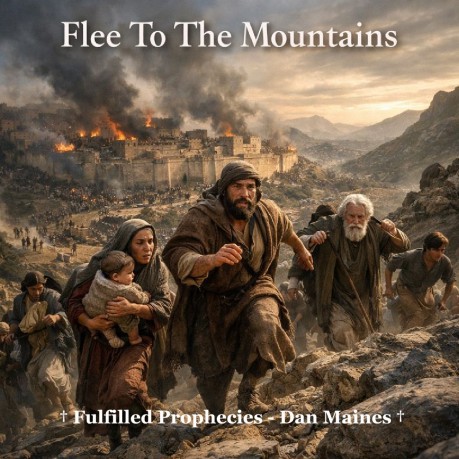
Flee To The Mountains Introduction † Jesus gave a direct, urgent command to His
disciples concerning a coming judgment that would occur within their
lifetime, not as symbolism, but as practical instruction meant to
preserve life (Matthew 24:34). † The command to flee to the mountains only
works in a localized, historical setting tied to Jerusalem and Judea,
not a global or future end of the world scenario (Luke 21:20-21). † This post shows the clarity of Jesus'
warning, its first century fulfillment, and why it stands as firm
evidence of fulfilled prophecy. Matthew 24:15-16 † Jesus connects this warning to a visible
event His audience could recognize, not a distant future generation
(Daniel 9:26-27). † The instruction is limited to Judea,
immediately ruling out a worldwide or modern application. † Fleeing to mountains is a physical act of
escape from invading armies, not symbolic spiritual language. Matthew 24:17-18 † Jesus emphasizes immediate physical flight,
leaving possessions behind, which only makes sense in a real
historical crisis. † The urgency confirms this was not a distant
or symbolic event, but a sudden danger requiring instant obedience. † This instruction matches known Roman siege
tactics, where delay meant death. Luke 21:20-21 † Luke removes all ambiguity by defining the
Abomination as Jerusalem surrounded by armies. † The urgency is unmistakable, leave
immediately, do not return, do not enter the city. † This perfectly aligns with Roman military
movements leading up to AD 70. † Jerusalem has never again been surrounded in
the same covenantal context described here, confirming the
fulfillment was unique and unrepeatable. Matthew 24:34 † Jesus anchors the entire Olivet Discourse,
including fleeing to the mountains, within His own generation. † Any interpretation that pushes this command
into the future directly contradicts Jesus' time statement. † The fulfilled perspective simply takes Jesus
at His word. Historical References † Eusebius records that the Jerusalem
Christians fled to Pella in the mountains, obeying Jesus' warning. † Josephus documents the Roman siege,
surrounding armies, and the destruction of Jerusalem exactly as Jesus
described. † Epiphanius of Salamis also confirms the
flight of believers to Pella, providing independent historical
corroboration. † No early Christian writer treated this
warning as symbolic or future. How It Applies To Us Today † This passage strengthens our confidence that
Jesus' words are reliable and precise. † It shows that God provides clear warning and
deliverance for His people. † Fulfilled prophecy builds faith, it doesn't
weaken it. † Believers today are not waiting for an escape
event, we're living in the completed kingdom Christ established. Q & A Appendix Q Did Christians actually flee Jerusalem before AD 70? Q Why didn't all Jews flee if the warning was clear? Q Why doesn't this apply to a future end of the world? Q Why is this important? † This is the fulfilled perspective we proclaim at
Fulfilled Prophecies † Source Index † Matthew 24:15-18, 34; Luke 21:20-21; Daniel
9:26-27
By Dan Maines
Therefore when you see the
Abomination of Desolation which was spoken of through Daniel the
prophet, standing in the holy place, let the reader understand, then
those who are in Judea must flee to the mountains.
Whoever is on the housetop
must not go down to get the things out that are in his house. Whoever
is in the field must not turn back to get his cloak.
But when you see Jerusalem
surrounded by armies, then recognize that her desolation is near.
Then those who are in Judea must flee to the mountains, and those who
are in the midst of the city must leave, and those who are in the
country must not enter the city.
Truly I say to you, this
generation will not pass away until all these things take place.
A
Yes. Historical records confirm they fled to Pella and escaped the
destruction.
A
Many rejected Jesus and did not believe His words, just as He warned
would happen.
A
Because it was limited to Judea, tied to Jerusalem, and fulfilled
within that generation. If the world were ending, He wouldn't have
given an escape route.
A It proves Jesus
meant exactly what He said.
© Fulfilled Prophecies - Dan
Maines.
† Josephus, Wars of the Jews, Book
6
† Eusebius, Ecclesiastical History, Book
3
† Epiphanius of Salamis, Panarion
Links