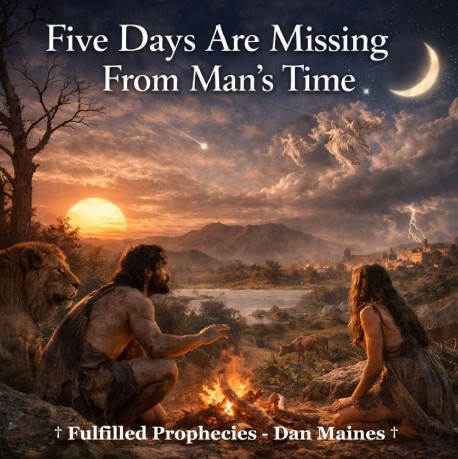
Five Days Are Missing From
Man's Time Introduction † This message is not about denying Scripture,
it's about letting Scripture define time on God's terms, not ours. Genesis 1:14-18 † Man's time is clearly defined here, days and
years are tied to the sun, moon, and stars. Genesis 1:3-5 † Evening and morning exist before the sun and
moon are created. † The light of Day One is not the sun, which is
created later. Genesis 1:6-8
† The
expanse describes God establishing order within creation by
separating what was previously undivided. Psalm 104:2 † God is described as clothed in light. 1 Timothy 6:16 † God's dwelling is light itself. Revelation 21:23 † God provides light without the sun. Isaiah 60:19 † God is explicitly identified as everlasting
light. Genesis 1:11-13 † Vegetation appears before the sun exists. Deuteronomy 8:3 † Life is sustained by God's word, not physical
systems. Matthew 4:4 † Jesus affirms this truth. Hebrews 1:3 † Creation is sustained by God's power. Isaiah 46:10 † God's time is purpose driven. Psalm 90:2-4 † God's time is not measured like man's. 2 Peter 3:8 † Scripture explicitly separates God's time
from man's. Job 38:4-7 † Man was not present. Job 10:4-5 † Scripture directly contrasts God's days with
man's days. Ecclesiastes 3:11 † Man cannot fully comprehend God's timing. Psalm 102:25-27 † Creation is subject to time. Genesis 2:4 † All creation is summarized as one day. Exodus 20:11 † Scripture affirms six days of creation. Hebrews 11:3 † Faith rests on God's word, not timelines. Revelation 1:8 † God exists across all time simultaneously. Hebrews 13:8 † God's nature does not change. † Three days pass before the sun exists. Historical References † Augustine stated the days of creation cannot
be ordinary days since the sun was created later. How It Applies To Us Today † Scripture does not require us to defend
assumptions. † The Bible tells us what God did, not how long
He took by our clocks. Anticipating Common Objections † Some will argue that evening and morning must
always mean a 24 hour solar day, but the text itself places evening
and morning before the sun exists. † Others will claim that questioning the length
of the days undermines biblical authority, but Scripture never
defines the length of those days. † Some will say this introduces human
reasoning, yet every conclusion here comes directly from Scripture
interpreting Scripture. Covenant Fulfillment and God's Time † Just as God's creative work was not bound to
man's measurements of time, His redemptive work was also carried out
according to His appointed time. Habakkuk 2:3 † God sets the appointed time. Galatians 4:4 † Christ did not come early or late. Matthew 24:34 † Jesus anchored fulfillment to a specific
generation. Revelation 1:1-3 † Soon and near are defined by God's
perspective, not future delay. † Forcing Genesis into human time creates the
same mistake as forcing prophecy into human delay. Closing Reflection † Before walking away from this, consider what
Scripture itself has shown us. † Man is not created until Day Six. † This is not denying Scripture. Why We Speak of Seven Days When Timekeeping Begins on Day
Four † Scripture clearly states that God created in
six days and rested on the seventh, and those days are real and
ordered as recorded in Genesis. † On Days One through Three, there is light,
evening, and morning, but there is no sun or moon to measure time. † On Day Four, God creates the sun, moon, and
stars and assigns them a specific function. † This means the Bible presents days before
timekeeping exists, and then introduces timekeeping later. † Man himself is not created until Day Six. † For this reason, Scripture allows us to
affirm seven real days of creation while also recognizing that not
all days are measured by the same standard. † When Scripture defines how time is measured,
we are bound by that definition. † This preserves the authority of Scripture by
letting God define His work on His own terms rather than forcing
human measurements onto divine action. † This is the fulfilled perspective we proclaim at
Fulfilled Prophecies † Source Index † Genesis 1:3-5; Genesis 1:11-13; Genesis
1:14-18; Genesis 2:4; Exodus 20:11; Job 10:4-5; Job 38:4-7; Psalm
90:2-4; Psalm 102:25-27; Psalm 104:2; Isaiah 46:10; Isaiah 60:19;
Matthew 4:4; Hebrews 1:3; Hebrews 11:3; Hebrews 13:8; 1 Timothy 6:16;
2 Peter 3:8; Revelation 1:8; Revelation 21:23
By Dan Maines
†
The Bible never says God's time and man's time are the same thing,
and Genesis itself gives us reasons to pause before making that
assumption.
† If Scripture is our authority,
then we've got to let the text speak, even when it challenges long
held traditions.
Then God said, Let there be
lights in the expanse of the heavens to separate the day from the
night, and let them be for signs and for seasons and for days and
years; and let them be for lights in the expanse of the heavens to
give light on the earth, and it was so. God made the two great
lights, the greater light to govern the day, and the lesser light to
govern the night; He made the stars also. God placed them in the
expanse of the heavens to give light on the earth, and to govern the
day and the night, and to separate the light from the darkness; and
God saw that it was good.
†
Before this point, Scripture gives no mechanism for measuring human
time.
† This shows man's time begins when God
establishes lights to govern it.
Then God said, Let there be
light; and there was light. God saw that the light was good; and God
separated the light from the darkness. God called the light day, and
the darkness He called night. And there was evening and there was
morning, one day.
† There is no man present
to observe, measure, or count these days.
†
This cannot be man's time, it must be God's time.
† Scripture consistently
presents God Himself as light.
† This
supports divine illumination rather than a solar source.
†
With no man, sun, or moon, God's evening and morning could span far
beyond human measurement for day one.
Then God
said, Let there be an expanse in the midst of the waters, and let it
separate the waters from the waters. God made the expanse, and
separated the waters which were below the expanse from the waters
which were above the expanse; and it was so. God called the expanse
heaven. And there was evening and there was morning, a second day.
†
The separation of the waters shows God structuring creation according
to His purpose, not human observation.
†
God naming the expanse heaven identifies His authority over what He
formed and defined.
†
With no man, sun, or moon, God's evening and morning could span far
beyond human measurement for day two.
Covering Yourself with light as
with a cloak, Stretching out heaven like a tent curtain.
†
This aligns with the light of Day One preceding the sun.
†
The source of light is God Himself.
Who alone possesses
immortality and dwells in unapproachable light, whom no man has seen
or can see.
†
This reinforces that light does not require created bodies.
†
The first light fits God's nature.
And the city has no need of
the sun or of the moon to shine on it, for the glory of God has
illumined it, and its lamp is the Lamb.
†
This shows divine light is sufficient for life and order.
†
Genesis follows the same pattern.
No longer will you have the sun
for light by day, nor for brightness will the moon give you light;
but you will have the Lord for an everlasting light.
† This confirms the nature of the
first light.
† God does not merely provide
light, He replaces the need for the sun and the moon entirely, and
Scripture identifies this reality in His spiritual Kingdom, the New
Jerusalem.
† Scripture interprets Scripture.
Then God said, Let the earth
sprout vegetation, plants yielding seed, and fruit trees on the earth
bearing fruit after their kind with seed in them; and it was so. The
earth brought forth vegetation, plants yielding seed after their
kind, and trees bearing fruit with seed in them, after their kind;
and God saw that it was good. There was evening and there was
morning, a third day.
†
This means plant life did not depend on the sun at this stage.
†
God sustained creation directly.
† With no
man, sun, or moon, God's evening and morning could span far beyond
human measurement for day three.
Man does not live by bread
alone, but man lives by everything that proceeds out of the mouth of
the Lord.
† This principle applies to all
creation.
† Vegetation existed by divine
provision.
Man shall not live on bread
alone, but on every word that proceeds out of the mouth of God.
†
God's word sustains life apart from natural means.
†
Genesis reflects this reality.
Upholding all things by the word
of His power.
†
The sun was not required for preservation.
†
God alone is sufficient.
Declaring the end from the
beginning, and from ancient times things which have not been done.
†
His days are defined by accomplishment.
†
Genesis days reflect divine purpose, not clocks.
From everlasting to
everlasting, You are God. For a thousand years in Your sight are like
yesterday when it passes by.
†
Long periods are insignificant to Him.
† This
applies directly to creation days.
With the Lord one day is like a
thousand years, and a thousand years like one day.
† This supports non human
measurement of early days.
† Genesis allows
for extended duration.
Where were you when I laid the
foundation of the earth.
†
Timekeeping did not exist.
† God alone acted
and defined the process.
Do You have eyes of flesh? Or do
You see as a man sees? Are Your days as the days of a mortal, or Your
years as man's years.
† God's time cannot be assumed to
match human time.
† This removes the
requirement for human length days.
He has made everything
appropriate in its time. He has also set eternity in their heart, yet
so that man will not find out the work which God has done from the
beginning even to the end.
†
Scripture acknowledges limits to human understanding.
†
Creation timing fits this principle.
Of old You founded the
earth, and the heavens are the work of Your hands. Even they will
perish, but You endure; and all of them will wear out like a garment.
†
God is not subject to time.
† This
distinction governs how we read Genesis.
This is the account of the
heavens and the earth when they were created, in the day that the
Lord God made earth and heaven.
†
Scripture itself uses day flexibly.
† This
confirms non rigid usage.
For in six days the Lord made
the heavens and the earth, the sea and all that is in them.
†
Scripture does not define their length.
†
Duration is not specified.
By faith we understand that the
worlds were prepared by the word of God.
†
The focus is on divine action.
† Duration is
irrelevant to the message.
Who is and who was and who is
to come.
†
He is not bound to chronology.
† He was
present long before man.
Jesus Christ is the same
yesterday and today and forever.
†
His work is not limited by time.
† Scripture
never demands a 6,000 year earth.
†
Five days pass before man exists.
† Without
man, this cannot be man's time.
†
Origen acknowledged the creation days are not to be understood as
common days.
† Philo described creation as
divine order, not chronological sequence.
†
Justin Martyr affirmed God's eternal nature beyond time.
†
Irenaeus taught God is not bound to created order.
†
Josephus acknowledged God's works exceed human understanding.
† God's authority stands
independent of timelines.
† Faith rests in
God's word, not tradition.
† God's time and man's
time are not the same.
† Letting Scripture
speak strengthens confidence, not doubt.
†
Scripture defines man's days by the sun and moon, and those are not
created until Day Four.
† Therefore Scripture
itself prevents us from forcing a solar definition onto Days One
through Three.
† Accepting
what Scripture does not specify is not compromise, it is submission
to the text.
† Biblical authority is upheld
by saying no more and no less than what God has revealed.
† God's time is
explicitly distinguished from man's time throughout the Bible.
†
Letting God define His own work honors Him rather than confining Him
to human limits.
† Scripture
consistently shows that God fulfills His purposes when the time is
full, not when man expects it.
† This same
principle governs both creation and covenant.
†
When we allow God to define time in creation and covenant, we see
that Scripture has always been fulfilled according to His purpose,
not man's expectations.
For the vision is yet for the
appointed time; it hastens toward the goal and it will not fail.
Though it tarries, wait for it; for it will certainly come, it will
not delay.
†
Delay is only perceived from a human perspective.
†
Fulfillment occurs exactly when God intends.
But when the fullness of the
time came, God sent forth His Son.
†
Redemption unfolded on God's timetable.
†
Time is defined by divine purpose.
Truly I say to you, this
generation will not pass away until all these things take place.
† God's timing was precise, not
symbolic or delayed.
† The promise was
fulfilled exactly as spoken.
The Revelation of Jesus
Christ, which God gave Him to show to His bond servants, the things
which must soon take place. And He sent and communicated it by His
angel to His bond servant John. Blessed is he who reads and those who
hear the words of the prophecy, and heed the things which are written
in it; for the time is near.
† Fulfillment
occurred within the stated time frame.
†
Measuring prophecy by man's clock leads to error.
†
Both errors come from measuring God by man's clock.
†
Letting God define His own time preserves the integrity of Scripture.
† Not
opinions, not tradition, just the order the Bible gives.
†
The sun and moon, which define human days and years, are not created
until Day Four.
† Days One through Five occur
with no man present to observe or measure them.
†
Three days pass before the sun exists.
† Five
days pass before man exists.
† Therefore,
none of the first five days can honestly be called man's time.
†
This is letting Scripture define its own terms.
† At the same
time, Scripture does not define all days in the same way.
†
Without the sun and moon, Scripture provides no mechanism for
defining days and years as man later understands them.
†
Scripture explicitly states that these lights are for signs, seasons,
days, and years.
† This is the first point in
the creation account where measured time is defined.
†
The days are real, but their duration is not defined in human terms
until Day Four.
†
Even after timekeeping begins, there is still no man present to live
within or observe that measured time.
†
The text never states that Days One through Three must be solar,
twenty four hour days.
† When
Scripture does not define duration, we are not free to impose one.
© Fulfilled Prophecies - Dan
Maines.
†
Augustine, Confessions; Origen, De Principiis; Philo of Alexandria,
On the Creation; Justin Martyr, Dialogue with Trypho; Irenaeus,
Against Heresies; Josephus, Antiquities of the Jews
Links