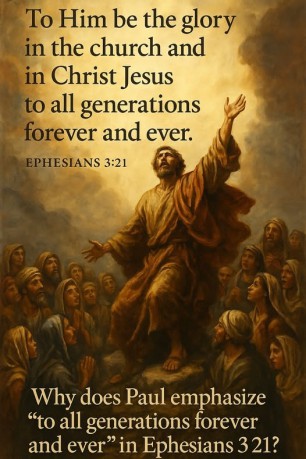
Why
does Paul emphasize "to all generations forever and ever"
in Ephesians 3:21? Paul emphasizes "to all
generations forever and ever" to highlight the eternal and
unending nature of God's glory. He's not talking about a temporary
moment of praise, but a perpetual glorifying of God, through the
church and through Christ, across every generation, without end. It stresses that God's plan, fulfilled
in Christ, isn't just for the early church or for Israel alone, but
for all people in all time, showing the limitless reach of God's
redemptive purpose. It reinforces the success of God's
eternal purpose (Ephesians 3:11). God's plan wasn't a short-term fix,
but something that would produce enduring glory through the church
throughout time. It contrasts with the fading glory of
the Old Covenant. Under the Law, glory was limited and passing (see 2
Corinthians 3:7-11), but now in Christ and His church, glory is
permanent and ever-expanding. It confirms the church is not a
temporary institution. Many see the church as a parenthesis or
temporary placeholder, but Paul affirms its role in God's eternal
plan by tying God's glory to it forever. It reflects the fulfillment of Old
Testament hope. God's promises to Abraham and the prophets pointed to
a blessing for all nations and future generations. Paul shows that
this has been fulfilled in Christ through the church. It brings comfort and identity. No
matter the generation or cultural setting, believers are part of
something eternal and glorious. We're not just another religious
movement, we're the very vessel of God's glory across ages.
By Dan Maines
Links