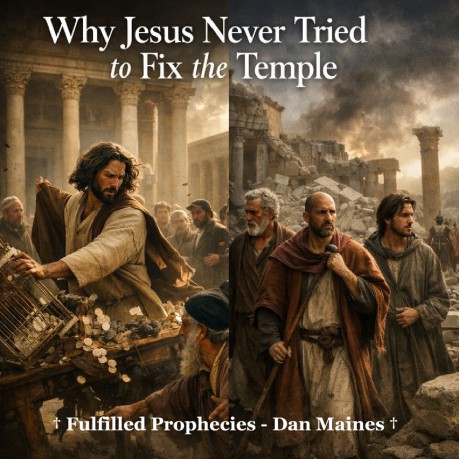
Why Jesus Never Tried to Fix
the Temple Introduction † This message is not about disrespecting the
Temple, it's about understanding Jesus' purpose. Jesus and the Temple Matthew 12:6 Yet I say to you that in this place there is One greater than the
temple. † Jesus didn't argue for Temple reform, He
declared its replacement. John 2:19 Jesus answered and said to them, Destroy this temple, and in three
days I will raise it up. † Jesus redirected attention away from the
building to His own body. Matthew 21:12-13 Then Jesus went into the temple of God and drove out all those who
bought and sold in the temple, and overturned the tables of the money
changers and the seats of those who sold doves. † This act was not a repair, it was a prophetic
indictment. Matthew 23:38 See, your house is left to you desolate. † Jesus called it your house, not My Father's
house. Luke 21:5-6 Then, as some spoke of the temple, how it was adorned with
beautiful stones and donations, He said, † Jesus showed no emotional attachment to the
structure. Hebrews 9:11 But Christ came as High Priest of the good things to come, with
the greater and more perfect tabernacle not made with hands, that is,
not of this creation. † The writer confirms what Jesus
demonstrated. † What Jesus declared in word and action, the
apostles carried forward in doctrine and preaching. The Apostles and the Absence of Temple Theology After the
Cross Acts 6:13-14 They also set up false witnesses who said, This man does not cease
to speak blasphemous words against this holy place and the law, † Stephen was accused of teaching Temple
destruction, not Temple reform. Acts 7:48 However, the Most High does not dwell in temples made with hands,
as the prophet says. † Stephen openly denied the Temple as God's
dwelling place. Acts 17:24 God, who made the world and everything in it, since He is Lord of
heaven and earth, does not dwell in temples made with hands. † Paul preached this while the Temple was still
standing. 2 Corinthians 6:16 And what agreement has the temple of God with idols? For you are
the temple of the living God. As God has said, I will dwell in them
and walk among them. I will be their God, and they shall be My
people. † Paul didn't point believers back to
Jerusalem. Hebrews 8:13 In that He says, A new covenant, He has made the first obsolete.
Now what is becoming obsolete and growing old is ready to vanish
away. † The Temple stood physically, but it was
already obsolete. Hebrews 10:9 Then He said, Behold, I have come to do Your will, O God. He takes
away the first that He may establish the second. † The first covenant was not repaired, it was
taken away. Historical References † Josephus recorded that the Temple leadership
had become corrupt long before AD 70, Wars of the Jews, Book 5. How It Applies To Us Today † Jesus still doesn't repair what He's
replaced. † This is the fulfilled perspective we proclaim at
Fulfilled Prophecies † Appendix, Questions and Answers Q: Did Jesus respect the Temple or reject it? † Jesus respected the Law and the Prophets, but
He did not preserve the Temple as an ongoing dwelling place (Matthew
5:17; Matthew 12:6). Q: Why did Jesus cleanse the Temple if it was about to be
destroyed? † The cleansing was prophetic exposure, not
restoration (Matthew 21:12-13). Q: If the Temple was obsolete, why did the apostles still
go there early on? † The apostles preached Christ wherever Jews
gathered (Acts 3:1-6; Acts 5:42). Q: Does this mean God abandoned Israel? † No, it means God fulfilled His promises in
Christ (Romans 9:6-8; 2 Corinthians 1:20). Q: Why is there no New Testament command to rebuild the
Temple? † Because Christ fulfilled its purpose (Hebrews
10:1, 9). Q: What does this mean for Christians today? † Faith is not anchored to sacred locations
(John 4:21). Source Index † Matthew 12:6; John 2:19; Matthew 21:12-13;
Matthew 23:38; Luke 21:5-6; Hebrews 9:11; Acts 6:13-14; Acts 7:48;
Acts 17:24; 2 Corinthians 6:16; Hebrews 8:13; Hebrews 10:9
By Dan Maines
†
If the Temple was meant to continue, it's because Jesus would've
worked to restore it.
† Instead, everything
He said and did pointed to its removal, not its repair.
†
The question isn't why the Temple fell, the question is why Jesus
never tried to save it.
† Calling Himself
greater than the Temple was a direct covenantal statement.
†
You don't repair what's already been surpassed.
†
If Christ Himself was the greater dwelling place, the lesser one had
no future role.
† He didn't promise
to restore stones, He promised resurrection life.
†
The Temple's fate was already sealed in His words.
†
His silence about rebuilding it speaks louder than any miracle He
performed.
And He said to
them, It is written, My house shall be called a house of prayer, but
you have made it a den of thieves.
† Jesus didn't cleanse the Temple
to preserve it, He exposed it.
† He quoted
Scripture to show it had failed its purpose.
†
Judgment precedes removal, not renovation.
† Ownership had shifted, abandonment
had begun.
† Desolation was declared before
destruction occurred.
† A house declared
desolate is not meant to be fixed.
These things which you
see, the days will come in which not one stone shall be left upon
another that shall not be thrown down.
† He didn't warn Rome, He warned
His disciples.
† His focus was escape, not
preservation.
† Demolition was certain
because replacement was already standing.
† Christ's priesthood did not
operate through the Temple.
† The physical
building had become unnecessary.
† A greater
tabernacle makes the former obsolete.
for
we have heard him say that this Jesus of Nazareth will destroy this
place and change the customs which Moses delivered to us.
† His
accusers understood exactly what the gospel implied.
†
The charge wasn't false in substance, only in intent.
†
The apostles were preaching change, not preservation.
† This wasn't post AD 70
hindsight, it was pre AD 70 preaching.
† The
apostolic message had already moved beyond the building.
†
You don't fix what God no longer inhabits.
† He made no effort to defend or
honor it.
† His gospel functioned completely
independent of Jerusalem.
† The Temple's
relevance was already gone in apostolic theology.
† He declared them to be the
dwelling place of God.
† This statement alone
ends any need for Temple restoration.
†
Identity replaced architecture.
† Decay is not repairable
by design.
† Vanishing was imminent, not
hypothetical.
† The apostles knew the system
was in its final stage.
† Establishing the second
required removal of the first.
† This
confirms replacement, not renovation, was God's intent.
†
Eusebius stated the Christians fled Jerusalem before its destruction,
showing they knew it was beyond saving, Ecclesiastical History, Book
3.
† Tacitus described the Temple's fall as
inevitable due to internal decay, Histories 5.
†
No early Christian record exists of any attempt to rebuild or
preserve the Temple after the cross.
† He doesn't renovate old covenant
thinking, He removes it.
† Our identity is
not tied to structures, systems, or religious monuments.
†
Christ Himself is the dwelling place of God with His people.
†
When something has served its purpose, clinging to it only delays
freedom.
© Fulfilled Prophecies - Dan
Maines.
† His actions showed
authority over it, not dependence on it (Matthew 21:12-13).
†
Declaring Himself greater than the Temple established succession, not
hostility (Matthew 12:6).
† Respect does not
equal permanence (Matthew 23:38).
† Biblical
judgment often begins with exposure before removal (Isaiah 1:21-25;
Jeremiah 7:11-14).
† Jesus quoted Scripture
to show the Temple had failed its purpose (Matthew 21:13).
†
Cleansing revealed corruption, it did not signal repair (Luke
19:45-46).
† Presence
does not equal endorsement (Acts 17:2-3).
†
Their message never promoted Temple loyalty or restoration (Acts
7:48-50).
† As persecution increased, Temple
association disappeared from apostolic theology (Hebrews 8:13;
Hebrews 9:11).
†
Covenant fulfillment is not abandonment (Matthew 23:31-36).
†
The people of God were redefined around Christ, not a building
(Ephesians 2:19-22).
† Scripture consistently
moves from place to person (John 4:21-24).
† A fulfilled shadow is not rebuilt
(Colossians 2:16-17).
† The New Testament
consistently identifies believers as God's dwelling place (1
Corinthians 3:16; 2 Corinthians 6:16).
†
Silence here is theological, not accidental (Hebrews 8:13).
† God's presence is not accessed
through structures or rituals (Acts 17:24).
†
Christ is the meeting place between God and man (John 14:6; 1 Timothy
2:5).
† Freedom comes from recognizing what
God has replaced, not trying to restore it (Galatians 5:1).
†
Josephus, Wars of the Jews, Book 5
†
Eusebius, Ecclesiastical History, Book 3
†
Tacitus, Histories 5
Links