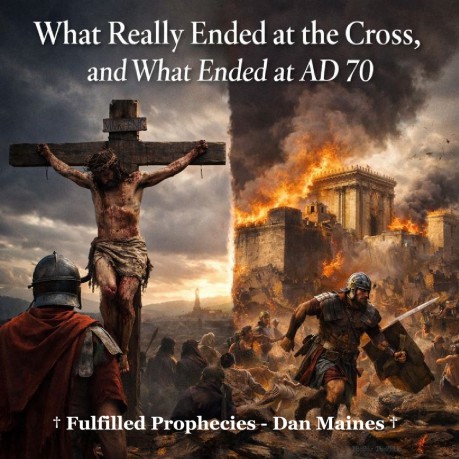
What
Really Ended at the Cross, and What Ended at AD 70 Introduction † Many confuse
the Cross and AD 70 as if they accomplished the same thing, Scripture
never treats them that way. John 19:30 † Redemption was
completed at the Cross, nothing was left unfinished concerning sin. Hebrews 9:26 † Sin was dealt
with once, not progressively over centuries. Matthew 27:51 † Access to God
was opened immediately at the Cross. Hebrews 8:13 † The old
covenant was legally obsolete at the Cross. Hebrews 9:8 † The old system
still stood outwardly even though access had already changed. 2 Corinthians 3:7-11 † Paul taught
the covenant was fading, not eternal. Matthew 24:34 † Jesus tied
covenant judgment to His own generation. Luke 21:22 † AD 70
fulfilled written judgment, not salvation. Hebrews 12:26-28 † The shaking
removed covenant structures, not the physical planet. † With
redemption completed and judgment fulfilled, Scripture now allows us
to state clearly how the Cross and AD 70 relate without
contradiction. Clarifying the Cross and AD
70 † The Cross
didn't make the old covenant vanish, it stripped it of authority. † From the Cross
to AD 70 there was an overlap period by God's design. † AD 70 didn't
bring redemption, it brought final removal. † Scripture
places the disappearance of the old covenant at a definite historical
point, AD 70. † This
distinction preserves the authority of the Cross and the words of
Jesus. Historical References † Josephus
recorded the total destruction of the temple system in AD 70. How It Applies To Us Today † We're not
waiting for forgiveness, it was finished at the Cross. † This is the fulfilled
perspective we proclaim at Fulfilled Prophecies †
By Dan Maines
† The Cross
finished redemption, AD 70 finished the covenant world that rejected
it.
† When we blur these two events, we end
up waiting for things Christ already secured.
Therefore
when Jesus had received the sour wine, He said, It is finished. And
He bowed His head and gave up His spirit.
†
Jesus didn't say it is started, He declared completion.
†
Forgiveness, reconciliation, and victory over sin were fully
accomplished here.
Otherwise,
He would have needed to suffer often since the foundation of the
world, but now once at the consummation of the ages He has been
manifested to put away sin by the sacrifice of Himself.
†
The Cross marked the consummation of the ages, not the beginning of
an unfinished process.
† Nothing in Scripture
suggests sin removal waited for a future event.
And
behold, the veil of the temple was torn in two from top to bottom,
and the earth shook, and the rocks were split.
† The
torn veil signaled the end of priestly mediation.
†
God was already declaring the temple obsolete before it fell.
When
He said, A new covenant, He has made the first obsolete. But whatever
is becoming obsolete and growing old is ready to disappear.
†
Something obsolete can still exist physically for a time.
†
Scripture itself places a transition period between the Cross and its
disappearance.
The
Holy Spirit is signifying this, that the way into the holy place has
not yet been disclosed while the outer tabernacle is still standing,
†
The Cross altered access before the building was removed.
†
This verse explains the overlap period between the Cross and AD 70.
But
if the ministry of death, in letters engraved on stones, came with
glory, so that the sons of Israel could not look intently at the face
of Moses because of the glory of his face, fading as it was, how will
the ministry of the Spirit fail to be even more with glory. For if
the ministry of condemnation has glory, much more does the ministry
of righteousness abound in glory. For indeed what had glory, in this
case has no glory because of the glory that surpasses it. For if that
which fades away was with glory, much more that which remains is in
glory.
†
Fading implies a process already underway.
†
What remained after AD 70 was already superior and permanent.
Truly
I say to you, this generation will not pass away until all these
things take place.
†
The passing of that generation marked the end of the old covenant
world.
† AD 70 wasn't redemption, it was
confirmation.
Because
these are days of vengeance, so that all things which are written
will be fulfilled.
†
Vengeance language belongs to covenant accountability.
†
This verse places fulfillment squarely in that generation.
And
His voice shook the earth then, but now He has promised, saying, Yet
once more I will shake not only the earth, but also the heaven. This
expression, Yet once more, denotes the removing of those things which
can be shaken, as of created things, so that those things which
cannot be shaken may remain. Therefore, since we receive a kingdom
which cannot be shaken, let us show gratitude, by which we may offer
to God an acceptable service with reverence and awe.
†
What remained after AD 70 was the unshakable Kingdom.
†
Believers were already receiving this Kingdom before the shaking
completed.
†
Hebrews says the old covenant was made obsolete, not immediately
removed.
† Obsolete means no longer binding,
even if it still existed outwardly.
†
During that time, the old covenant stood physically while fading
covenantally.
† This explains why the
apostles preached Christ while the temple still stood.
†
What lost authority at the Cross lost existence in AD 70.
†
The destruction of the temple ended sacrifices, priesthood, and
covenant identity permanently.
† The Cross marked the legal
end.
† AD 70 marked the historical end.
† It explains the transition period
without contradiction.
† It keeps our
teaching consistent with Scripture and history.
†
Eusebius testified that Jesus' words concerning that generation were
fulfilled.
† Tacitus confirmed the severity
and finality of Jerusalem's fall.
† No
priesthood, sacrifices, or temple worship have existed since AD 70.
†
We're not living between covenants, the old one's gone.
†
Our faith rests in completion, not anticipation.
†
Fear based religion survives only when AD 70 is ignored.
†
We live in what remains, not in what was shaken.
©
Fulfilled Prophecies - Dan Maines.
Source Index
† John 19:30;
Hebrews 9:26; Matthew 27:51; Hebrews 8:13; Hebrews 9:8; 2 Corinthians
3:7-11; Matthew 24:34; Luke 21:22; Hebrews 12:26-28
†
Josephus, Wars of the Jews
† Eusebius,
Ecclesiastical History
† Tacitus, Histories
Links