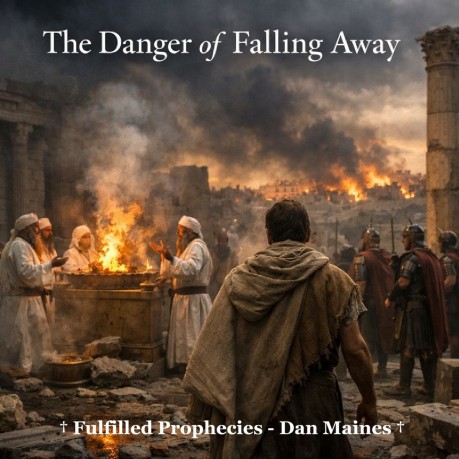
The Danger of Falling Away Introduction † This passage is written to those within the
covenant community who were being tempted to retreat back into the
old system rather than press forward in Christ. Hebrews 6:1-3 † The elementary teachings listed are
foundational Jewish covenant doctrines, not New Covenant
distinctives. Hebrews 6:4-6 † Enlightened describes covenant exposure, not
eternal security language. Hebrews 6:7-8 † The ground represents Israel under the
covenant. Historical References † Clement of Alexandria taught that Hebrews
warned Jewish believers against reverting to the Law after receiving
gospel light. A Clarification Concerning Sabbath Keepers † This warning in Hebrews isn't aimed at people
resting in Christ, it's aimed at those who, after coming to Christ,
turn back to covenant signs like Sabbath observance, ritual washings,
and law keeping as if Christ hasn't fulfilled them. How It Applies To Us Today † This passage warns against clinging to
religious systems once Christ has fulfilled them. † This is the fulfilled perspective we proclaim at
Fulfilled Prophecies † Source Index † Hebrews 6:1-8
By Dan Maines
†
Hebrews addresses the danger of abandoning Christ in favor of
returning to the shadows of the Law, not losing personal salvation in
a modern sense.
† The warning is covenantal,
historical, and urgent, tied to the transition period before
Jerusalem's destruction.
† Hebrews was
written during the last days of the Old Covenant, while that system
was still standing but ready to vanish away (Hebrews 8:13).
Therefore leaving the
elementary teaching about the Christ, let us press on to maturity,
not laying again a foundation of repentance from dead works and of
faith toward God, of instruction about washings and laying on of
hands, and about the resurrection of the dead and eternal judgment.
And this we will do, if God permits.
† Dead works refers to the
works of the Law that could never bring life or perfection.
†
Maturity is moving fully into the completed work of Christ, not
circling back to Mosaic rituals.
† Hebrews
later confirms this transition by stating the Old Covenant was
obsolete and near to disappearing (Hebrews 8:13).
For it is impossible, in the
case of those who have once been enlightened and have tasted of the
heavenly gift and have been made partakers of the Holy Spirit, and
have tasted the good word of God and the powers of the age to come,
and then have fallen away, to restore them again to repentance, since
they again crucify to themselves the Son of God and put Him to open
shame.
† Tasting doesn't
mean full possession, it means participation in the covenant
environment.
† Falling away is apostasy, a
deliberate return to the old covenant system that rejected Christ.
†
Restoring them again to repentance is impossible because there was no
other sacrifice beyond Christ.
† To return to
the Law was to side with those who crucified Him and deny His
finished work.
† This warning aligns with
Paul's teaching that returning to the Law nullifies grace and severs
one from Christ (Galatians 5:1-4).
For ground that drinks the
rain which often falls on it and produces vegetation useful to those
for whose sake it is also tilled, receives a blessing from God, but
if it yields thorns and thistles, it is worthless and close to being
cursed, and it ends up being burned.
† The same rain fell on all, yet
the response determined the outcome.
† Thorns
and thistles echo covenant curse imagery from the Law and the
prophets.
† Burned points to covenant
judgment, fulfilled in the destruction of Jerusalem, not eternal
torment language.
† Jesus used the same
vineyard judgment imagery when warning of Israel's coming destruction
(Matthew 21:33-45).
† Eusebius connected Hebrews
warnings with the impending judgment on Jerusalem.
†
John Chrysostom stated this passage addressed those abandoning Christ
for the old sacrifices.
† Josephus recorded
that Jerusalem and the temple were burned and the land left desolate
as a result of covenant judgment.
†
Hebrews defines falling away as a backward movement into the obsolete
covenant, not a struggle with personal faith or obedience.
†
Returning to covenant signs that pointed to Christ, after He's
fulfilled them, is the very regression Hebrews warns against.
†
The issue isn't sincerity, it's direction, pressing forward into
fulfillment or retreating back into shadows.
†
Early Christian writers consistently warned against returning to
Sabbath observance as a covenant obligation after Christ.
†
Ignatius taught that believers were no longer living according to the
Sabbath but according to the Lord's life, showing a clear break from
Mosaic covenant signs.
† Justin Martyr argued
that Sabbath keeping belonged to Israel under the Law and wasn't
binding on those in Christ, identifying it as a sign fulfilled in
Him.
†
It reminds us that spiritual growth means moving forward in faith,
not retreating into shadows.
† Any system
that replaces Christ's finished work with ritual obligation repeats
the same error.
† Modern Sabbath keeping
systems mirror the same backward movement Hebrews warned against,
returning to covenant signs that have already been fulfilled.
†
True rest isn't found in law keeping, it's found in remaining
grounded in Christ alone.
© Fulfilled Prophecies - Dan
Maines.
†
Hebrews 8:13
† Galatians 5:1-4
†
Matthew 21:33-45
† Clement of Alexandria,
Stromata
† Eusebius, Ecclesiastical History
†
John Chrysostom, Homilies on Hebrews
†
Josephus, Wars of the Jews, Book 6
Links