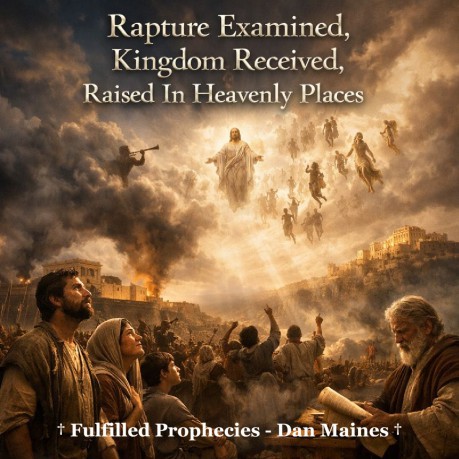
Rapture Examined, Kingdom
Received, Raised In Heavenly Places Introduction † The idea of a future rapture has become one
of the most assumed teachings in modern Christianity, yet it doesn't
come from the apostles, the prophets, or the early church. Colossians 1:13 He rescued us from the domain of darkness, and transferred us to
the kingdom of His beloved Son. † The verb transferred is past tense, not
future expectation, this action was already accomplished. Ephesians 2:4-6 But God, being rich in mercy, because of His great love with which
He loved us, even when we were dead in our transgressions, made us
alive together with Christ, by grace you have been saved, and raised
us up with Him, and seated us with Him in the heavenly places in
Christ Jesus. † Paul places resurrection, ascension, and
seating as one completed covenant act. Luke 17:20-21 Now having been questioned by the Pharisees as to when the kingdom
of God was coming, He answered them and said, The kingdom of God is
not coming with signs to be observed, nor will they say, Look, here
it is, or, There it is. For behold, the kingdom of God is in your
midst. † Jesus explicitly denied a visible, outward
arrival of the kingdom. Daniel 7:13-14 I kept looking in the night visions, and behold, with the clouds
of heaven One like a Son of Man was coming, and He came up to the
Ancient of Days and was presented before Him. † Clouds here signify divine authority and
enthronement, not physical travel through the atmosphere. 1 Thessalonians 4:15-17 For this we say to you by the word of the Lord, that we who are
alive and remain until the coming of the Lord, will not precede those
who have fallen asleep. † Paul repeatedly uses we and us, placing
fulfillment within his own generation. Isaiah 13:9-10 Behold, the day of the Lord is coming, cruel, with fury and
burning anger, to make the land a desolation, and He will exterminate
its sinners from it. † Cosmic language here describes judgment on
nations, not literal astronomical collapse. Hebrews 12:22-24 But you have come to Mount Zion and to the city of the living God,
the heavenly Jerusalem, and to myriads of angels, to the general
assembly and church of the firstborn who are enrolled in heaven, and
to God, the Judge of all, and to the spirits of the righteous made
perfect, and to Jesus, the mediator of a new covenant, and to the
sprinkled blood, which speaks better than the blood of Abel. † You have come is present reality, not future
hope. What The Heavenly Places Are † Heavenly places describe covenant standing,
authority, and access to God through Christ. Historical References † Josephus recorded the judgment on Jerusalem
using the same signs Jesus foretold. How It Applies To Us Today † We don't live waiting to disappear, we live
as citizens of the kingdom already received. † This is the fulfilled perspective we proclaim at
Fulfilled Prophecies † Source Index † Colossians 1:13; Ephesians 2:4-6; Luke
17:20-21; Daniel 7:13-14; 1 Thessalonians 4:15-17; Isaiah 13:9-10;
Hebrews 12:22-24 Common Futurist Objections To The Rapture, Answered From
Scripture † Objection: The rapture is clearly taught in 1
Thessalonians 4, believers are taken to heaven. † Objection: Being caught up proves physical
removal. † Objection: The kingdom hasn't come yet
because the world is still evil. † Objection: Heavenly places means heaven after
death. † Objection: The resurrection must be physical
because graves are mentioned. † Objection: The rapture wasn't taught clearly
because it was a mystery. † Objection: The early church believed in a
future rapture. † Objection: If Christ already came, why are we
still here. † Objection: Denying the rapture removes
hope. † Objection: This view spiritualizes the
Bible. † The simple truth is this: The rapture
doctrine requires reading Scripture through a futurist lens that the
Bible itself never uses. When the text is allowed to speak in its own
covenantal, historical, and prophetic context, the rapture
disappears, and the kingdom stands exactly where Scripture says it
is, already received, already reigning, already ours.
By Dan Maines
†
Scripture never teaches believers escaping the earth, instead it
teaches believers being transferred, raised, and seated in Christ.
†
This sermon will let Scripture define the kingdom, the resurrection,
the coming of Christ, and the heavenly places, without importing
futurist assumptions.
†
The movement described is covenantal, not geographical, from darkness
to light, from death to life.
† If believers
were already transferred into Christ's kingdom, there isn't any
biblical room for a future rapture into it.
†
Raised up doesn't describe physical elevation into the sky, it
describes covenant resurrection from death in Adam to life in
Christ.
† Being seated means sharing in
Christ's reign now, not waiting for a future bodily removal.
† If the kingdom
doesn't arrive by observation, it can't arrive by mass disappearance
either.
† The kingdom was present in Christ
and fully established through His death, resurrection, and judgment.
And to Him was
given dominion, glory, and a kingdom, that all the peoples, nations,
and men of every language might serve Him. His dominion is an
everlasting dominion which will not pass away, and His kingdom is one
which will not be destroyed.
†
The Son of Man comes to the Father, not away from the earth.
†
This passage defines the kingdom as already received, ruling, and
everlasting.
For the Lord Himself will descend from
heaven with a shout, with the voice of the archangel and with the
trumpet of God, and the dead in Christ will rise first.
Then we
who are alive and remain will be caught up together with them in the
clouds to meet the Lord in the air, and so we shall always be with
the Lord.
†
Trumpets and clouds are covenant judgment imagery rooted in the Old
Testament.
† Meeting the Lord reflects royal
reception language, not believers abandoning the earth.
For the stars of heaven and their
constellations will not flash forth their light, the sun will be dark
when it rises and the moon will not shed its light.
†
This establishes how prophetic imagery functions throughout
Scripture.
† Paul uses the same language
pattern in Thessalonians.
† Heavenly Jerusalem is a covenant
identity, not a physical location believers are waiting to reach.
†
Believers are already participating in the heavenly realm while
living on earth.
†
They contrast with the earthly shadows of the Mosaic system, temple,
and priesthood.
† Being seated with Christ
means reigning with Him now, not escaping creation later.
†
Eusebius affirmed Christ's coming in judgment occurred in that
generation.
† Irenaeus rejected escapist
eschatology and taught resurrection as transformation, not removal.
†
Clement of Alexandria taught believers already participate in
heavenly realities through Christ.
†
Our assurance rests in what Christ has already accomplished.
†
Resurrection life is lived now through faithfulness, obedience, and
covenant identity.
© Fulfilled Prophecies - Dan
Maines.
† Josephus, Wars of the
Jews
† Eusebius, Ecclesiastical History
†
Irenaeus, Against Heresies
† Clement of
Alexandria, Stromata
†
Answer: The text never says believers leave the earth or go to
heaven. Paul describes a meeting with the Lord using clouds,
trumpets, and descent, all established Old Testament judgment and
enthronement imagery. The language comes from Daniel, Isaiah, and the
Psalms, not from space travel concepts. Paul also places this event
in his generation by repeatedly saying we who are alive and remain.
† Answer: Caught up is not a
technical term for escape. The same language is used in prophetic and
royal reception settings where subjects go out to meet a coming king
and return with him in victory. Nothing in the passage says believers
leave creation or stay suspended in the sky.
† Answer:
Scripture never defines the kingdom by global morality. Jesus said
the kingdom does not come with observation and is not located by here
or there. The kingdom is defined by Christ's reign, not by the
absence of sin in the world. Colossians 1:13 says believers were
already transferred into it.
† Answer: Ephesians 2 places believers
already seated in heavenly places while still alive. Hebrews 12 says
believers have already come to the heavenly Jerusalem. Heavenly
places describe covenant access, authority, and identity in Christ,
not a future relocation.
† Answer:
Resurrection language in Scripture consistently describes covenant
transition from death to life. Paul explicitly contrasts natural and
spiritual bodies and places resurrection within redemptive history.
Ephesians 2 calls the living dead, and then raised, without leaving
their physical bodies.
† Answer: Mystery
in Scripture refers to something once hidden and now revealed, not
something delayed for thousands of years. Paul says the mystery was
revealed to his generation, not postponed to ours.
† Answer: There is no
documented belief in an escape based rapture in the early church.
Writers like Irenaeus, Clement, and Eusebius interpreted resurrection
and Christ's coming in covenantal and historical terms, not removal
from the earth.
† Answer: Scripture never says
Christ's coming ends human history. His coming ended the Old Covenant
age, judged Jerusalem, and established the everlasting kingdom.
Believers remain as citizens of that kingdom, living resurrection
life now.
† Answer: Our hope is not escape, it's
union with Christ, assurance, and kingdom life now. Scripture places
hope in what has been accomplished, not in fear driven timelines.
† Answer: Scripture itself defines how
prophetic language works. When God judged Egypt, Babylon, and Edom,
the same cosmic language was used without literal stars falling.
Letting Scripture interpret Scripture isn't spiritualizing, it's
biblical.
Links