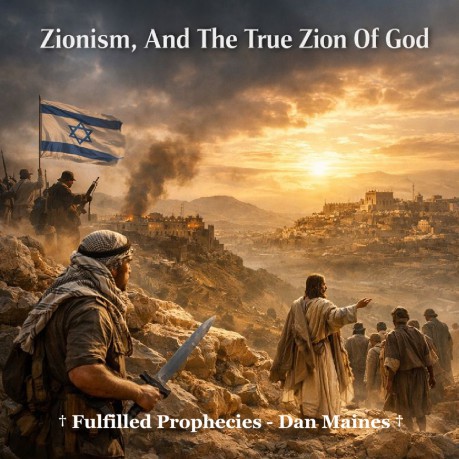
Zionism, And The True Zion Of
God Introduction † Zionism is a modern political movement, but
Scripture defines Zion long before modern nations existed. Psalm 87:1-3 His foundation is in the holy mountains. † Zion is first defined as God's dwelling
place, not merely a geographic territory. Isaiah 2:2-3 Now it will come about that † Zion here is connected to instruction,
covenant teaching, and the spreading of God's word. Galatians 4:24-26 This is allegorically speaking, for these women are two covenants,
one proceeding from Mount Sinai bearing children who are to be
slaves, she is Hagar. † Paul contrasts two Jerusalems, one earthly
and one heavenly. Hebrews 12:22-24 But you have come to Mount Zion and to the city of the living God,
the heavenly Jerusalem, and to myriads of angels, † Believers had already come to Mount Zion in
the first century. Revelation 21:2 And I saw the holy city, new Jerusalem, coming down out of heaven
from God, made ready as a bride adorned for her husband. † The New Jerusalem is not built by human hands
or political movements. Revelation 21:9-10 Then one of the seven angels who had the seven bowls full of the
seven last plagues came and spoke with me, saying, Come here, I will
show you the bride, the wife of the Lamb. † The bride and the city are the same
reality. Ephesians 2:19-22 So then you are no longer strangers and aliens, but you are fellow
citizens with the saints, and are of God's household, † Zion is a spiritual house made of living
people. Historical References † Eusebius identified the New Jerusalem as the
church established through Christ, not a future rebuilt city. How It Applies To Us Today † We don't look to political movements to
fulfill God's promises. † This is the fulfilled perspective we proclaim at
Fulfilled Prophecies † Source Index † Psalm 87:1-3; Isaiah 2:2-3; Galatians
4:24-26; Hebrews 12:22-24; Revelation 21:2, 9-10; Ephesians 2:19-22
By Dan Maines
†
Confusing political Zionism with biblical Zion reshapes prophecy, the
gospel, and the identity of God's people.
†
The Bible itself tells us what Zion is, who belongs to it, and when
it was fulfilled.
† Let's understand why
Zionism comes up so often today and why it gets confused with
biblical Zion. Modern Zionism arose in the late 19th and early 20th
centuries as a political response to persecution, nationalism, and
displacement, not as a movement born out of New Testament theology.
Many Christians support modern Zionism because they assume biblical
promises to Zion must still be fulfilled through a modern
nation-state, often based on a literal, futurist reading of Old
Testament prophecy. But Scripture itself defines Zion, and the rest
of the post will let the Bible speak for itself.
The Lord loves the
gates of Zion
More than all the other dwelling places of
Jacob.
Glorious things are spoken of you,
O city of God.
†
Scripture speaks of Zion in covenantal terms, tied to God's presence
among His people.
† The glory of Zion is
rooted in who dwells there, not in political control or borders.
In the last days
The
mountain of the house of the Lord
Will be established as the
chief of the mountains,
And will be raised above the hills,
And
all the nations will stream to it.
And many peoples will come
and say,
Come, let us go up to the mountain of the Lord,
To
the house of the God of Jacob,
That He may teach us concerning
His ways
And that we may walk in His paths.
For the law
will go forth from Zion
And the word of the Lord from Jerusalem.
†
All nations streaming to Zion rules out an ethnic or national
limitation.
† This vision points forward to
the Messianic age, not modern nationalism.
Now this Hagar is Mount Sinai in Arabia
and corresponds to the present Jerusalem, for she is in slavery with
her children.
But the Jerusalem above is free, she is our
mother.
† Present Jerusalem under
the old covenant is identified with slavery, not promise.
†
True inheritance belongs to the Jerusalem above, not to an earthly
city.
To the general
assembly and church of the firstborn who are enrolled in heaven, and
to God, the Judge of all, and to the spirits of the righteous made
perfect,
And to Jesus, the mediator of a new covenant, and to
the sprinkled blood, which speaks better than the blood of Abel.
† Zion is defined as the
church of the firstborn, not a future political state.
†
This passage places Zion within the New Covenant reality, not a
postponed fulfillment.
† Zion descends from
God, it isn't established by armies or governments.
†
The city is identified as a bride, pointing directly to God's
covenant people.
And he carried me away
in the Spirit to a great and high mountain, and showed me the holy
city, Jerusalem, coming down out of heaven from God.
† Zion is the covenant people of
God, not a geographic capital.
† Scripture
removes any doubt by interpreting itself.
Having
been built on the foundation of the apostles and prophets, Christ
Jesus Himself being the corner stone,
In whom the whole
building, being fitted together, is growing into a holy temple in the
Lord,
In whom you also are being built together into a dwelling
of God in the Spirit.
† Citizenship in Zion is covenantal,
not ethnic or national.
† God's dwelling
place is no longer a stone city but a redeemed people.
†
Augustine taught that the City of God is a spiritual kingdom
fulfilled in Christ and His people.
†
Josephus recorded the destruction of earthly Jerusalem, marking the
end of its covenant role.
† Our identity is
rooted in Christ, not in earthly nations or borders.
†
We live as citizens of the heavenly Zion right now, walking in New
Covenant life.
© Fulfilled Prophecies - Dan
Maines.
†
Eusebius, Ecclesiastical History
† Augustine,
The City of God
† Josephus, The Jewish War
Links