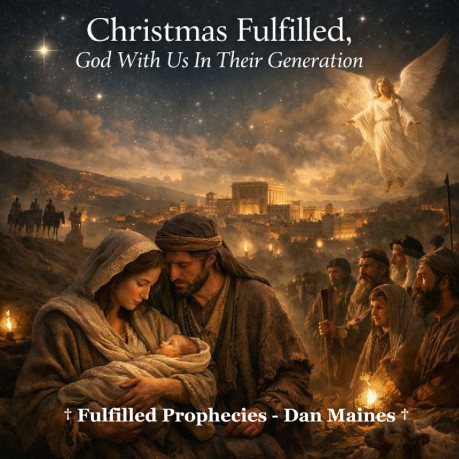
Christmas Fulfilled, God With
Us In Their Generation Introduction † Christmas is often treated as the beginning
of a future plan rather than the arrival of a fulfilled promise. Isaiah 7:14 Therefore the Lord Himself will give you a sign, Behold, a virgin
will be with child and bear a son, and she will call His name
Immanuel. † Isaiah identifies this birth as a sign, not a
vague hope, but a measurable event within Israel's covenant
timeline. Micah 5:2 But as for you, Bethlehem Ephrathah, † Micah connects the birth of the Messiah
directly to kingship, not a delayed reign. Matthew 1:21-23 She will bear a Son, and you shall call His name Jesus, for He
will save His people from their sins. † Matthew says all this took place, not some of
it, not part of it, but all of it. Luke 2:10-11 But the angel said to them, Do not be afraid, for behold, I bring
you good news of great joy which will be for all the people, † The angel locates the event in time, today,
not thousands of years later. Galatians 4:4-5 But when the fullness of the time came, God sent forth His Son,
born of a woman, born under the Law, † Paul identifies the timing of Christ's birth
as the fullness of the time, meaning nothing was missing and nothing
was waiting. Matthew 16:27-28 For the Son of Man is going to come in the glory of His Father
with His angels, and will then repay every man according to his
deeds. † Jesus places the completion of His kingdom
within the lifetime of His first century audience. Historical References † Justin Martyr affirmed that Christ's birth
fulfilled Isaiah's prophecy and marked the arrival of God dwelling
with His people. How It Applies To Us Today † Christmas reminds us that God keeps His
promises exactly when He says He will. † This is the fulfilled perspective we proclaim at
Fulfilled Prophecies † Source Index † Isaiah 7:14; Micah 5:2; Matthew 1:21-23; Luke
2:10-11; Galatians 4:4-5; Matthew 16:27-28
By Dan Maines
†
Scripture presents the birth of Christ as the decisive moment when
God entered history to complete what He had already spoken through
the prophets.
† The incarnation wasn't a
delay, a setup, or a symbolic gesture, it was the beginning of
fulfillment that reached its completion within that generation.
† Immanuel means God with us, not
God shown at a distance or postponed for another age.
†
Matthew explicitly states this prophecy was fulfilled in the birth of
Jesus, confirming Isaiah wasn't pointing to an indefinite future.
Too little to be among
the clans of Judah,
From you One will go forth for Me to be
ruler in Israel.
His goings forth are from long ago,
From
the days of eternity.
†
The ruler comes from Bethlehem, anchoring fulfillment to a historical
location and time.
† This prophecy expects
immediate authority, not a postponed kingdom centuries later.
Now all this took place to
fulfill what was spoken by the Lord through the prophet,
Behold,
the virgin shall be with child and shall bear a Son, and they shall
call His name Immanuel, which translated means, God with us.
† The
purpose of His birth is clearly stated, He will save His people from
their sins, not attempt to, not offer the possibility.
†
Christmas is inseparable from fulfillment because Scripture ties the
birth directly to completed prophetic action.
for
today in the city of David there has been born for you a Savior, who
is Christ the Lord.
† The birth of
Christ is announced as good news because it marks the arrival of
salvation, not the delay of it.
† The title
Christ the Lord confirms kingship from birth, not kingship postponed
until a future millennium.
so that He might redeem
those who were under the Law, that we might receive the adoption as
sons.
† Redemption is tied directly to
His coming, not to a later age.
† Christmas
marks the turning point where covenant transition moved from promise
to action.
Truly I say to you, there are some of those who are
standing here who will not taste death until they see the Son of Man
coming in His kingdom.
†
The kingdom announced at His birth is the same kingdom seen in power
before some standing there died.
† Christmas
begins a fulfillment arc that Scripture itself confines to that
generation.
† Irenaeus taught that the
incarnation was necessary for covenant completion, not merely a
prelude to another age.
† Tertullian argued
that Christ's advent initiated the decisive transition from the old
covenant to the new.
† Eusebius recorded that
the early church understood Christ's coming as the beginning of the
end of the old covenant order.
†
We're not waiting for God to come near, He already has.
†
Because Christ has come, fulfilled the Law, and completed redemption,
we live in access, confidence, and covenant life now.
© Fulfilled Prophecies - Dan
Maines.
†
Justin Martyr, Dialogue with Trypho
†
Irenaeus, Against Heresies
† Tertullian,
Against Marcion
† Eusebius, Ecclesiastical
History
Links