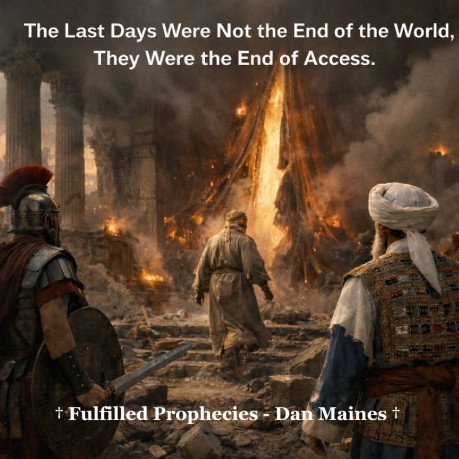
The Last Days Were Not the
End of the World, They Were the End of Access Introduction Most people hear the phrase "the last days" and
immediately think of the end of the planet, stars falling, oceans
boiling, and history collapsing into nothingness. But Scripture never
defines the last days that way. The Bible defines them covenantally,
not cosmically. The last days were not about God destroying the
world, they were about God removing a system that restricted access
to Him. From Genesis to Revelation, the central issue is not where people
live, but how they approach God. Sin did not destroy the earth, it
severed access. Redemption did not evacuate the earth, it restored
access. Judgment was never about annihilation, it was about removal. † The Bible's storyline is access, who can come
near, how they can come near, and what stands in the way. † End of the world language is often read
backward into the text. The prophets and apostles were addressing
covenant realities, not planetary destruction. † When access is ignored, prophecy is
misunderstood from Eden to AD 70. Access Lost in Adam Genesis 3:22-24 † Adam was not struck dead physically at that
moment. He was expelled. Death entered as separation from access to
God, not the end of biological life. † The guarded Tree shows the issue was never
the planet. The issue was access to life. † Humanity continued living east of Eden, but
outside covenant proximity. Access Restricted Under the Law Exodus 26:33 † What began in Eden became institutionalized
under the Law. Separation was now codified. † The veil did not invite approach, it enforced
distance. † God's presence existed, but access was
restricted by design. Leviticus 16:2 † Access was rare, dangerous, and conditional. † One man, one day, one location shows how
incomplete access still was. † The Law managed separation, it never removed
it. The Prophets Promised the Removal of Barriers Isaiah 25:7 † The prophets did not predict the destruction
of the world. † They foretold the removal of a covering that
blocked access. † The language is temple language, not cosmic
language. Isaiah 35:8 † A highway is restored access imagery. † God promised a way back, not an escape route. † Eden language begins to reappear through
prophecy. Christ Opened the Way John 10:9 † Jesus did not point to a future structure, He
identified Himself as access. † Entry is personal, immediate, and secure. † Freedom replaces fear where access is
restored. Matthew 27:50-51 † God tore the veil, man did not. † The barrier that began in Eden was declared
removed at the cross. † Access was opened before the temple fell. The Last Days and the End of Restricted Access Hebrews 9:8 † As long as the old system stood, access was
incomplete. † The last days marked the countdown to its
removal. † Judgment targeted the structure that
restricted access. Hebrews 10:19-20 † Access is described as present confidence,
not future hope. † What was inaugurated spiritually would be
completed historically. † The old and new overlapped briefly until the
old was removed. AD 70 and the Final Removal Matthew 24:1-2 † The destruction of the temple removed the
last physical symbol of restricted access. † God was not made homeless, He had already
taken up residence in His people. † Nothing remained that could block access
again. Living With Open Access Ephesians 2:18 † Access is now the permanent condition of
covenant life. † There is no veil to tear, no temple to enter,
no distance to cross. † We live from access, not toward it. How It Applies to Us Today † We do not approach God as outsiders seeking
permission. We live as those already welcomed. † Fear driven religion belongs to a system that
ended. Access produces confidence, not arrogance. † Prayer is not reaching up to a distant God,
it is fellowship within His dwelling. † When access is misunderstood, people replace
relationship with performance. † When access is understood, obedience flows
from identity, not fear. † The fulfilled perspective restores assurance
without diminishing reverence. Historical References Justin Martyr recognized the destruction of Jerusalem as divine
judgment tied to covenant transition. † This is the fulfilled perspective we proclaim at
Fulfilled Prophecies † Source Index
By Dan Maines
Then the LORD God said,
"Behold, the man has become like one of Us, knowing good and
evil, and now, he might stretch out his hand, and take also from the
tree of life, and eat, and live forever" therefore the LORD God
sent him out from the garden of Eden, to cultivate the ground from
which he was taken. So He drove the man out, and at the east of the
garden of Eden He stationed the cherubim and the flaming sword which
turned every direction to guard the way to the tree of life.
You shall hang up the veil
under the clasps, and shall bring in the ark of the testimony there
within the veil, and the veil shall serve for you as a partition
between the holy place and the holy of holies.
The LORD said to Moses, "Tell
your brother Aaron that he shall not enter at any time into the holy
place inside the veil, before the mercy seat which is on the ark, or
he will die; for I will appear in the cloud over the mercy seat."
And on this mountain He will
swallow up the covering which is over all peoples, Even the veil
which is stretched over all nations.
A highway will be there, a
roadway, And it will be called the Highway of Holiness. The unclean
will not travel on it, But it will be for him who walks that way, And
fools will not wander on it.
I am the door; if anyone enters
through Me, he will be saved, and will go in and out and find
pasture.
And Jesus cried out again
with a loud voice, and yielded up His spirit. And behold, the veil of
the temple was torn in two from top to bottom; and the earth shook
and the rocks were split.
The Holy Spirit is signifying
this, that the way into the holy place has not yet been disclosed
while the outer tabernacle is still standing.
Therefore, brethren, since
we have confidence to enter the holy place by the blood of Jesus, by
a new and living way which He inaugurated for us through the veil,
that is, His flesh.
Jesus came out from the
temple and was going away when His disciples came up to point out the
temple buildings to Him. And He said to them, "Do you not see
all these things? Truly I say to you, not one stone here will be left
upon another, which will not be torn down."
for through Him we both have
our access in one Spirit to the Father.
Josephus records the
complete destruction of the temple and the end of sacrifice in AD
70.
Eusebius connected the fall of Jerusalem to the fulfillment
of Jesus' warnings in the Gospels.
© Fulfilled Prophecies - Dan
Maines.
† Genesis
3:22-24; Exodus 26:33; Leviticus 16:2; Isaiah 25:7; Isaiah 35:8; John
10:9; Matthew 27:50-51; Matthew 24:1-2; Hebrews 9:8; Hebrews
10:19-20; Ephesians 2:18
† Josephus, The
Jewish War, Book 6
† Justin Martyr, Dialogue
with Trypho
† Eusebius, Ecclesiastical
History, Book 3
Links