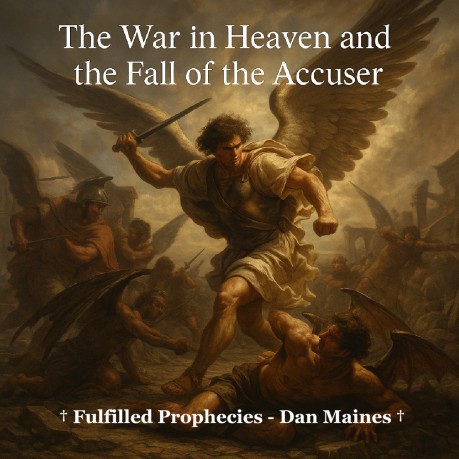
The War in Heaven and the
Fall of the Accuser Introduction Heaven as Covenant Realm, Isaiah 51:15-16 † God established heavens and earth when
forming Israel's covenant. Revelation 12:1-6, The Sign That Sets the Stage † The woman is faithful Israel, proven by
Genesis 37:9-10, where sun, moon, and stars represent Jacob, Rachel,
and the twelve tribes. The War in Heaven, Revelation 12:7-9 † Heaven is the covenant realm, not physical
sky. This war takes place where accusation and priesthood operated. The Loud Voice Declaring Victory, Revelation
12:10 † Salvation, power, the Kingdom, and the
authority of Christ arrive when the accuser is thrown down. That
means this event is covenantal. They Overcame Him, Revelation 12:11 † The Lamb's blood removes the condemnation of
the Law. Woe to the Land and the Sea, Revelation 12:12 † The short time is the same short time
repeated throughout Revelation. It refers to the closing years before
AD 70. The Dragon's Rage Against the Woman, Revelation
12:13-17 † The woman represents faithful Israel, the
covenant people who birthed the Messiah. Witness, Jude 6 † Jude connects angels, judgment, and covenant
rebellion. The Fall of the Accuser Is the Removal of the Law's
Condemnation † Death ruled through the Law. Daniel 7 Connection, The Kingdom and the Ending of the
Beast † Daniel 7 shows the saints receiving the
Kingdom when judgment is rendered against the beast. Historical References How It Applies to Us Today † This is the fulfilled perspective we proclaim at
Fulfilled Prophecies † Source Index
By Dan Maines
The Book of Revelation isn't
describing a future cosmic battle in outer space. It's a first
century covenant war. Heaven in prophetic language often refers to
the covenant realm where God's throne, authority, and priesthood
operate. Revelation 12 shows the removal of the Old Covenant accuser
whose power came from the Law. When the Law passed away, the
accuser's standing collapsed. This is the fulfilled perspective
Revelation presents.
Isaiah
51:15-16
For I am the Lord your God, who stirs up the sea and
its waves roar, the Lord of hosts is His name. I have put My words in
your mouth and have covered you with the shadow of My hand, to
establish the heavens, to found the earth, to say to Zion, You are My
people.
† This proves that
heaven often refers to covenant standing, not physical sky.
†
Revelation's heavenly war is therefore a covenantal transition, not a
cosmic meteorological event.
Revelation
12:1-6 describes the woman, the child, the dragon, and the woman's
flight into the wilderness.
† The male child is
Christ, and His being caught up to God shows the timeline begins in
the first century.
† The woman fleeing into
the wilderness for 1,260 days aligns perfectly with Jesus instruction
in Matthew 24:15-16 when He warned His disciples to flee Judea.
†
This roots Revelation 12 in their generation, exactly as Jesus
foretold.
Revelation
12:7-9
And there was war in heaven, Michael and his angels
waging war with the dragon. The dragon and his angels waged war, and
they were not strong enough, and there was no longer a place found
for them in heaven. And the great dragon was thrown down, the serpent
of old who is called the devil and Satan, who deceives the whole
world, he was thrown down to the earth, and his angels were thrown
down with him.
†
The dragon isn't losing a physical seat in a spatial heaven, he's
being expelled from covenant authority.
† The
Old Covenant was the system through which Satan accused Israel,
because the strength of sin was the Law, 1 Corinthians 15:56.
†
His fall signals the removal of the Law's condemning power.
Revelation 12:10
Then I heard a loud voice
in heaven, saying, Now the salvation, and the power, and the kingdom
of our God and the authority of His Christ have come, for the accuser
of our brethren has been thrown down, the one who accuses them before
our God day and night.
† The
accuser's power existed only as long as the Law remained. Once the
Law was fulfilled and removed, his accusations lost their legal
ground.
† This is why Hebrews 8:13 says the
Old Covenant was becoming obsolete and ready to disappear. Its
disappearance is Revelation 12's victory.
Revelation
12:11
And they overcame him because of the blood of the Lamb and
because of the word of their testimony, and they did not love their
life even when faced with death.
† The testimony of the saints stands
as evidence that they belonged to the New Covenant where no
accusation remains.
† This verse shows
persecution was happening in their generation, not ours.
Revelation
12:12
For this reason, rejoice, O heavens, and you who dwell in
them. Woe to the earth and the sea, because the devil has come down
to you, having great wrath, knowing that he has only a short time.
† Satan's activity intensifies during
the last days of the Old Covenant age, because his authority is about
to be ended.
† The heavens rejoice because
the New Covenant realm is freed from accusation. The land and the
sea, symbols of Israel and the nations, experience the final
convulsions of judgment.
Revelation 12:13-17 shows the dragon pursuing
the woman and her seed.
†
The persecution is historical, recorded by Jesus in Matthew 23 and
Matthew 24, and fulfilled in their generation.
†
The dragon's war is against the remnant of her seed, those who keep
the commandments of God and hold the testimony of Jesus. This is
first century covenant persecution.
Jude 6
And angels who
did not keep their own domain, but abandoned their proper abode, He
has kept in eternal bonds under darkness for the judgment of the
great day.
† Their judgment aligns with the
same great day that culminated in AD 70.
†
This supports Revelation 12 as a first century covenantal event.
1 Corinthians 15:56
The sting of
death is sin, and the power of sin is the law.
†
Accusation stood on the foundation of the Law.
†
Once the Law passed away, covenant death ended, and the accuser
fell.
† Revelation 12 is the heavenly
proclamation that the Old Covenant age has ended and the New Covenant
reign of Christ has arrived.
Daniel 7:21-22
I kept looking, and that horn
was waging war with the saints and overpowering them until the
Ancient of Days came and judgment was passed in favor of the saints
of the Highest One, and the time arrived when the saints took
possession of the kingdom.
†
Revelation 12 shows the accuser cast down at the same moment the
Kingdom arrives.
† Both visions describe the
same first century transition, fulfilled in the destruction of
Jerusalem.
† This confirms that the War in
Heaven is the covenantal fulfillment Daniel foresaw.
Early Christian
writers understood the conflict in Revelation as connected to the
first century crisis. Persecution under Nero, the Jewish War, and the
fall of Jerusalem form the historical backdrop. Eusebius, Josephus,
and others record the turmoil, confirming the short time of
intensified satanic activity before the destruction of the Temple.
We're not living
in the age of accusation. We're living in the age where the accuser
has fallen, where the Law that condemned has passed away, and where
the Kingdom of Christ stands fully established. We're not waiting for
victory. We're living in the results of victory. Satan's legal power
is gone, covenant death is gone, and access to God is open because
heaven has been cleansed.
† We're not
fighting an enemy Christ already defeated. We're living in the
fullness of His finished work and His completed Kingdom.
© Fulfilled Prophecies, Dan
Maines.
† Revelation
12:1-17, Genesis 37:9-10, Matthew 23, Matthew 24, Isaiah 51:15-16, 1
Corinthians 15:56, Hebrews 8:13, Jude 6, Daniel 7:21-22
†
Josephus, Wars of the Jews 5-6
† Eusebius,
Ecclesiastical History 2-3
Links