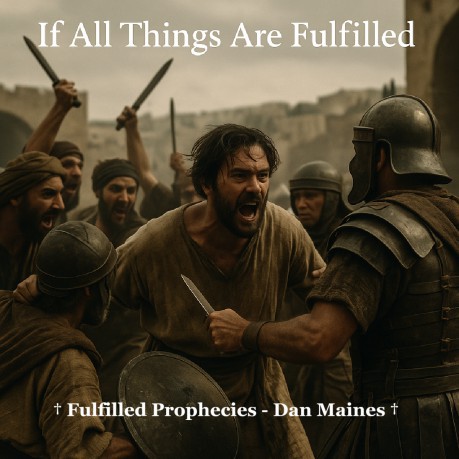
If All Things Are Fulfilled Introduction If all things are fulfilled, then Jesus kept every time statement
He spoke. The fulfilled perspective accepts His words exactly as He
gave them. The law, the prophets, the judgment, the resurrection, and
the kingdom reached covenant completion in the generation He
addressed. That means we live in the fullness of the new creation
today. Matthew 24:34 Luke 21:22 Acts 3:24 Acts 26:6 Romans 10:4 Hebrews 10:37 Hebrews 8:13 Revelation 1:3 Revelation 22:6 All Things That Were Fulfilled Redemption Colossians 1:13-14 Hebrews 9:12 Judgment Matthew 23:35-36 Luke 21:20-22 Resurrection 1 Corinthians 15:54-56 Philippians 3:10-11 Kingdom Matthew 16:27-28 Colossians 1:13 New Jerusalem Galatians 4:26 Revelation 21:2 End of the Age Matthew 24:3 Hebrews 9:26 Death Romans 6:23 1 Corinthians 15:56 New Creation 2 Corinthians 5:17 Galatians 6:15 Elect Gathered John 11:52 Ephesians 1:9-10 Spirit Outpoured Acts 2:16-18 Promises to the Fathers Acts 26:6-7 Romans 15:8 Restoration of All Things Luke 1:68-75 Prophets Fulfilled Acts 3:18 Acts 3:24 Heaven and Earth Changed Hebrews 12:26-28 2 Peter 3:10-13 Historical References † Josephus, Wars 6.2, records the destruction of Jerusalem
exactly as Jesus foretold. How It Applies to Us Today If all things are fulfilled, then we're not waiting for a future
kingdom or a future last days. We live in the everlasting kingdom
Christ established. We are not under the law's condemnation. We do
not fear a future judgment. We live in the completed new creation
that Christ secured through His finished work. Because all things are fulfilled, believers live in the fullness
of covenant life, restored access to God, and the assurance that
death's covenant power has been removed forever. † This is the fulfilled perspective we proclaim at
Fulfilled Prophecies † Source Index
By Dan Maines
Truly I say to you, this
generation will not pass away until all these things take place.
†
Jesus placed every prophetic event inside the lifetime of the people
standing before Him. This was the same covenant generation condemned
in Matthew 23, and the same generation that saw the end of the old
covenant age in AD 70.
† Jesus tied judgment,
resurrection, kingdom arrival, and the end of the age to one specific
generation, not multiple generations across history.
†
The phrase this generation always refers to the generation Jesus was
speaking to. Not once in scripture does it ever mean a far future
group.
† If His words failed, He would not be
the Messiah. But they did not fail. Every event He described unfolded
exactly when He said it would, proving the fulfilled perspective is
simply taking Jesus at His word.
Because these are days of
vengeance, so that all things which are written will be fulfilled.
†
All things which are written refers to the prophetic writings of
Israel. Jesus tied the complete fulfillment of prophecy to the
destruction of Jerusalem, showing the end of the old covenant age in
their generation.
† The phrase days of
vengeance echoes Deuteronomy 32, where Moses warned of Israel's
covenant breaking and the destruction that would follow. Jesus
identifies His generation as the one Moses foresaw.
†
When Jesus says all things written, He includes Daniel, Zechariah,
Isaiah, Joel, and every prophet. Nothing is left unfulfilled.
†
This eliminates futurist speculation. If Jesus said all things
written were fulfilled in the fall of Jerusalem, then prophecy is not
waiting for a modern completion.
And likewise, all the prophets who
have spoken, from Samuel and his successors onward, have also
announced these days.
† Peter declares that
the prophets announced these days, not future days thousands of years
removed. Fulfillment was happening right then, in the first
century.
† These days refers to the last days
of the old covenant age, the very days when the Messiah appeared and
judgment was approaching.
† If the prophets
announced their days, then the last days were already unfolding,
confirming that the prophetic timeline was reaching its completion.
†
Futurism collapses under this verse. Peter locates fulfillment in his
own generation, not ours.
And now I am standing trial for
the hope of the promise made by God to our fathers.
Acts
26:7
The promise to which our twelve tribes hope to
attain, as they earnestly serve God night and day. And for this hope,
O King, I am being accused by Jews.
† Paul
preached the arrival of the promise given to Israel, not its
postponement. Christ fulfilled the covenant promises in the same
generation that rejected Him.
† The hope of
Israel included resurrection, the kingdom, forgiveness, and
restoration. Paul said this hope was arriving, not delayed for
thousands of years.
† Paul never separated
Christianity from Israel's promises. He declared they were being
fulfilled through Christ in their own time.
For Christ is the end of the Law
for righteousness to everyone who believes.
†
Christ brought the law's condemnation to its appointed end. The old
covenant's power to condemn was removed through His finished work.
†
The destruction of the temple in AD 70 publicly ended the law's
sacrificial and priestly system, confirming the new covenant as the
only standing covenant.
† If Christ is the
end of the law, then the law cannot continue past the destruction of
the old covenant age. Fulfillment belongs to the first century, not
our future.
For yet in a very little
while, He who is coming will come, and will not delay.
†
A very little while does not mean thousands of years. The writer
expected Christ's coming within their lifetime.
†
Hebrews connects this coming directly to the removal of the old
covenant system and the judgment on Jerusalem.
†
The verse ends any futurist timeline. The inspired author said He
would not delay.
When He said, A new covenant,
He has made the first obsolete. But whatever is becoming obsolete and
growing old is about to disappear.
† The old
covenant was already fading away when Hebrews was written. It had not
disappeared yet because the temple was still standing.
†
In AD 70, the temple fell and the old covenant system vanished
exactly as Hebrews predicted.
† This proves
beyond doubt that the end of the age was the end of the old covenant
age, not the end of world history.
Blessed is the one who reads
and those who hear the words of the prophecy, and keep the things
which are written in it, for the time is near.
†
Revelation opens with a clear and unmistakable statement that its
events were near, not distant.
† Near means
near. John did not confuse his audience. He told them the prophecy
concerned their time.
† Revelation cannot be
separated from Jesus' teaching in Matthew 24. Both are anchored to
the same generation and the same judgment.
And the Lord, the God of the
spirits of the prophets, sent His angel to show to His bond servants
the things which must soon take place.
Revelation
22:10
Do not seal up the words of the prophecy of this
book, for the time is near.
† Daniel was told
to seal his prophecy because fulfillment was far off. John was told
not to seal his prophecy because fulfillment was near.
†
This proves Revelation was for the first century, not our modern
age.
† The end of the old covenant age and
the destruction of Jerusalem are the context, timing, and fulfillment
of Revelation.
Ephesians 1:7
In
Him we have redemption through His blood, the forgiveness of our
trespasses, according to the riches of His grace.
†
Redemption was the release from the law's condemnation. Christ
fulfilled it completely.
For He rescued us from
the domain of darkness, and transferred us to the kingdom of His
beloved Son, in whom we have redemption, the forgiveness of sins.
†
Redemption is not future. It arrived fully in Christ before AD 70,
and was revealed covenantally when the old system ended.
And not through the blood of
goats and calves, but through His own blood, He entered the holy
place once for all, having obtained eternal redemption.
†
Eternal redemption was already obtained before the temple fell. AD 70
manifested it through the end of the old covenant structure.
Deuteronomy
32:35-36
Vengeance is Mine, and retribution, for the
Lord will vindicate His people.
† Moses
predicted the judgment on Israel for breaking the covenant.
Truly I say to you, all
these things will come upon this generation.
†
Jesus places covenant judgment on the first century generation.
Because these are days of
vengeance, so that all things which are written will be fulfilled.
†
Jesus identifies Jerusalem's fall as the fulfillment of covenant
judgment.
1 Corinthians
15:21-22
For as in Adam all die, so also in Christ all
will be made alive.
† Adam brought biological
mortality into the world, but Paul is speaking of covenant death, the
condemnation that came through the law.
Death is swallowed up
in victory... The power of sin is the law.
†
Resurrection is the removal of the law's condemnation, not biological
change.
That I may attain to the
resurrection from the dead.
† Paul is seeking
covenant resurrection, the release from the old covenant world of
death.
Daniel 7:13-14
His
dominion is an everlasting dominion.
† Christ
received the kingdom at His ascension.
Some standing here will not
taste death until they see the Son of Man coming in His kingdom.
†
The kingdom arrived in their generation.
He rescued us and
transferred us into the kingdom.
† The
kingdom was already present before AD 70.
Hebrews 12:22-24
You
have come to Mount Zion, the heavenly Jerusalem.
†
The New Jerusalem was already accessible.
The Jerusalem above is free,
she is our mother.
† The true Jerusalem is
covenantal.
The holy city, new
Jerusalem, coming down out of heaven.
†
Revealed fully when the old city was destroyed.
Matthew 13:39-40
The
harvest is the end of the age.
† Not the end
of the physical world, but the end of the old covenant age.
What will be the sign of the
end of the age?
† Jesus answers with the
destruction of Jerusalem.
He has been manifested at the
consummation of the ages.
† Christ appeared
in the transition between the old covenant age and the new.
Romans 5:12
Through
one man sin entered into the world, and death through sin.
†
Adam introduced biological mortality, but the death Paul teaches is
covenant death, the condemnation that came through the law.
The wages of sin is death.
†
This is the death produced by sin's relationship to the law, not
physical death.
The power of sin is the
law.
† Paul defines this death as the law's
power to condemn. That death ended when the old covenant ended.
Isaiah 65:17
For
behold, I create new heavens and a new earth.
†
This is covenant restoration, not a change in the physical universe.
If anyone is in Christ,
he is a new creature.
† New creation life is
already present in Christ.
A new creation is what
matters.
† The new covenant people are the
new creation.
Matthew 24:31
He
will gather His elect.
† This occurred at the
end of the old covenant age.
To gather together into one the
children of God.
† Christ gathered the elect
into one covenant body.
The summing up of all
things in Christ.
† The elect were gathered
into one new covenant body.
Joel 2:28-29
I
will pour out My Spirit.
† Fulfilled in Acts
2.
This is what was spoken of
through the prophet Joel.
† Peter confirms
the outpouring was fulfilled in their generation.
Acts
13:32-33
We preach that God has fulfilled this
promise.
† Paul declares fulfillment in their
day.
The hope of our twelve tribes.
†
Paul says this hope was happening in their generation.
Christ to confirm the promises
given to the fathers.
† Christ completed
them.
Acts
3:21
The period of restoration of all things.
†
Occurring in the apostolic era.
He has visited and accomplished
redemption.
† Restoration was underway
through Christ.
Luke 24:44
All
things written must be fulfilled.
† Jesus
declares total fulfillment.
God fulfilled what He announced
through the prophets.
† Fulfillment occurred
in their generation.
All the prophets announced these
days.
† Their days, not ours.
Matthew
5:17-18
Until heaven and earth pass away.
†
This refers to the old covenant world.
The removal of things that
can be shaken.
† The old covenant was
removed.
New heavens and a new
earth.
† The new covenant world.
† Eusebius, Ecclesiastical History
3.7, confirms Matthew 24 was fulfilled in the fall of Jerusalem.
†
Clement of Alexandria taught that the old covenant ended with the
destruction of the temple.
† Tertullian affirmed that Israel's
prophetic judgments reached fulfillment in the days of the apostles.
© Fulfilled Prophecies - Dan
Maines.
† Matthew
24:34, Luke 21:22, Acts 3:24, Acts 26:6-7, Romans 10:4, Hebrews 8:13,
Hebrews 10:37, Revelation 1:3, Revelation 22:6, Revelation 22:10,
Ephesians 1:7, Colossians 1:13-14, Hebrews 9:12, Deuteronomy
32:35-36, Matthew 23:35-36, Luke 21:20-22, 1 Corinthians 15:21-22, 1
Corinthians 15:54-56, Philippians 3:10-11, Daniel 7:13-14, Matthew
16:27-28, Colossians 1:13, Hebrews 12:22-24, Galatians 4:26,
Revelation 21:2, Matthew 13:39-40, Matthew 24:3, Hebrews 9:26, Romans
5:12, Romans 6:23, 1 Corinthians 15:56, Isaiah 65:17, 2 Corinthians
5:17, Galatians 6:15, Matthew 24:31, John 11:52, Ephesians 1:9-10,
Joel 2:28-29, Acts 2:16-18, Acts 13:32-33, Acts 26:6-7, Romans 15:8,
Acts 3:21, Luke 1:68-75, Luke 24:44, Acts 3:18, Acts 3:24, Matthew
5:17-18, Hebrews 12:26-28, 2 Peter 3:10-13
Links