Understanding the Fulfilled
View Revelation 11:8 † This identifies Babylon directly. The great
city is the place where the Lord was crucified. That is Jerusalem.
Scripture interprets scripture. There is no guesswork. Revelation
uses covenant imagery, but it points to a real covenant city. † Jerusalem is called Sodom and Egypt because
she had taken on the character of the nations. The covenant people
had become the persecutors. This was not Rome. Rome never crucified
the Lord in their city. Only Jerusalem matches this description. † The prophets consistently condemned Jerusalem
for covenant rebellion. Revelation continues that pattern. The great
city is the covenant city under judgment for rejecting her Messiah. Revelation 17:6 † The city guilty of killing the prophets and
the saints is Jerusalem. Jesus said that all the righteous blood
would fall on that generation in Jerusalem. Revelation is not
redefining that truth. It is applying it in the final covenant
judgment. † Babylon is not Rome. Rome killed some
Christians, but Rome never killed the prophets. Revelation says the
harlot had been drunk with the blood of the prophets long before the
first century church. Only Jerusalem fits that biblical history. † Revelation shows the culmination of that
guilt. The harlot had filled up the measure of her sins. The judgment
was the destruction of the old covenant world in AD 70. Matthew 23:29-37 † Jesus Himself identifies the city that kills
the prophets. It is Jerusalem. He declares that all the covenant
blood would fall on that generation. Revelation simply shows the
fulfillment of what Jesus already said. † The guilt was not symbolic. It was covenantal
and historical. The leaders of Jerusalem filled up the measure of
their fathers. The judgment Jesus promised fell on them in the
destruction of the city. † Jesus connects the judgment directly to that
generation. This matches perfectly with Revelation's timeline. The
harlot's fall is the fall of Jerusalem. Luke 13:33-35 † Jesus taught plainly that Jerusalem was the
city that killed the prophets. Revelation does not give a new city
that holds this identity. It continues the same covenant accusation. † The desolation of the house is the
destruction of Jerusalem. Revelation presents that judgment with
apocalyptic imagery, but the fulfillment is the historical fall of
the city in AD 70. † The covenant house was left desolate because
the people rejected their Messiah. The new covenant world could not
begin until the old covenant house fell. 1 Thessalonians 2:14-16 † Paul confirms the same pattern. Those who
killed the Lord and the prophets were the Jews of Jerusalem. He says
wrath had come upon them. This is the same wrath Jesus predicted and
Revelation describes. † Scripture consistently identifies the
persecuting city. There is no biblical basis for shifting Babylon to
Rome. The inspired writers all point to Jerusalem as the covenant
breaker. † The wrath that came upon them is the covenant
judgment that culminated in AD 70. Paul saw the process unfolding.
Revelation shows the final act. Historical References How It Applies To Us Today † This is the fulfilled perspective we proclaim at
Fulfilled Prophecies † Source Index Series
- Understanding the Fulfilled View 01 The Time Statements Mean What
They Say Website
Facebook -
https://www.facebook.com/groups/1349070089314462/posts/1894198244801641/ Facebook -
https://www.facebook.com/groups/1349070089314462/posts/1894198808134918/ Facebook -
https://www.facebook.com/groups/1349070089314462/posts/1894199314801534/ Facebook -
https://www.facebook.com/groups/1349070089314462/posts/1894199971468135/ Facebook -
https://www.facebook.com/groups/1349070089314462/posts/1894200534801412/ Facebook -
https://www.facebook.com/groups/1349070089314462/posts/1894201221468010/ Facebook -
https://www.facebook.com/groups/1349070089314462/posts/1894201884801277/ Facebook -
https://www.facebook.com/groups/1349070089314462/posts/1894202518134547/ Facebook -
https://www.facebook.com/groups/1349070089314462/posts/1894203221467810/ Facebook -
https://www.facebook.com/groups/1349070089314462/posts/1894203778134421/
By Dan Maines
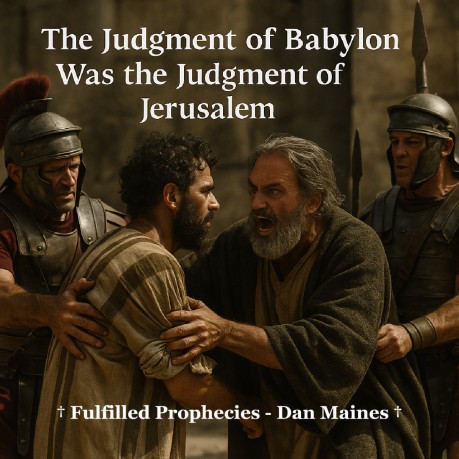
The Judgment of Babylon Was the Judgment of Jerusalem
Part
6 of 10, all posted same day, links at bottom
And their dead bodies will
lie in the street of the great city which mystically is called Sodom
and Egypt, where also their Lord was crucified.
And I saw the woman drunk
with the blood of the saints, and with the blood of the witnesses of
Jesus. When I saw her, I wondered greatly.
Woe to you, scribes and
Pharisees, hypocrites, for you build the tombs of the prophets and
adorn the monuments of the righteous, and say, If we had been living
in the days of our fathers, we would not have been partners with them
in shedding the blood of the prophets. So you testify against
yourselves, that you are sons of those who murdered the prophets.
Fill up, then, the measure of the guilt of your fathers. You
serpents, you brood of vipers, how will you escape the sentence of
hell? Therefore, behold, I am sending you prophets and wise men and
scribes, some of them you will kill and crucify, and some of them you
will scourge in your synagogues, and persecute from city to city, so
that upon you may fall the guilt of all the righteous blood shed on
earth, from the blood of righteous Abel to the blood of Zechariah,
the son of Berechiah, whom you murdered between the temple and the
altar. Truly I say to you, all these things will come upon this
generation. Jerusalem, Jerusalem, who kills the prophets and stones
those who are sent to her.
Nevertheless I must journey on
today and tomorrow and the next day, for it cannot be that a prophet
would perish outside of Jerusalem. Jerusalem, Jerusalem, the city
that kills the prophets and stones those sent to her. How often I
wanted to gather your children together, just as a hen gathers her
brood under her wings, and you would not have it. Behold, your house
is left to you desolate.
For you, brethren,
became imitators of the churches of God in Christ Jesus that are in
Judea, for you also endured the same sufferings at the hands of your
own countrymen, even as they did from the Jews, who both killed the
Lord Jesus and the prophets, and drove us out. They are not pleasing
to God, but hostile to all men, hindering us from speaking to the
Gentiles so that they may be saved, with the result that they always
fill up the measure of their sins. But wrath has come upon them to
the utmost.
Early Christian
writers recorded the destruction of Jerusalem as the fulfillment of
Jesus words. These writings do not create doctrine, but they
acknowledge the historical reality of the judgment that scripture
already promised.
Jerusalem's fall
shows the faithfulness of Christ. He kept His word, brought an end to
the old covenant world, and established the new covenant kingdom. We
live in that kingdom. We live in the world where righteousness
dwells. The judgment of Jerusalem was not the end of hope. It was the
beginning of the new creation in Christ. The covenant promises stand
fulfilled, and the kingdom continues to increase without end.
© Fulfilled Prophecies - Dan
Maines.
† Revelation
11:8, Revelation 17:6, Matthew 23:29-37, Luke 13:33-35, 1
Thessalonians 2:14-16
02 Audience Relevance,
Their Generation Website
03 The End of the Age Was
Not the End of the World Website
04 The Last Days Were
Their Last Days, Not Ours Website
05 The Coming of the Son
of Man Was a Judgment Coming Website
06 The Judgment of Babylon
Was the Judgment of Jerusalem Website
07 What Heaven and Earth
Meant in Scripture Website
08 The Kingdom Arrived in
the First Century Website
09 The Resurrection Was a
Covenant Resurrection Website
10 The New Creation Is
Covenant Restoration in Christ Website
Links