Understanding the Fulfilled
View Introduction Jesus Taught Imminence, Not Delay Matthew 10:23 Matthew 16:27-28 The Olivet Discourse Fixes the Time Matthew 24:34 Luke 21:22 The Apostles Repeated the Same Deadline Romans 13:11-12 Hebrews 10:37 James 5:8-9 1 Peter 4:7 Revelation Continues the Pattern Revelation 1:1-3 Revelation 22:6 How Scripture Interprets Scripture How It Applies To Us Today † This is the fulfilled perspective we proclaim at
Fulfilled Prophecies † Source Index Series
- Understanding the Fulfilled View 01 The Time Statements Mean What
They Say Website
Facebook -
https://www.facebook.com/groups/1349070089314462/posts/1894198244801641/ Facebook -
https://www.facebook.com/groups/1349070089314462/posts/1894198808134918/ Facebook -
https://www.facebook.com/groups/1349070089314462/posts/1894199314801534/ Facebook -
https://www.facebook.com/groups/1349070089314462/posts/1894199971468135/ Facebook -
https://www.facebook.com/groups/1349070089314462/posts/1894200534801412/ Facebook -
https://www.facebook.com/groups/1349070089314462/posts/1894201221468010/ Facebook -
https://www.facebook.com/groups/1349070089314462/posts/1894201884801277/ Facebook -
https://www.facebook.com/groups/1349070089314462/posts/1894202518134547/ Facebook -
https://www.facebook.com/groups/1349070089314462/posts/1894203221467810/ Facebook -
https://www.facebook.com/groups/1349070089314462/posts/1894203778134421/
By Dan Maines
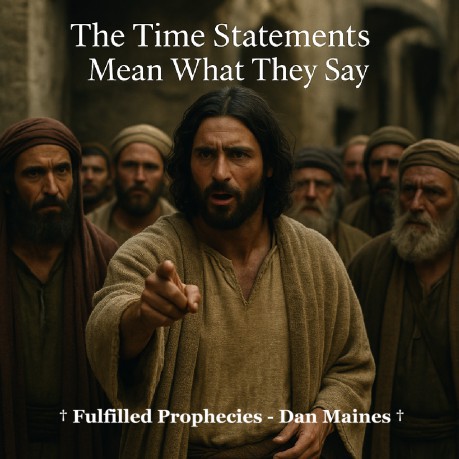
The Time Statements Mean What They Say
Part 1 of 10,
all posted same day, links at bottom
Jesus and the apostles did not
speak vaguely about timing. They spoke with clarity, urgency, and
direct relevance to their own generation. When we let scripture
interpret scripture, the time statements stand as some of the
strongest proof of fulfilled eschatology. The New Testament repeats
the same message again and again, declaring that the end of the age,
the coming of the Son of Man, the judgment on Jerusalem, and the
establishing of the kingdom would happen soon, shortly, at hand, and
within that generation. This post lets scripture speak for itself
without adding human tradition.
But whenever they persecute
you in one city, flee to the next, for truly I say to you, you will
not finish going through the cities of Israel until the Son of Man
comes.
† Jesus was not speaking in riddles or
allegory. He told His disciples directly that His coming would occur
before they finished their mission in Israel. This was not about the
end of the physical universe but about the end of the covenant
order.
† If futurists were right, this verse
makes Jesus wrong, because the disciples died two thousand years ago
and never finished preaching to every city on earth. But Jesus wasn't
talking about the whole world. He spoke of the cities of Israel,
proving the coming He referenced was tied to Israel's judgment in the
first century.
† Scripture interprets itself.
Matthew 10, Matthew 16, and Matthew 24 all describe the same event.
Jesus never separated His coming from that generation or that
mission.
For the Son of Man is going
to come in the glory of His Father with His angels, and will then
repay every person according to his deeds. Truly I say to you, there
are some of those who are standing here who will not taste death
until they see the Son of Man coming in His kingdom.
†
Jesus anchored the timing to living people standing in His presence.
Not symbolic people, not future believers, not a distant church age.
Real individuals hearing His voice. Some would still be alive when He
came.
† Futurism forces Jesus to be wrong by
pushing His coming thousands of years away. But Jesus put it within
the lifetime of those listening. He did not say maybe, or might, or
possibly. He said truly I say to you.
† This
verse alone destroys the futurist framework. If the coming of the Son
of Man didn't happen when Jesus said it would, then His words failed.
But His words didn't fail. They were fulfilled in that generation.
Truly I say to you, this
generation will not pass away until all these things take place.
†
Jesus gave an unbreakable time marker. This generation means the
generation He was speaking to, just as throughout the entire Gospel
of Matthew. The same people He rebuked in Matthew 23 were the ones
who would see the events of Matthew 24.
†
Futurists have to redefine generation into something it never means
anywhere in scripture. They stretch it into thousands of years to
protect their tradition, but Jesus spoke plainly. The disciples asked
about the destruction of the temple they were looking at, and Jesus
answered them directly.
† Nothing in Matthew
24 suggests a second meaning for a later age. Jesus tied the entire
prophecy to His own generation, and scripture confirms it all
throughout the New Testament.
Because these are the days of
punishment, so that all things which have been written will be
fulfilled.
† Jesus declared that the
destruction of Jerusalem would fulfill all things written, meaning
the prophetic expectations of Israel's covenantal end. No other event
in history fits the description Jesus gave.
†
This connects directly to Daniel 12, the shattering of the holy
people. It also connects to Hosea, Micah, Isaiah, Jeremiah, and all
other covenant judgment prophecies.
†
Scripture interprets scripture. Jesus didn't say some things written.
He said all things written. This ends futurism immediately.
Do this, knowing the time,
that it is already the hour for you to awaken from sleep, for now
salvation is nearer to us than when we first believed. The night is
almost gone, and the day is near.
† Paul
wasn't telling them about something far off in the future. He told
them the day was near, the night was almost gone. These words have no
meaning if the event is thousands of years away.
†
Salvation here is covenantal deliverance from the Old Covenant order
that was about to vanish. Hebrews 8:13 confirms the same.
†
The urgency is real. The apostles lived in the last days of the Old
Covenant world.
For yet in a very little
while, He who is coming will come, and will not delay.
†
God said He would not delay. Futurism accuses God of delay. Scripture
contradicts futurism.
† A very little while
does not mean two thousand years. No one in their right mind would
interpret language that way outside of religious conditioning.
†
Hebrews was written just before AD 70, urging believers not to fall
back into the doomed Old Covenant system.
You too be patient, strengthen
your hearts, for the coming of the Lord is near. Do not complain,
brothers and sisters, against one another, so that you may not be
judged, behold, the Judge is standing right at the door.
†
James' language matches Jesus exactly in Matthew 24:33. Near. At the
door. Not symbolic. Not delayed.
† James
wasn't confused. He spoke by the Spirit, confirming Jesus'
timeline.
† There is no theological reason to
move this event to the future except to protect tradition.
The end of all things is near,
therefore, be of sound judgment and sober spirit for the purpose of
prayer.
† Peter didn't say the end will be
near someday. He said it was near when he wrote.
†
The end of all things refers to the Old Covenant heaven and earth
system, not the globe.
† Again, scripture
interprets scripture. The end was covenantal, not cosmic.
The Revelation of Jesus
Christ, which God gave Him to show to His bond servants the things
which must soon take place, and He sent and communicated it by His
angel to His bond servant John, who testified to the word of God and
to the testimony of Jesus Christ, everything that he saw. Blessed is
the one who reads and those who hear the words of the prophecy, and
keep the things which are written in it, for the time is near.
†
Revelation opens with timing that can't be twisted. Must soon take
place. The time is near. God didn't lie.
†
Futurists treat these words as meaningless. But scripture doesn't
allow that. God told the truth.
† Everything
in Revelation fits the first century context, including the beast,
the harlot, and the fall of the city where the Lord was crucified.
These words are faithful and
true, and the Lord, the God of the spirits of the prophets, sent His
angel to show His bond servants the things which must soon take
place.
† The book ends exactly as it began.
Soon means soon. Near means near.
† Scripture
interprets scripture. God did not confuse His people.
†
The end of Revelation confirms the beginning. Nothing is postponed.
†
When we compare Matthew 24, Romans, Hebrews, James, 1 Peter, and
Revelation, every writer uses the same timing language. No writer
ever points to a far future generation. The consistency is perfect.
†
Jesus promised judgment on that generation, and every apostle
affirmed the nearness of His coming. The New Testament is in total
unity about the timing.
† Futurism collapses
completely when scripture interprets scripture.
†
Fulfillment strengthens faith. Jesus kept His word exactly as He
said.
† We now live in the fully established
New Covenant kingdom without waiting for fear, wrath, or
destruction.
† Understanding fulfilled
prophecy removes confusion and restores confidence in the authority
of Jesus' teaching.
© Fulfilled Prophecies - Dan
Maines.
† Matthew
10:23, Matthew 16:27-28, Matthew 24:34, Luke 21:22, Romans 13:11-12,
Hebrews 10:37, James 5:8-9, 1 Peter 4:7, Revelation 1:1-3, Revelation
22:6
02 Audience Relevance,
Their Generation Website
03 The End of the Age Was
Not the End of the World Website
04 The Last Days Were
Their Last Days, Not Ours Website
05 The Coming of the Son
of Man Was a Judgment Coming Website
06 The Judgment of Babylon
Was the Judgment of Jerusalem Website
07 What Heaven and Earth
Meant in Scripture Website
08 The Kingdom Arrived in
the First Century Website
09 The Resurrection Was a
Covenant Resurrection Website
10 The New Creation Is
Covenant Restoration in Christ Website
Links