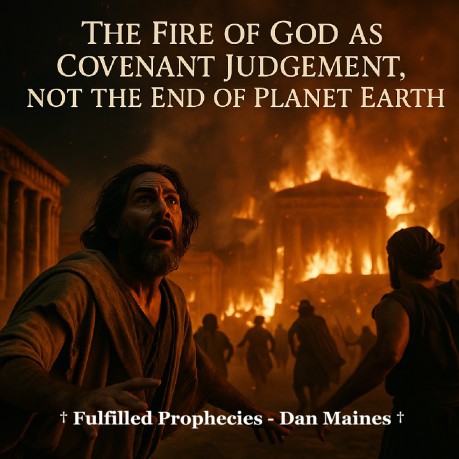
The Fire Of God As Covenant
Judgment, Not The End Of Planet Earth Introduction The Prophets Defined Fire As Covenant Judgment † Jeremiah spoke of God's fire kindled in His
anger against Jerusalem, Jeremiah 4:4; 21:12. The fire was the
Babylonian destruction. The earth did not melt, the land of Judah
did. Jeremiah 4 uses cosmic language, but the chapter is clearly
about Jerusalem's fall under Babylon, not the end of the universe. † Ezekiel said God would rain fire on Gog,
Ezekiel 38:22, yet the context is covenant vindication for God's
people, not the annihilation of the cosmos. God uses fire to defend
His covenant and judge those who rise against it. † Malachi described the coming of the Lord as a
refiner's fire, Malachi 3:2-3. Fire purifies the righteous and
destroys the wicked. The context is the priesthood of Israel. This is
covenantal, not cosmic. Malachi ends with the warning that God's fire
would leave Old Covenant Israel like stubble, Malachi 4:1, and that
is exactly what happened in AD 70 when Jerusalem and the temple were
burned. † Every fire prophecy was spoken to people
living under the Old Covenant, and every warning targeted their
covenant world, not ours. Isaiah, Jeremiah, Ezekiel, Malachi, John
the Baptist, and Jesus Himself spoke to Israel, not to a future
civilization. Fire was the symbol of God's wrath against that
covenant people in that generation, Matthew 23:36; Matthew 24:34.
Audience relevance locks these prophecies into the first century and
removes the futurist escape hatch entirely. † When Jesus warned of fire, desolation, and
the end of the age in Matthew 24, He quoted Isaiah, Joel, and Daniel
to show that He was fulfilling their covenant fire prophecies. The
same language the prophets used for Babylon's destruction becomes the
language Jesus uses for Jerusalem's. This proves that prophetic fire
is covenantal and typological, not geological or planetary. Jesus Continued The Prophetic Fire Theme † Jesus repeated this same covenant message. In
Matthew 13:40-43 He said the fiery judgment is the removal of
stumbling blocks from the kingdom at the end of the age. Jesus
defines that age as the Old Covenant age ending in their generation,
Matthew 24:3; 24:34. The fire falls on that covenant world, not on
the globe. † Jesus warned the scribes and Pharisees that
they would not escape the sentence of hell, Matthew 23:33. That hell
is Gehenna, the valley outside Jerusalem that had become the symbol
of covenant judgment. It is not a literal underground torture
chamber, it is the picture of Jerusalem's coming destruction, tied
directly to AD 70 in the same chapter. The Fire Of AD 70 Fulfilled These Prophecies † This fire purified the covenant people. It
removed the corrupt priesthood, ended animal sacrifices, and closed
the Old Covenant age. It opened the everlasting kingdom where
righteousness dwells, fulfilling 2 Peter 3:7-13 in covenant terms,
not astronomical ones. The heavens and earth that were stored up for
fire were the Old Covenant heavens and earth, not the starry sky and
the dirt under our feet. † Nothing in scripture points to a fiery
destruction of planet earth. Every single fire text in the prophets
is about covenant judgment on Israel or surrounding nations. Futurism
rips the imagery from its covenant context and tries to push it
thousands of years past the audience Jesus addressed. Once you keep
the time statements and the covenant framework in place, the fire of
God is exactly where Jesus and the prophets put it, on Old Covenant
Israel in that generation. † Peter wasn't warning the Romans, Greeks, or
the globe. He was warning the same Jewish audience he addressed at
Pentecost, Acts 2:14-40. The heavens and earth reserved for fire, 2
Peter 3:7, were the covenant heavens and earth of the Mosaic order.
Peter applies Malachi's fire to their world, not ours. The one New
Heavens and New Earth promised in Isaiah 65-66 arrived when the Old
Covenant world was destroyed in AD 70. † The temple was the heart of the Old Covenant
world, so its burning was the definitive sign that God's covenant
fire had fallen. No temple, no priesthood, no sacrifices, no Mosaic
age. Once the temple was gone, the Old Covenant world was gone
forever. That is exactly what Jesus meant when He said not one stone
would be left upon another, Matthew 24:2. † Futurism depends on global fire because it
refuses to acknowledge covenant fire. But scripture never once
teaches the destruction of planet earth. The Bible begins with
creation and ends with covenant renewal, not cosmic obliteration. The
fire fell exactly where the prophets said it would, on Old Covenant
Israel, and it happened exactly when Jesus said it would, in their
generation. Historical References How It Applies To Us Today † This is the fulfilled perspective we proclaim at
Fulfilled Prophecies † Source Index
By Dan Maines
† The
prophets never used fire to describe the destruction of the physical
cosmos. Fire is the language of covenant judgment, God acting against
His covenant breaking people. From Isaiah to Malachi, and from John
the Baptist to Jesus Himself, fire represents the purifying,
consuming judgment that fell on Old Covenant Israel in AD 70. When we
let the prophets define their own symbolism, every futurist claim
collapses. Fire is not about the end of planet earth, it is about the
end of the covenant world that stood under Moses.
†
Isaiah declared that God would burn the Assyrians who threatened
Jerusalem in his generation, Isaiah 31:9. That fire did not consume
the planet, it consumed a covenant breaking enemy. Isaiah
consistently uses fire as judgment on nations and covenant violators,
not on creation itself, Isaiah 30:27-30; 33:10-14.
†
John the Baptist warned that the coming Messiah would baptize Israel
with the Holy Spirit and fire, Matthew 3:11-12. The chaff is burned
with unquenchable fire. This is the judgment of that generation.
Matthew 3 ties it to the axe already laid at the root of the trees.
Judgment was near for Israel then, not for planet earth two thousand
years later.
†
The destruction of Jerusalem by Rome in AD 70 matches every prophetic
fire text. The temple burned. The city burned. Josephus recorded that
no one could stop the flames and that the Roman soldiers set fire to
the temple against the will of their commanders. God removed the Old
Covenant system exactly as Jesus said in Matthew 22:7, where the king
sent his armies, destroyed those murderers, and burned their city.
†
Josephus, Wars of the Jews, Book 6, records the burning of the temple
and city and the uncontrollable spread of the fires.
†
Tacitus, Histories 5, confirms Rome's siege, famine, and the
consuming fire of Jerusalem.
† Eusebius,
Ecclesiastical History, Book 3
†
God's covenant fire has already fallen. The Old Covenant world was
judged and removed. We now stand in the everlasting kingdom that
cannot be shaken. We don't fear global destruction, because scripture
never promised such a thing. The fire already purified God's people
when Jerusalem fell in AD 70. Our hope isn't escape from a burning
planet, our hope is the finished work of Christ and the fully
established kingdom we now live in.
© Fulfilled Prophecies - Dan
Maines.
† Isaiah
30:27-30; 31:9; 33:10-14; Jeremiah 4:4, 21; Jeremiah 21:12; Ezekiel
38:22; Malachi 3:2-3; Malachi 4:1; Matthew 3:7-12; Matthew 13:40-43;
Matthew 22:7; Matthew 23:33; Matthew 24:3, 34; 2 Peter 3:7-13
Links