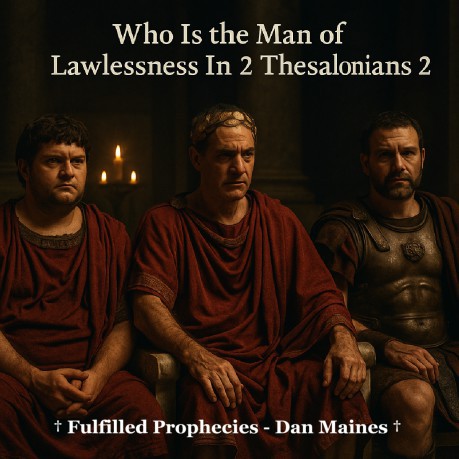
Who Is The Man Of Lawlessness
In 2 Thessalonians 2 Introduction Warning this post is not short. Its for the serious Berean.
Paul wrote 2 Thessalonians to calm believers who feared the Day of
the Lord had already come. He reminded them that certain things had
to happen first. From the fulfilled perspective, every sign Paul
listed was fulfilled in the first century. The man of lawlessness was
a real first century figure, not a future world ruler. Understanding
who he was confirms that Paul was warning about events in his own
generation, not ours. The Text Itself 2 Thessalonians 2:3 2 Thessalonians 2:4 2 Thessalonians 2:6-7 2 Thessalonians 2:8 The Man Of Lawlessness Identified † Paul said the mystery of lawlessness was
already at work in the first century. This means Paul was not
predicting someone 2,000 years later. It was already active in his
time. † The man of lawlessness rises during the
apostasy. The great falling away was happening inside Israel during
the generation leading up to AD 70, as Jesus foretold in Matthew 23
and Matthew 24. † The man of lawlessness sits in the temple of
God. This alone confines the fulfillment to the first century,
because the Jerusalem temple was destroyed in AD 70 and has never
been rebuilt. † He exalts himself as God. This matches
perfectly with the Roman Caesars of that era who demanded divine
honors. Nero, Vespasian, and Titus were all called gods, worshiped as
gods, and honored with sacrifices and incense. † Paul said the Lord would destroy this figure
with the breath of His mouth at His coming. That is exactly what
happened in AD 70 when Jesus returned in judgment against Jerusalem
and the persecuting power of Rome. † This figure is the same persecuting ruler
Jesus warned about. The same Beast of Revelation. The same little
horn that spoke arrogant words in Daniel 7. The same ruler who
exalted himself above every god in Daniel 11:36. Additional Strengthening On The Apostasy † The apostasy was the great covenantal
rebellion inside Israel during the generation leading to AD 70. Jesus
said Jerusalem would be left desolate because they rejected Him,
rejected the prophets, and rejected the gospel. The book of Acts
shows Israel stirring riots, rejecting Paul, persecuting believers,
and resisting the message. That is the apostasy Paul predicted, and
it was happening right in front of him. The Fulfilled Identification The man of lawlessness is the Roman Caesar of Paul's generation,
specifically the line of Caesars that persecuted the saints leading
up to the destruction of Jerusalem. Nero fits the beginning of the
rise of lawlessness. Vespasian and Titus complete the pattern as the
ones who carried out the destruction of the city and the temple. He was not a future antichrist. He was the living embodiment of
Roman imperial lawlessness against God's covenant people during the
last days of the Old Covenant age. † He sat in the temple, through Roman
authority, dictating the fate of Jerusalem. This perfectly matches Paul's timeline, language, and context. Additional Clarification On Other Claims Some say the man of lawlessness was John Levi of Gischala or
Eleazar ben Simon. Others say it's the antichrist, the Beast, or even
Satan himself. But none of those options fit Paul's requirements. † Paul said this figure would sit in the temple
of God. John of Gischala and Eleazar ben Simon were inside Jerusalem,
but they never fulfilled Paul's description of exalting themselves as
God above every so called god or object of worship. Josephus records
both men as zealot leaders driven by political control and rebellion,
not as men demanding divine worship. They never matched the imperial
self deification of the Caesars. Josephus, Wars 4.3, 4.5. † Paul also said this figure would be destroyed
by the appearance of Christ's coming. John and Eleazar both survived
the siege. John was taken to Rome in chains, and Eleazar was captured
and removed. Neither one was slain by the parousia judgment that
ended the Old Covenant age. Josephus, Wars 6.9.4. † Some say it's Satan, but Satan was not
sitting in the temple, nor was Satan being restrained by a political
force that had to be removed. Paul clearly described a man whose
actions were visible, political, and tied directly to the temple
system. † Some point to a future antichrist or a future
Beast. But Paul said the mystery of lawlessness was already at work
in his day. He tied the fulfillment to the living temple that still
stood. He tied it to the parousia Jesus said would occur in that
generation. Satan, a spirit, does not sit in temples. Future
antichrists do not fit a first century temple context that no longer
exists. Those alternative views do not match the timing, the context, or
the historical fulfillment Paul required. The Roman Caesars fit every
detail without forcing anything. Additional Clarification On The Phrase Sat In The Temple
Of God Many claim Nero, Vespasian, and Titus did not sit in the temple,
so they cannot be the man of lawlessness. But this misunderstands the
biblical and first century meaning of the phrase. † In Scripture, sitting in the temple does not
require a man to physically walk into the Holy Place and sit on a
chair. It means taking authority over the temple, ruling it, claiming
control of its functions, and placing oneself above God's covenant
order. This is how the phrase is used in Isaiah, Jeremiah, Ezekiel,
and in the Second Temple period. † Roman Caesars absolutely exercised that
authority. They appointed high priests. They removed high priests.
They controlled the temple treasury. They dictated temple policy.
They overruled Jewish law. They claimed divine titles and demanded
obedience from the very priesthood that served in that temple. That is sitting in the temple. † Josephus says the Romans took seats of
judgment inside the temple grounds during the siege. Titus entered
the temple area repeatedly. Roman soldiers set up their ensigns in
the temple courts, offered sacrifices to them, and proclaimed Titus
as lord and god. Josephus, Wars 6.6.1, 6.6.2. That is sitting in the temple. † The phrase seat in the temple is a covenantal
authority term. Just like Matthew 23:2 says the scribes and Pharisees
sat in Moses' seat, even though there was no literal chair called the
Moses seat. It meant authority, not furniture. The Romans sat in
Moses' seat in the temple by taking the authority that belonged only
to God. † Paul was not predicting a man walking into
the Holy of Holies and sitting on the Ark. He was describing a ruler
placing himself over God's covenant people and God's holy place,
claiming divine status, ruling from the position of authority that
belonged to God alone. Nero began it by claiming divinity and persecuting the saints.
Vespasian and Titus completed it by taking literal control of the
temple, overruling its system, entering its courts, offering
sacrifices to their standards, and destroying it at the coming of the
Lord. This objection does not weaken the case. It actually strengthens
it, because no future ruler can ever sit in a temple that no longer
exists, and no zealot leader ever had the imperial authority that
Scripture calls sitting in the temple. Additional Clarification On Who The Man Of Lawlessness Is So, are we saying the man of lawlessness is Nero, Vespasian, and
Titus? Yes, and here is why. † Paul describes one man of lawlessness, but
that man represents the living head of the persecuting Roman power at
that moment. Rome was a single imperial office that continued through
successive Caesars. When one Caesar died, another took that same seat
of divine pretension, that same authority over the temple, that same
persecution of the saints, and that same blasphemous exaltation. † In biblical prophecy, the office can remain
the same even as individual rulers change. † Nero begins the rise of lawlessness, starts
the persecution of the saints, claims divinity, and unleashes the
mystery of lawlessness that Paul says was already at work. The three are not three separate fulfillments. They are the single
prophetic office carried through three successive Caesars during the
final generation of the Old Covenant age. That is why the prophecy perfectly fits the Roman Caesars as the
man of lawlessness. Additional Clarification On Why The Text Says Man, Not Men Many point out that Paul uses the singular phrase the man of
lawlessness and argue that this means it must be one individual only.
But Scripture consistently uses singular prophetic titles for offices
held by multiple rulers. † Daniel 7 refers to one Beast, but it spans
multiple kings. This is the biblical prophetic pattern. Different individuals, one prophetic man. Additional Clarification On Galba, Otho, Vitellius, And
Titus Some ask why Galba, Otho, and Vitellius are not included if Nero,
Vespasian, and Titus fulfill the prophetic office, and why Titus
fulfills the prophecy before officially taking office in AD 79. This
is clarified by understanding the prophetic structure and the history
of the year of the four emperors. † Galba, Otho, and Vitellius never fulfilled
Paul's requirements. They did not display themselves as divine, did
not claim worship as gods, did not sit in authority over the
Jerusalem temple, did not persecute the saints, did not participate
in the Jewish War, did not interact with the temple system, did not
match Daniel 11:36, did not match the lawlessness already at work in
Paul's day, did not survive long enough to exercise imperial
stability, and did not participate in the judgment that ended the Old
Covenant age. They came and went in a brief civil war and had no
covenant relevance. † The prophecy requires a ruler directly
connected to the temple crisis of AD 66-70. Galba, Otho, and
Vitellius were fighting for survival in Rome while Vespasian was
conducting the Judean campaign. They had no role in the Jewish War. † Nero inaugurated the persecution and divine
claims. Prophecy is fulfilled by actions tied to the judgment on
Jerusalem, not by the legal date of coronation. Nero began it, Vespasian carried it, Titus finished it. Additional Clarification On The Restrainer † The restrainer fits the political stability
under Claudius, whose rule held back Nero's destructive impulses.
When Claudius died, Nero's lawlessness exploded, matching Paul's
words that something was restraining but would soon be removed. † Others note that Roman governors like Gallio
and Felix protected Paul and slowed Jewish persecution. Once they
were removed, persecution intensified exactly as Paul warned. This shows the restrainer was a real first century power the
Thessalonians already knew. Additional Clarification On Daniel 11 † Daniel 11:36 describes a ruler who exalts
himself above every god, speaks monstrous things, prospers until the
indignation is finished, then is destroyed. This matches the Caesars
perfectly and ties Paul's prophecy directly to Second Temple history. Additional Clarification On Why It Was Not Constantine Some claim the man of lawlessness must be Constantine because he
blended church and empire and held significant religious influence.
But Constantine does not fit Paul’s prophecy or Daniel’s
timeline. † Daniel 11:36 is tied to the Second Temple
period, not the fourth century. Constantine lived centuries after the
indignation was finished. He cannot fit a prophecy anchored to the
final days of the Old Covenant age. † Paul tied the man of lawlessness to a still
standing temple. Constantine never saw it, never interacted with it,
and lived long after it was destroyed in AD 70. † Paul said the mystery of lawlessness was
already at work in his day. Constantine lived 250 years later. † Constantine never persecuted the saints.
Paul’s man of lawlessness persecuted and opposed the covenant
community. Constantine legalized and favored the church. † Constantine did not exalt himself above every
god or claim to be divine. The Caesars in Paul’s generation
demanded divine worship and received sacrifices. † Constantine cannot fit any Old Covenant
markers. The prophecy required the first century temple, the first
century apostasy, the first century restrainer, and the AD 70
judgment. Constantine does not fit any part of the context. Additional Clarification On Why No Future Fulfillment Is
Possible † Paul tied the prophecy to the temple standing
in his own day. Once the temple fell in AD 70, the prophecy could
never again be fulfilled. No future ruler can sit in a temple that no
longer exists. This eliminates futurism completely. Historical References Josephus records the arrogance, blasphemy, and self exaltation of
the Caesars during the Jewish War, especially Nero, Vespasian, and
Titus. Tacitus describes their brutality, their divine titles, and the
way they demanded worship. Suetonius records Nero calling himself the savior of the world and
demanding honor as a god. Every historical detail matches Paul's description of the man of
lawlessness. How It Applies To Us Today We are not waiting for a future antichrist. The man of lawlessness
was a first century ruler whose actions fulfilled Paul's prophecy
before the temple fell. We live in the fulfilled kingdom where Christ
reigns without rival. The powers that opposed Him have been judged.
The enemies He warned about have been removed. Our calling today is
not fear, speculation, or watching for signs. Our calling is
confidence in the finished work of Christ, boldness in the fulfilled
kingdom, and assurance that no man of lawlessness will ever rise
again to threaten what He has already completed. † This is the fulfilled perspective we proclaim at
Fulfilled Prophecies † Source Index
By Dan Maines
Let no one in any way deceive you, for it
will not come unless the apostasy comes first, and the man of
lawlessness is revealed, the son of destruction.
Who opposes and exalts himself above
every so called god or object of worship, so that he takes his seat
in the temple of God, displaying himself as being God.
And you know what restrains him now, so
that in his time he will be revealed. For the mystery of lawlessness
is already at work, only he who now restrains will do so until he is
taken out of the way.
Then that lawless one will be revealed
whom the Lord will slay with the breath of His mouth and bring to an
end by the appearance of His coming.
†
He exalted himself as a god.
† He persecuted
the saints.
† His power was restrained, then
released.
† He was destroyed by the coming of
the Lord in AD 70.
Daniel 7 shows one
Beast with multiple heads.
Revelation 13 shows one Beast with
multiple heads.
Revelation 17 shows one Beast carried through
multiple kings.
The high priest was one office held by many men.
†
Vespasian takes the same imperial office, inherits Nero's
persecution, takes control over Jerusalem, and positions Titus to
fulfill the final destruction.
† Titus
completes the prophecy by taking authority over the temple, sitting
in judgment within its courts, accepting divine acclamation,
receiving sacrifices to the Roman standards, and destroying the
temple at the coming of the Lord.
† Daniel 11 refers to one
king, but the description covers a succession.
†
Revelation 13 refers to one Beast with seven heads, each head a
different king.
† Revelation 17 calls the
Beast one, even as the kings change.
† The
high priest was one man, yet many different men held the office.
† Vespasian fulfilled the role by
taking command of the Jewish War and inheriting Nero's office.
†
Titus fulfilled the climax by commanding the siege, entering the
temple precincts, taking seats of judgment, accepting divine
acclamation, receiving sacrifices to Roman standards, and destroying
the temple at the parousia judgment, all years before his coronation
in AD 79.
© Fulfilled Prophecies - Dan
Maines.
† 2
Thessalonians 2:1-12, Daniel 7, Daniel 11:36, Matthew 23, Matthew
24
† Josephus, Wars of the Jews 4-6
†
Tacitus, Annals 15
† Suetonius, Lives of the
Caesars
Links