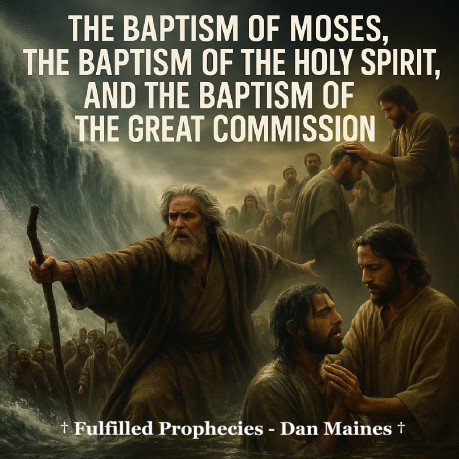
The Baptism Of Moses, The
Baptism Of The Holy Spirit, And The Baptism Of The Great Commission Introduction † Baptism in scripture is never a random
ritual. Each major baptism represents a covenantal transition, a
passing through judgment into a new life with God. From Moses leading
Israel through the sea, to Christ baptizing His church with the
Spirit, to the apostles baptizing the nations under the Great
Commission, each baptism marks a new covenant reality. And every one
of these baptisms reaches its fulfillment in the completed work of
Christ by AD 70 when the Old Covenant world passed away and the New
Covenant stood fully established. The Baptism Of Moses † Paul connects Israel's crossing of the Red
Sea with baptism. It wasn't a water ritual they performed, it was a
covenantal transition God performed on them. 1 Corinthians 10:1-2 † Israel passed through waters of judgment,
leaving Egypt behind and entering a covenant relationship through
Moses. This baptism wasn't about getting wet. It was about
deliverance, separation, and covenant identity. It was God bringing
His people through death into life. † Baptism represents passing from the old
creation into the new creation. Israel passed through the waters of
the Red Sea, and we pass through the waters of baptism. Both point to
God bringing His people into a new world. The early believers entered
the new creation as the old world was ending. Today we enter that
same world through baptism. The Baptism Of The Holy Spirit † John the Baptist declared plainly that Jesus
would bring a greater baptism. Matthew 3:11 † This is the baptism that defines the New
Covenant. It's the outpouring of God's presence, the giving of His
life, the sealing of His people, and the empowerment to be witnesses. Acts 1:5 † Acts 2 records this fulfillment at Pentecost,
the dawn of the New Covenant age. This baptism equipped the early
church to proclaim the kingdom that was arriving in fullness before
the end of that first century generation. † By AD 70, Christ had fully judged the Old
Covenant system, removed the temple, and established His new creation
kingdom where His Spirit dwells in His people. † John's baptism was a final call to repentance
for Israel before judgment fell on the Old Covenant world. Christ's
baptism brought the Spirit and the new creation. John's baptism
belonged to the fading age, but Spirit baptism belongs to the age
that cannot end. The Baptism Of The Great Commission † Jesus tied baptism to discipleship, teaching,
and the spread of the fulfilled kingdom to all nations. Matthew 28:18-20 † Notice two things: † The Great Commission baptism isn't about
ritual alone. It's about bringing people into covenant relationship
with the Father, Son, and Spirit. † And Jesus ties this mission directly to the
end of the age, the same age He said would end within their
generation. The apostles carried the gospel to the nations before the
destruction of Jerusalem, fulfilling Colossians 1:23 which says the
gospel had been proclaimed in all creation under heaven. † Baptism in the Great Commission is the
outward sign of entering the fulfilled kingdom Christ established. † Under the Old Covenant, circumcision marked
covenant identity. Under the New Covenant, baptism marks covenant
identity. The outward sign changed because the covenant changed.
Baptism is the sign of the kingdom that was fully established when
the Old Covenant system ended. Why Baptism Matters Today † Baptism isn't a ritual we perform to earn
anything. It's a covenant declaration that we belong to Christ. In
the first century it marked the transition from the Old Covenant
world into the New Covenant kingdom. Today it marks our union with
the finished work of Christ. We aren't baptized to get saved. We're
baptized because Christ already completed redemption and we're
publicly identifying with His fulfilled kingdom. It's an outward sign
of an inward reality, the reality that we've entered the life He
already secured. † Baptism places us publicly inside the
covenant people of God. It declares that we belong to the body Christ
established and finished. It's not an initiation into a future
kingdom. It's identification with the kingdom that's already here. Is Baptism Required † Baptism isn't required to be saved, forgiven,
resurrected, or included in Christ. Salvation was finished by Christ
alone. Baptism is a covenant sign, not a covenant requirement. It
doesn't add anything to what Jesus already did. It doesn't cause
salvation, it doesn't activate salvation, and it doesn't complete
salvation. It simply declares publicly that we belong to the kingdom
that Christ already fulfilled. † People were saved before baptism, people were
saved without baptism, and Paul himself said Christ did not send him
to baptize but to preach the gospel, which makes no sense if baptism
was required. † Baptism is important as a sign, but Christ
alone is the substance. What Baptism Does Not Mean † It doesn't mean we're washed physically to
change our spiritual condition. It doesn't mean we're waiting for
forgiveness. It doesn't mean water itself has power. It doesn't mean
we're joining a future age. Baptism doesn't add to Christ's work. It
points to it. The power is not in the water. The power is in the
finished work of Jesus. Baptism is our confession that the kingdom is
here, judgment is finished, and resurrection life is ours through
Him. What It Means To Be Baptized Into His Death And
Resurrection Romans 6:3-5 † To be baptized into His death means we die to
the Old Covenant order, the body of sin, and everything Adam
represented. To be baptized into His resurrection means we rise with
Him into the New Covenant creation. It's not waiting for a future
resurrection. It's participation in His already accomplished
resurrection life. Baptism declares that the old world has passed,
the new has come, and we share in His victory over death. † Baptism symbolizes the removal of the body of
death that belonged to Adam and the Old Covenant world. When we go
under the water we picture that body passing away, and when we rise,
we picture the resurrection life of Christ that we now share. Why Baptism Still Has Meaning In The Fulfilled Kingdom † Even though all prophecy is fulfilled and
resurrection is complete, baptism continues because it's a sign of
union with Christ's completed story. It identifies us with the people
who live in the New Covenant world. It marks us as citizens of the
fulfilled kingdom. It isn't pointing forward. It's pointing upward,
to the reality Christ already secured. Baptism remains a visible
reminder that we're joined to the risen Lord, filled with His Spirit,
and living in the world He made new. † Baptism isn't a temporary sign like tongues
or prophecy. Temporary gifts confirmed the gospel during the
transition period until the Old Covenant ended. Baptism continues
because the New Covenant continues, and it's the sign of our union
with Christ in His completed work. How These Baptisms Connect In Fulfillment † The Baptism of Moses pointed to deliverance
out of bondage. † The Baptism of the Holy Spirit brought the
life and power of the New Covenant. † The Baptism of the Great Commission brought
the nations into the kingdom Christ fully established by AD 70. † Each baptism marks a transition. Moses: From slavery to covenant nation. † All three reach their full meaning in the
fulfilled work of Christ. Testimony Reflection † Every baptism I've ever witnessed reminds me
of the same truth. Christ finished everything, opened the kingdom to
all, removed the Old Covenant world, and gave us resurrection life.
Baptism is a visual reminder that we live in what they hoped for. How It Applies To Us Today † We don't live in the shadow. We live in the
reality. Christ's kingdom is complete. † We aren't waiting to cross the sea. Final Encouragement † If you've been baptized, remember what it
means. You're alive with Christ. You're in His kingdom. You're part
of the covenant He fulfilled. There's no waiting and nothing
unfinished. Baptism is your reminder that everything God promised has
already come to pass. Historical References † Justin Martyr describes baptism as entering
the new life that Christ inaugurated. † This is the fulfilled perspective we proclaim at
Fulfilled Prophecies † Source Index
By Dan Maines
For I do not want you to be unaware,
brethren, that our fathers were all under the cloud and all passed
through the sea. And all were baptized into Moses in the cloud and in
the sea.
As for me, I baptize you with water for
repentance, but He who is coming after me is mightier than I, and I
am not fit to remove His sandals. He will baptize you with the Holy
Spirit and fire.
For John baptized with water, but you will be
baptized with the Holy Spirit not many days from now.
And Jesus came up and spoke to them, saying,
All authority has been given to Me in heaven and on earth. Go
therefore and make disciples of all the nations, baptizing them in
the name of the Father and the Son and the Holy Spirit, teaching them
to observe all that I commanded you. And behold, I am with you
always, even to the end of the age.
Or do you not know that all of us who have been
baptized into Christ Jesus have been baptized into His death.
Therefore we have been buried with Him through baptism into death, so
that as Christ was raised from the dead through the glory of the
Father, so we too might walk in newness of life. For if we have
become united with Him in the likeness of His death, certainly we
shall also be in the likeness of His resurrection.
Spirit: From dead Old
Covenant to living New Covenant.
Commission: From Israel only to
all nations.
The Spirit is present.
The
nations are invited.
Baptism today is not a ritual waiting for a
future age.
It's a declaration that we belong to the already
established kingdom of Christ.
We
aren't waiting for the Spirit.
We aren't waiting for the age to
end.
We're living in the fullness the early church longed for.
†
Irenaeus connects the Spirit's baptism to the completion of the new
covenant work in Christ.
† Eusebius records
the unstoppable spread of the gospel throughout the Roman world
before Jerusalem fell.
† Tertullian explains
baptism as entering the already established kingdom of the risen
Christ.
† Josephus records the end of the Old
Covenant world in AD 70, aligning with Jesus's prediction of the age
ending.
© Fulfilled Prophecies - Dan
Maines.
† Exodus 14;
1 Corinthians 10:1-4
† Matthew 3:11; Acts
1:5; Acts 2
† Matthew 28:18-20; Colossians
1:23
† Romans 6:3-5
†
Josephus, Wars 6
† Eusebius, Ecclesiastical
History 2-3
† Justin Martyr, First Apology
†
Irenaeus, Against Heresies
Links