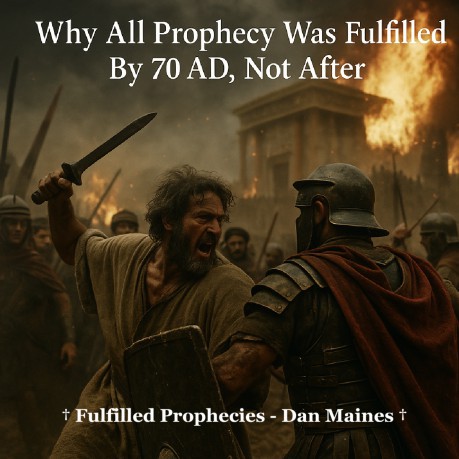
Why All Prophecy Was
Fulfilled By 70 AD, Not After Introduction The Prophetic Clock Set By Jesus Matthew 23:36 † Jesus set the forty year limit. That
generation lived to see 70 AD, and the prophetic timeline could not
extend into any later year (Luke 21:20-22). Matthew 24:1-2 † Jesus tied the fulfillment to the destruction
of the Temple, not Masada. The Temple fell in 70 AD Jerusalem, Not Masada, Was The Prophetic Center Luke 21:20-22 † Jesus said all things written would be
fulfilled in the days of Jerusalem's destruction, and that
fulfillment ended in 70 AD, never in any later year The End Of The Age Required The End Of The Temple Hebrews 8:13 † Hebrews places the disappearance of the Old
Covenant in the near future, which was 70 AD The Priesthood Ended In 70 AD † The Levitical priesthood required a standing
Temple and genealogical records. Both were destroyed in 70 AD (Ezra
2:62, Hebrews 7:11-18). Added Refutation To Cover All Later Dates † Some people try to extend the prophetic
timeline beyond 70 AD because Rome continued military clean up for
several years. But prophecy does not revolve around the last rebel
dying. It revolves around the destruction of the Temple, the end of
the priesthood, and the fall of the covenant city. Once those fell in
70 AD, the prophetic clock reached its end no matter what dates
anyone assigns to later battles (Luke 21:22, Hebrews 8:13). The Great Tribulation Was Tied To Jerusalem, Not Masada Matthew 24:21 † Jesus tied the great tribulation to
Jerusalem's siege. It reached its climax in 70 AD Masada Was Not A Covenantal Event † Masada was a military cleanup operation, not
a prophetic marker (Luke 21:22). Daniel 12 Clarified † Some people claim Daniel 12 pushes
fulfillment past 70 AD because of the 1290 and 1335 days (Daniel
12:11-12). The Sign Of The Son Of Man Appeared In 70 AD Matthew 24:30 † Every sign Jesus gave was fulfilled in the
events surrounding Jerusalem's fall (Matthew 16:27-28). The Kingdom Was Fully Opened In 70 AD Revelation 21:2 † The judgment of the harlot city and the full
unveiling of the bride was tied to Jerusalem's fall. That happened in
70 AD (Revelation 17:1, Revelation 18:20). Closing Covenant Finality † When the covenant city fell, the Temple fell,
and the priesthood ended, nothing was left waiting to be fulfilled.
The Old Covenant died in 70 AD, and the New Covenant stood alone in
its fullness (Hebrews 8:13, Luke 21:22). Historical References How It Applies To Us Today † This is the fulfilled perspective we proclaim at
Fulfilled Prophecies † Source Index
By Dan Maines
† This
message explains why all prophecy was fulfilled by 70 AD and not
carried forward to 73, 74 AD or later. Scripture never tied
fulfillment to Masada. It tied it to Jerusalem, the Temple, the
priesthood, and the covenant people. When those fell in 70 AD, the
prophetic timeline ended exactly where Jesus said it would (Luke
21:20-22).
† Prophecy does not revolve around
rebels hiding in a fortress. It revolves around the covenant
structures God Himself established. Once Jerusalem fell and the
Temple burned, the Old Covenant age came to its end (Hebrews 8:13).
Truly I say to you, all these
things will come upon this generation.
†
Nothing in His words stretches fulfillment past the destruction of
Jerusalem.
† The prophecy was tied to the
people standing in front of Him. They saw the judgment fall in 70 AD
(Luke 21:20-22).
Jesus came out from the
temple and was going away when His disciples came up to point out the
temple buildings to Him. And He said to them, Do you not see all
these things Truly I say to you, not one stone here will be left upon
another, which will not be torn down.
†
Once the Temple was gone, the Old Covenant world ended. Prophecy was
never linked to the survival of Zealots at a desert fortress (Hebrews
8:13).
But when you see Jerusalem
surrounded by armies, then recognize that her desolation is near.
Then those who are in Judea must flee to the mountains, and those who
are inside the city must leave, and those who are in the country must
not enter the city, because these are days of vengeance, so that all
things which are written will be fulfilled.
†
Prophecy revolves around Jerusalem because Jerusalem was the covenant
city. Masada is never mentioned in scripture (Luke 13:33, Matthew
23:37-38).
When He said, A new covenant,
He has made the first obsolete. But whatever is becoming obsolete and
growing old is ready to disappear.
†
The Old Covenant disappeared when the Temple, priesthood, and
sacrifices ended, all in 70 AD (Matthew 24:1-2).
† Once the priesthood
ended, the covenant world ended. Prophecy cannot be stretched beyond
the death of the priesthood to any later year (Hebrews 7:18).
†
Zealots at Masada were not priests, were not offering sacrifices, and
had no covenantal authority (Exodus 28:1, Hebrews 5:1-4).
For then there will be a great
tribulation, such as has not occurred since the beginning of the
world until now, nor ever will again.
†
The horrors Jesus described were in that city, not at Masada (Luke
19:41-44).
† No prophet
predicted Masada. Jesus never mentioned it. The apostles never
pointed to it (Matthew 24:1-2).
† The
prophetic timeline ended when the covenant city fell, not when the
last rebels died (Luke 21:20-22).
† The numbers in Daniel 12 never
extend the Old Covenant beyond the destruction of the Temple, because
Daniel tied those numbers directly to the ending of the daily
sacrifice, which stopped forever in 70 AD (Daniel 12:11, Matthew
24:15).
† The 1290 days in Daniel 12 begin
when the daily sacrifice is taken away. That happened during the
siege of Jerusalem when the Temple services collapsed shortly before
its destruction in 70 AD. Once the sacrifices stopped, the prophetic
timer Daniel mentioned began and pointed directly to the end of the
Old Covenant system in that same period (Daniel 12:11, Luke 21:20).
†
The 1335 days in Daniel 12 simply extend past the 1290 days to show
the blessedness of those who endured through the tribulation leading
up to the destruction of the Temple. These are not extra years added
to the prophetic timeline. They are day counts tied to the same
event, the ending of the daily sacrifice in 70 AD, not to Masada or
any later battle (Daniel 12:12).
Then the sign of the Son of
Man will appear in the sky, and then all the tribes of the earth will
mourn, and they will see the Son of Man coming on the clouds of the
sky with power and great glory.
†
Nothing in the Olivet Discourse extends fulfillment to any later date
(Matthew 24:34).
And I saw the holy city, new
Jerusalem, coming down out of heaven from God, made ready as a bride
adorned for her husband.
†
Masada plays no role in the covenant shift revealed in Revelation.
†
Josephus records Jerusalem's destruction, the burning of the Temple,
and the end of the priesthood in 70 AD.
† He
also records Masada, but only as the final military sweep, not as a
covenantal turning point.
† Early Christian
writers like Eusebius saw the fall of Jerusalem, not Masada, as the
fulfillment of Jesus prophecy.
†
Knowing prophecy was fulfilled in 70 AD strengthens our confidence in
Jesus words (Matthew 24:34).
† It removes
confusion by keeping the prophetic timeline tied to the events Jesus
actually identified (Luke 21:22).
† It frees
believers from futurist fear and anchors us in the completed work of
Christ (Hebrews 12:22-28).
† We live in the
New Jerusalem today. The Kingdom is open, the judgment is past, and
prophecy has reached its fulfillment (Revelation 21:2-3).
© Fulfilled Prophecies - Dan
Maines.
† Matthew
23:36, Matthew 24:1-2, Luke 21:20-22, Hebrews 8:13, Matthew 24:21,
Matthew 24:30, Revelation 21:2
† Josephus,
The Jewish War Books 5 to 7
† Eusebius,
Ecclesiastical History
Links