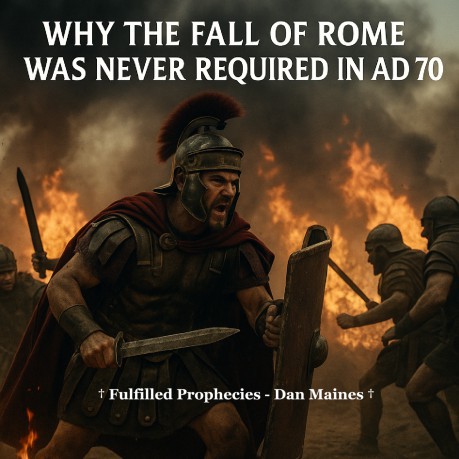
Why The Fall Of Rome Was
Never Required In AD 70 Introduction There is a reason these theories keep popping up. Once people
reject the first century fulfillment that Jesus and the apostles
repeatedly declared as near, soon, and at hand, they have to invent
new interpretations to avoid the clear time statements. This leads to
complicated wordplay, artificial timelines, and symbolic systems that
contradict the simple reading of scripture. This sermon sets the
record straight so God's people stay grounded in the truth already
delivered. † Jesus Himself warned His own generation that
all these things would come upon them (Matthew 23:36). Daniel 2 And The Shattering Of The Statue † Jesus' kingdom replaced all former dominions
spiritually and covenantally, not politically (Luke 1:33). 2 Thessalonians 2 And The Forced Greek Redefinitions † Judgment language in scripture reflects
covenant removal, not always physical death (Isaiah 10:12). Revelation 9 And The Claim That Titus Was Apollyon † Revelation uses prophetic imagery drawn from
the Old Testament, not Roman unit nicknames (Joel 2:1-11). The Abyss Is Not Egypt And Not The Lake Of Fire † The Abyss represents confinement of evil
beings (Luke 8:31). Revelation 19 And The Beast Being Cast Alive Into The Lake
Of Fire † Prophetic burning represents covenant
destruction, not literal fire (Isaiah 34:8-10). Daniel 7 And The Distinction Between Removal Of Dominion
And Judgment † Dominion removal does not require political
extinction, as shown in Daniel 7:12. The Real Issue: Revelation's Timing Cannot Be Escaped The Consistent Apostolic Witness The fulfilled perspective does not deny the seriousness of God's
judgment. It places that judgment exactly where Jesus and His
apostles said it would fall, on the covenant-breaking generation that
rejected their Messiah. Once we honor the inspired timeline,
Revelation, Daniel, and the Olivet Discourse all harmonize perfectly.
The destruction of Jerusalem, not the fall of Rome, is the event
scripture centers as the covenantal turning point of history. † Paul said the day was approaching, not
distant (Hebrews 10:25). How It Applies To Us Today Historical References † This is the fulfilled perspective we proclaim at
Fulfilled Prophecies † Source Index
By Dan Maines
This sermon answers the recent
claims circulating online that Titus did not die in AD 70, that Rome
did not fall in AD 70, and that Daniel 2, Daniel 7, 2 Thessalonians
2, and Revelation 19 therefore cannot apply to the first century.
These arguments are built on misused Greek definitions, imaginary
wordplay, and symbolic interpretations that contradict the plain
meaning of scripture. From the fulfilled perspective, we will show
that none of these claims hold up under biblical or historical
examination.
†
The apostles repeated the same urgency because fulfillment was
unfolding before their eyes (Hebrews 10:37).
†
Fulfillment belonged to them, not us (Luke 21:20-22).
†
Jesus told them the kingdom was at hand, proving the expectation was
first century, not ours (Mark 1:15).
Some
insist that Daniel 2:35 requires all four kingdoms to fall on the
same calendar day and that since Babylon, Persia, and Greece did not
literally collapse in AD 70, the statue could not have been shattered
by the coming of Christ's kingdom. This misunderstands the symbolism.
Daniel is not describing the political demise of each empire at the
same moment. The vision describes God's kingdom replacing the entire
order of man's dominion. The stone strikes the feet because Rome
ruled when Christ's kingdom arrived. When Christ established His
kingdom, He shattered every human system of dominion in terms of
covenant authority. The image collapsing represents the end of the
old world order, not the physical fall of Rome, and not the literal
destruction of Babylon, Persia, and Greece in the first century.
†
The stone became a great mountain filling the whole earth, showing
expansion, not political conquest (Daniel 2:35).
†
God said His kingdom would never be destroyed, proving this is an
eternal dominion, not a Roman collapse (Daniel 2:44).
†
Christ was given all authority in heaven and on earth, fulfilling the
transfer of dominion (Matthew 28:18).
†
Christ's kingdom is not of this world, proving the prophecy is
spiritual in nature, not geopolitical (John 18:36).
†
Daniel 2 predicts the rise of the kingdom, not the political fall of
Rome, and the text never mentions Rome collapsing at all.
The
argument next moves to 2 Thessalonians 2:8, claiming that the Greek
words anaireo and katargeo really mean take away and render inactive
instead of overthrow and destroy. This is incorrect. Anaireo often
means kill or remove by force when used of people. Katargeo means
bring to an end or abolish. Paul says the Lord will slay the lawless
one with the breath of His mouth and bring him to nothing. These are
judgment terms. The claim that Titus was simply taken away to Rome
and therefore this prophecy was fulfilled is an attempt to soften the
language of judgment. This redefinition is not supported by the Greek
or by Paul's consistent usage.
†
Katargeo is used for the old covenant being abolished, proving it
means complete termination, not inactivity (Hebrews 8:13).
†
The breath of His mouth echoes Isaiah 11:4, showing divine judgment,
not a simple relocation.
† The Thessalonians
were told they would see these events, proving they were first
century (2 Thessalonians 2:5).
† The mystery
of lawlessness was already at work in their day, not ours (2
Thessalonians 2:7).
† Katargeo consistently
refers to the end of covenant standing or function, not necessarily
the end of physical existence, matching Paul's usage exactly.
Another
claim is that Apollyon means Apollo and destroy, therefore Titus is
Apollyon because he commanded Legio XV Apollinaris. This is wordplay,
not exegesis. Revelation 9 does not identify Apollyon as Titus. John
draws his imagery from Joel 2 and Exodus 10. The locust army is
symbolic of covenant judgment, not a literal Roman legion. Revelation
is not a guessing game linking names through sound similarities. The
argument collapses because it introduces external associations not
found in the text.
†
The locusts torment and do not kill, proving they are not soldiers
(Revelation 9:5).
† The shapes like horses
prepared for battle parallel Joel's imagery, not Roman cavalry (Joel
2:4).
† The command to harm only those
without God's seal shows this is judgment on Israel, not Rome
(Revelation 9:4).
† The Abyss is the realm of
the demonic, not a Roman province (Luke 8:31).
†
Revelation 9 is intentionally symbolic, and the imagery cannot be
read as literal Roman troops without violating the Old Testament
context John is quoting.
The
claim then says Titus rose out of the Abyss, which they define as
Egypt because Egypt is called an iron smelting furnace. The New
Testament never equates the Abyss with Egypt. The Abyss is the realm
of the demonic. Egypt is never called the Abyss or the lake of fire
in Revelation. The lake of fire and the Abyss are also not
interchangeable. John keeps them distinct. The argument depends on
merging symbols that scripture separates.
† Satan is bound in the
Abyss, proving it is spiritual, not geographic (Revelation 20:1-3).
†
The lake of fire is the final judgment scene, not a temporary holding
place like the Abyss (Revelation 20:14).
†
Egypt represents bondage and oppression, not the Abyss (Deuteronomy
4:20).
† Revelation 11:8 uses Egypt
symbolically for Jerusalem, not Rome and not the Abyss.
Revelation 19:20 says the beast and false
prophet were thrown alive into the lake of fire. This is covenant
judgment language. It does not mean the person had to physically die
on the spot. Prophetic judgment regularly uses imagery of burning,
consuming, and casting without requiring literal physical death. When
Isaiah 34 says Edom's land will burn forever, Edom did not become a
physical volcano. Revelation speaks of divine judgment against the
persecuting power. Titus did not need to drop dead in AD 70 for the
imagery of judgment to be fulfilled.
†
Jesus used outer darkness and weeping imagery for judgment on Israel,
not physical death (Matthew 8:12).
† Matthew
22:7 describes Jerusalem being burned, fulfilling covenant wrath.
†
Being cast alive means Rome's persecuting authority was judged, not
that the empire had to collapse (Revelation 19:20).
†
Revelation consistently uses fire as the symbol of covenantal
judgment (Revelation 20:10).
† The lake of
fire is symbolic everywhere in Revelation, and no early Christian
interpreted it as requiring the literal death of a living political
leader in the moment of judgment.
Daniel 7:11-12 says the first three beasts
lost dominion yet lived on for a time, while the fourth beast was
slain and given to the burning fire. This does not require the Roman
Empire to physically collapse in AD 70. It means Rome lost its
covenant authority over God's people. Rome's ability to oppress the
saints was judged and removed. The beast's destruction refers to
judgment against the persecuting power, not the geopolitical demise
of the entire empire. After Jerusalem fell, Rome no longer held
covenant authority over God's people because the old covenant age had
ended.
† Jesus
received the kingdom at His ascension, fulfilling Daniel 7:13-14
(Acts 2:33).
† The saints received the
kingdom after judgment fell on Jerusalem (Daniel 7:27).
†
Rome's persecution of the saints ended when covenant judgment fell
(Luke 21:22).
† Scripture never requires Rome
to collapse for Daniel 7 to be fulfilled, only the destruction of its
covenant authority (Daniel 7:11).
† Daniel 7
never predicts the political fall of Rome, only the judgment of its
persecuting role, which perfectly matches the events of AD 70.
All
of these complicated arguments attempt to avoid the obvious data:
Revelation gives its own timing.
Revelation 1:1 says the things
must soon take place.
Revelation 1:3 says the time is
near.
Revelation 22:6 again says the things must soon take
place.
Revelation 22:10 says do not seal the words of this
prophecy, for the time is near.
No amount of redefined Greek or
symbolic manipulation can overturn the timing Jesus Himself gave. The
events were near, not thousands of years away.
Every
apostle taught the same timing. Paul said the appointed time had
grown very short. Peter said the end of all things was near. James
said the judge was standing right at the door. John said it was the
last hour. None of these statements point to events thousands of
years later. They are all consistent with Jesus' own teaching that
all these things would take place in that generation. The fulfilled
timeline is not new, it is the original apostolic timeline.
† James warned that
the Lord's coming was near (James 5:8).
†
Peter declared they were living in the last days Joel predicted (Acts
2:16-17).
† John confirmed it was the last
hour (1 John 2:18).
† Jesus' generation
statement seals the timeline forever (Matthew 24:34).
The fulfilled
perspective shows us that God kept every promise He made concerning
the judgment of Israel and the establishing of Christ's kingdom.
Because those prophecies were fulfilled in their generation, we live
in the assurance that nothing stands between us and God today. The
kingdom is open, righteousness is available, and access to God is
complete. We are not waiting for another empire to fall or another
beast to rise. We are living in the age where Christ's rule has
already been established and cannot be shaken. This gives us
confidence, stability, and peace, knowing that every word Jesus spoke
has been confirmed. Instead of fear and speculation about world
events, we can live boldly in the finished work of Christ and the
security of His everlasting kingdom.
Justin Martyr
†
Justin said the destruction of Jerusalem fulfilled the words of the
prophets and Jesus, proving God judged Israel, not Rome (Dialogue
with Trypho 32).
Josephus
† Josephus
wrote that God had turned against Jerusalem and used Rome as His
instrument of judgment, placing the blame on Israel's rebellion, not
on Rome (Wars 6.2).
Tacitus
† Tacitus
recorded signs, disturbances, and divine omens pointing to the
judgment of the Jews and the destruction of their city, not the
collapse of Rome (Histories 5.13).
Eusebius
†
Eusebius said the destruction of Jerusalem fulfilled the predictions
of Jesus, and that the church escaped because they obeyed the Lord's
warnings, showing the judgment was on Israel, not Rome
(Ecclesiastical History 3.7).
Clement of Alexandria
†
Clement taught that after Israel's judgment the church became the
heir of the covenant blessings, confirming the shift happened when
Jerusalem fell, not when Rome fell (Stromata 6).
© Fulfilled Prophecies - Dan
Maines.
† Daniel
2:34-35, 44-45
† 2 Thessalonians 2:8
†
Revelation 9:1-11, Revelation 19:20
† Daniel
7:11-12
† Revelation 1:1, 3, Revelation 22:6,
10
Links