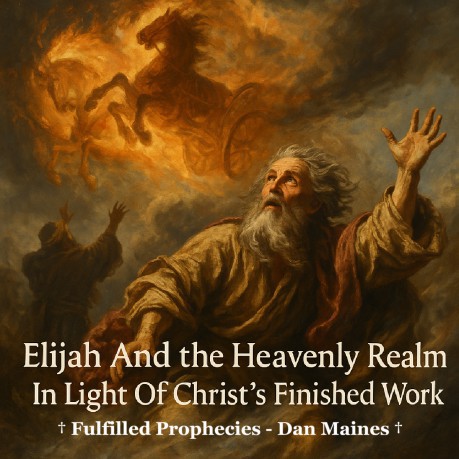
Elijah And The Heavenly Realm
In Light Of Christ's Finished Work John 3:13 Where Elijah Actually Went Before Heaven Was Opened 2 Kings 2:11 Meaning Of The Chariot Of Fire And Whirlwind Hebrews 11:13 Clarifying The Waiting Place Of The Old Covenant Saints Hebrews 10:19-20 Christ Alone Opens Heaven Contrast Between Elijah's Removal And Christ's Ascension Elijah, Moses, And The Transfiguration Why Elijah In Revelation 11 Is Not Literal Elijah Elijah And John The Baptist Prophetic Context From Malachi 4 Elijah's Story And The End Of The Old Covenant Age How It Applies To Us Today Fullness Of Our Present Heavenly Access Historical References † This is the fulfilled perspective we proclaim at
Fulfilled Prophecies † Source Index
By Dan Maines
Introduction
†
Many people read the story of Elijah and assume he entered the
heavenly realm the same way believers do in Christ today. But
scripture is clear that full access into God's presence did not exist
before Christ completed redemption. We have to let Jesus define this,
not tradition and not assumption. (John 3:13, Hebrews 9:8, Luke
16:22)
† Elijah's departure was miraculous, but it was not
glorification, not resurrection, and not entrance into the throne
room of heaven. Scripture shows exactly what happened and why it
matters in the fulfilled perspective. (John 3:13, Hebrews 11:13,
Hebrews 10:19-20)
† This post will walk verse by verse through
the key passages and show how Christ alone opened heaven, and why
Elijah's experience was divine removal, not resurrection life.
(Hebrews 9:15, Luke 24:26, Hebrews 2:14)
No man has ascended into heaven
but He who came down from heaven, the Son of Man who is in heaven.
†
Jesus Himself makes the boundary unmistakable. Before His finished
work, no one had ascended into the true heavenly sanctuary. This
includes Elijah, Enoch, Abraham, David, and every saint listed in
scripture. Elijah's removal from the earth did not override Jesus'
own teaching. Christ alone is the first to enter and open the
heavenly realm for the redeemed. (John 3:13, Hebrews 6:19-20, Hebrews
9:24, Acts 2:34)
† Jesus is not talking about clouds or the
sky. He is talking about the dwelling presence of God. Only the Son
could enter it before redemption was complete. (John 1:18, Exodus
33:20, Colossians 1:19)
†
Scripture is clear that before Christ, the righteous did not enter
the heavenly sanctuary. They went to a waiting place described as
Abraham's bosom, a place of comfort but not the throne room of God.
(Luke 16:22, Luke 16:25, Hebrews 11:39)
† Luke 16:22 says the
righteous were carried to Abraham's bosom, not heaven. (Luke 16:22,
John 3:13)
† Luke 23:43 shows Jesus telling the thief he would
be with Him in Paradise, but Paradise was not yet the heavenly
sanctuary. (Luke 23:43, John 20:17, Revelation 2:7)
† Hebrews
9:8 states that the way into the holy place had not yet been opened
while the first covenant was still standing. (Hebrews 9:8, Hebrews
10:19-20)
† This means Elijah, like every Old Covenant saint,
was preserved by God but did not enter the full heavenly presence
until Christ completed redemption. (Hebrews 11:40, Ephesians 4:8,
Hebrews 2:10)
As they were going along and
talking, behold, there appeared a chariot of fire and horses of fire
which separated the two of them. And Elijah went up by a whirlwind to
heaven.
† The word heaven in Hebrew can mean sky, firmament,
or the upper realm. The context decides which. Elijah was taken
upward, but not into the throne room of God that Jesus said no man
had entered. (Genesis 1:8, Deuteronomy 10:14, John 3:13)
†
What happened here was divine protection and divine transport. Elijah
was carried out of the earthly realm, removed from Israel's history,
and placed under God's care. But nothing in the text says
glorification, resurrection, or entrance into the heavenly sanctuary.
(Psalm 104:3, Psalm 91:11, Hebrews 11:5)
† Elijah did not die
physically, but he also did not receive resurrection life. He was
removed, not transformed. (1 Corinthians 15:50, Hebrews 11:40, John
14:6)
†
The chariot and whirlwind throughout scripture represent divine
movement, protection, and power, not glorification. (Psalm 68:17,
Isaiah 66:15, Nahum 1:3)
† In Psalm 104:3 God makes the clouds
His chariot. (Psalm 104:3, Psalm 18:10)
† In Isaiah 66:15 God
comes with His chariots in judgment, not resurrection life. (Isaiah
66:15, Ezekiel 1:4)
† Elijah's departure fits this pattern.
God removed His prophet dramatically, but this was not the
resurrection body promised only through Christ. (1 Corinthians
15:42-44, Philippians 3:21)
All these died in faith,
without receiving the promises.
† The writer includes the
entire Old Covenant era here, covering the time of Elijah. They did
not receive the promise because the way into the heavenly sanctuary
was not yet opened. Elijah is not treated as an exception. Hebrews 11
confirms Jesus' words in John 3:13 perfectly. (Hebrews 11:13, Hebrews
11:39-40, John 3:13)
† If Elijah had entered the heavenly
throne room, Hebrews 11 would contradict the words of Jesus. But it
does not. Instead, it affirms that the Old Covenant saints waited
until Christ fulfilled all things. (John 14:2-3, Hebrews 9:15, Luke
24:26)
†
Before Christ, the righteous were held in a place of comfort, not
glory, awaiting redemption. (Luke 16:22, Hebrews 9:15, Hebrews
11:39)
† Jesus told a parable that reflected this exact
condition, showing the righteous separated from the wicked, but not
yet glorified. (Luke 16:22-26)
† Elijah, though removed from
earth, still awaited the opening of heaven that only Christ provided.
(Hebrews 10:19-20, John 14:6)
Since therefore, brethren,
we have confidence to enter the holy place by the blood of Jesus, by
a new and living way which He inaugurated for us through the veil.
†
The way into the true heavenly holy place was opened by Christ, not
before Him. This is why Elijah could be taken up but still not enter
the glorified presence of God. The veil had not yet been removed.
Only the blood of Christ opened the way. (Hebrews 10:19-20, Matthew
27:51, Hebrews 9:24)
† Elijah was preserved alive, but he was
not glorified. Glorification is resurrection, and resurrection life
is only found in the One who conquered death. (John 11:25, Romans
6:9, 1 Corinthians 15:20)
† The
resurrection life Elijah did not receive is the very life all
believers now have in Christ. Elijah's removal was miraculous, but it
was still under the limitations of the Old Covenant. Christ broke
those limitations through His finished work. (Romans 8:11, Hebrews
9:15, John 14:6)
† Elijah was taken up, but he was not
transformed. Elijah was removed, but he was not resurrected. Elijah
was spared physical death, but he did not receive the heavenly access
that Christ alone provided. (1 Corinthians 15:50, Hebrews 11:40,
Ephesians 2:18)
†
Elijah went up, but Christ ascended into the true heavenly sanctuary.
(Acts 1:9, Hebrews 9:24, Ephesians 1:20)
† Elijah was carried
by a whirlwind, but Christ ascended by His own authority. (John
10:18, John 20:17)
† Elijah was taken somewhere, but Christ
sat down at the right hand of God. (Hebrews 1:3, Hebrews 10:12)
†
Elijah did not open heaven for anyone, but Christ opened heaven for
all believers. (Hebrews 10:19-20, John 14:6)
†
Moses and Elijah appeared with Christ in Matthew 17, but this was a
temporary revelation in glory, not their permanent heavenly entrance.
(Matthew 17:1-5, Luke 9:30-31)
† They still awaited Christ's
finished work, indicating that even these great prophets had not yet
entered the heavenly realm. (Hebrews 11:39-40, John 3:13)
†
The Transfiguration showed Christ's supremacy over the law and the
prophets, not that Elijah had already entered the glorified state.
(Matthew 17:5, Hebrews 1:1-2)
†
Revelation 11 uses symbolic temple language, covenant imagery, and
prophetic representation, not literal resurrected Old Covenant
prophets. (Revelation 11:1-4)
† Jesus already taught that John
the Baptist fulfilled the Elijah prophecy, ending any expectation of
Elijah returning in person. (Matthew 11:14, Matthew 17:12-13)
†
Revelation's two witnesses represent covenant testimony, not Elijah's
physical return. (Revelation 11:4, Zechariah 4:2-3)
† Elijah
cannot be the witness in Revelation 11 because Jesus said no one had
ascended into heaven before Him. (John 3:13)
† Elijah's
removal connects to the arrival of John the Baptist, the Elijah who
was to come. (Matthew 11:14, Luke 1:17, Malachi 4:5)
† Malachi
4 prophesied Elijah before the Day of the Lord, and Jesus says John
fulfilled this role. (Matthew 17:12-13, Malachi 4:5)
† This
shows Elijah's departure was part of God's transition from Old
Covenant to New, but still not resurrection life. (Hebrews 8:13,
Galatians 4:4)
†
Elijah's story is tied to the closing of the Old Covenant era.
(Malachi 4:5-6, Luke 1:17)
† Malachi 4:5 promised an Elijah
figure before judgment. (Malachi 4:5, Matthew 17:12)
† John
came in the spirit and power of Elijah to prepare the way for Christ,
who alone opened heaven. (Luke 1:17, John 1:29)
† Elijah's own
story reinforces God's plan through Christ, not an Old Covenant
entrance into glory. (Hebrews 9:15, John 14:6)
†
Elijah's removal foreshadowed the removal of the Old Covenant itself,
which ended with the destruction of Jerusalem in AD 70. (Hebrews
8:13, Matthew 24:34, Luke 21:22)
† John the Baptist completed
Elijah's role by preparing the way for judgment against Old Covenant
Israel. (Matthew 3:7-12, Malachi 4:5-6)
† Elijah's story
ultimately points toward the closing of the age, the new creation in
Christ, and the entrance into the heavenly realm that only Christ
opened. (2 Corinthians 5:17, Hebrews 12:27-28)
† Elijah's
story proves the supremacy of Christ. No one, not even a prophet as
mighty as Elijah, could enter the heavenly realm until Christ opened
it through His death and resurrection. This affirms the fulfilled
reality we stand in today. We enjoy what none of the Old Covenant
saints could receive until Christ completed redemption. (Hebrews
10:19-20, Ephesians 2:6, Colossians 1:13)
† Elijah's removal
was a miracle, but your position in Christ is greater. You have what
Elijah did not have, the fullness of access to God through the New
Covenant. (Ephesians 2:18, Hebrews 12:22-24)
†
Hebrews 12:22 says we have come to Mount Zion, the heavenly
Jerusalem, the assembly of the firstborn. (Hebrews 12:22-24)
†
Ephesians 2:6 says we are seated with Christ in the heavenly places
right now. (Ephesians 2:6, Colossians 3:1)
† Colossians 1:13
says we have been transferred into the kingdom of His beloved Son.
(Colossians 1:13, Romans 14:17)
† These blessings were not
available to Elijah, or any Old Covenant saint. They belong to us
through the finished work of Christ. (Hebrews 11:40, 1 Peter 1:3-4)
† Justin Martyr
taught in Dialogue with Trypho that the Old Covenant saints did not
enter the heavenly inheritance until Christ opened the way,
confirming none entered before His resurrection.
† Irenaeus
wrote that Christ alone opened the heavenly realm and that the saints
before Christ waited in a separate place until His victory, showing
Elijah was not an exception.
† Tertullian taught that the
faithful under the Old Covenant were kept in a waiting place until
Christ released them through His death and resurrection, proving no
Old Covenant figure entered heaven's throne room before Christ.
†
Clement of Alexandria explained that Christ alone brought immortality
and access to God, meaning Old Covenant figures like Elijah did not
enter the heavenly sanctuary before Him.
† Barnabas wrote that
the promises were fulfilled only in Christ and that the fathers
waited for Him, affirming that Elijah did not receive glorification
before the cross.
† Eusebius recorded that Christ opened the
way into heaven for all the righteous who had lived before His
coming, confirming Elijah was not glorified before Christ's finished
work.
† Josephus described Elijah as taken from the earth, but
never claimed he entered the heavenly throne room, fitting perfectly
with the biblical teaching that Christ alone ascended into heaven.
© Fulfilled Prophecies - Dan
Maines.
† John 3:13, 2 Kings 2:11,
Hebrews 11:13, Hebrews 10:19-20
Links