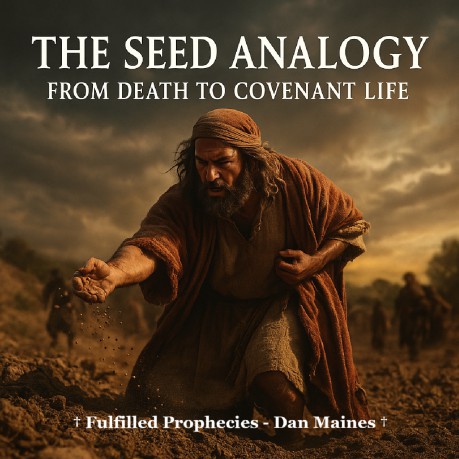
The Seed Analogy: From Death
to Covenant Life Part 2 of 3 1 Corinthians 15:37-38 † The resurrection chapter in 1 Corinthians 15
is one of the most misunderstood passages in Scripture. Paul wasn't
describing the end of the physical universe or the reanimation of
human corpses. He was explaining the transformation of covenant
Israel from the body of death in Adam to the spiritual body of life
in Christ. † Paul's seed analogy in 1 Corinthians 15:37-38
has often been misunderstood. Many claim Paul was teaching about a
change from a physical seed body to a heavenly plant body after
biological death. But that's actually not what Paul is teaching. He's
not talking about a change from a "physical seed body" to a
"heavenly plant body" that exists after biological death.
Paul's analogy isn't about human biology at all, it's about the
covenantal transformation from the perishable body of the Old
Covenant to the imperishable body of the New Covenant, fulfilled
through Christ. † Paul says, That which you sow does not come
to life unless it dies; and that which you sow, you do not sow the
body which is to be, but a bare grain… but God gives it a body just
as He wished (1 Corinthians 15:36-38). The death he refers to here is
not the death of a physical body at the end of life, but the death of
the old covenantal body, Israel after the flesh. The "resurrection"
is the bringing forth of the new covenant body, the Church, the body
of Christ. † Isaiah also prophesied this same
transformation, saying, Your dead will live; their corpses will rise.
You who lie in the dust, awake and shout for joy (Isaiah 26:19). This
wasn't a prediction of biological resurrection but of covenant
restoration, the renewal of God's people into spiritual life through
Christ. † Romans 7:4 says, Therefore, my brethren, you
also were made to die to the Law through the body of Christ, so that
you might be joined to another, to Him who was raised from the dead.
2 Corinthians 5:17 declares, Therefore if anyone is in Christ, he is
a new creature; the old things passed away; behold, new things have
come. Hebrews 8:13 confirms, When He said, "A new covenant,"
He has made the first obsolete. But whatever is becoming obsolete and
growing old is ready to disappear. These passages align perfectly
with Paul's seed analogy, revealing the covenantal death and
resurrection that occurred through Christ. † Paul was addressing some in Corinth who
denied the resurrection that was already taking place (1 Corinthians
15:12). His seed analogy explains that there must first be a "death"
(the end of the Old Covenant world) before the new "body"
(the New Covenant creation) could come forth. Just as the seed's
outer shell must perish for the new life to emerge, the Old Covenant
had to die for the New Covenant to come alive. The "seed"
doesn't represent each believer's corpse, it represents the covenant
people transitioning from one mode of existence to another. † The continuity Paul describes is not in the
flesh, but in covenant identity, the same people of God transformed
through Christ from mortality in Adam to immortality in the New
Covenant. † Notice Paul never says the individual
believer's corpse sprouts into another biological body. Instead, he
says in verses 42-44 that the body is sown in corruption, raised in
incorruption, sown in dishonor, raised in glory. These are covenantal
contrasts, not biological ones, showing the transformation from
mortal Israel in Adam to immortal life in Christ. As he concludes,
Flesh and blood cannot inherit the kingdom of God (v. 50), not
because we're waiting for new flesh, but because the old covenant
order couldn't inherit what only the spiritual, corporate body of
Christ could. † So the "seed" is Israel sown in
death through judgment in AD 70, and the "plant" is the
resurrected body of Christ's people, His Church, now living in the
glory of the fulfilled kingdom. Historical References How It Applies To Us Today Why Futurists Misunderstand This There Was Never a Rapture in Any Form † The seed analogy stands as one of Paul's
clearest pictures of covenantal resurrection, fulfilled in the
transition from the Old Covenant body of death to the New Covenant
body of life in Christ, completed in AD 70 just as the Scriptures
foretold. † This is the fulfilled perspective we proclaim at
Fulfilled Prophecies † Source Index
By Dan Maines
†
Josephus, Wars of the Jews 6.8, describing the destruction of
Jerusalem and the passing of the Old Covenant system.
†
Eusebius, Ecclesiastical History 3.5, confirming that the early
church recognized the end of the Jewish age as the time of divine
transition.
† Clement of Alexandria, Stromata
3.15, who emphasized that the true resurrection was the
transformation of the soul and life into knowledge of Christ rather
than the rising of physical bodies.
†
Paul's seed analogy teaches that true resurrection life is not about
waiting for a physical transformation after death, but about entering
the spiritual body of Christ now. The same principle applies today:
the old must die for the new to live. Just as the Old Covenant
perished, we too must die to the flesh and live in the power of the
New Covenant reality. The resurrection life is not future, it's
fulfilled, and it's lived out through the eternal kingdom of Christ
that cannot perish.
†
Futurists assume Paul was describing the resurrection of physical
corpses, which leads them to separate the seed and the plant as
different beings instead of understanding them as covenantal
transitions. They read the analogy biologically rather than
covenantally, believing the "seed" must die physically for
a new body to rise. However, Paul was teaching about Israel's death
to the flesh and the rise of the spiritual body in Christ. The
continuity is in the same person, but the transformation is
covenantal. The natural man (in Adam) could not inherit the kingdom,
but the spiritual man (in Christ) could. The death and resurrection
Paul described were fulfilled in the transition from the Old Covenant
world to the New, not in the decay and reanimation of physical
bodies.
†
Because Paul's teaching was covenantal, not physical, there is no
scriptural or historical basis for any rapture event, whether future
or in AD 66. The "change" Paul spoke of in 1 Corinthians
15:51-52 was the transformation of the covenant body, not a physical
removal of believers from the earth. The idea of people vanishing
from the world contradicts Paul's entire analogy. The rapture theory
in any form depends on a physical resurrection and disappearance that
Paul never taught. His seed analogy removes that idea completely. The
resurrection and gathering were fulfilled spiritually in Christ's
coming in judgment and redemption in AD 70, when the old covenant
world passed away and the New Covenant stood complete.
© Fulfilled Prophecies - Dan
Maines.
† 1
Corinthians 15:12, 36-38, 42-44, 50; Romans 7:4; 2 Corinthians 5:17;
Hebrews 8:13; Isaiah 26:19
† Josephus, Wars
of the Jews 6.8
† Eusebius, Ecclesiastical
History 3.5
† Clement of Alexandria, Stromata
3.15
Links