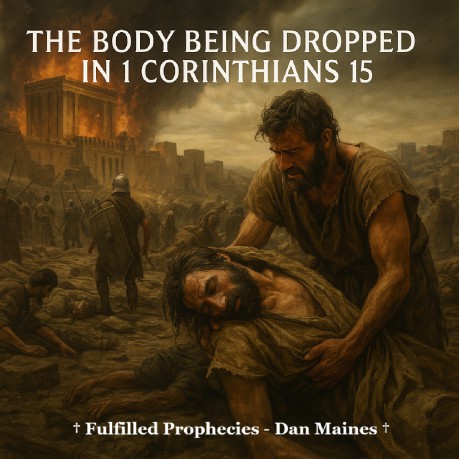
The Body Being Dropped in 1
Corinthians 15 Part 1
of 3 † There is very strong scriptural evidence
showing that the "body" in 1 Corinthians 15 refers to the
corporate covenantal body, Old Covenant Israel, rather than
individual fleshly corpses. Scripture itself proves this clearly and
consistently within the fulfilled framework. Paul already defines "body" as corporate earlier
in 1 Corinthians † Here Paul unmistakably defines "body"
as a corporate collective of believers, joined by the Spirit. The
same letter, 1 Corinthians, uses "body" consistently to
describe the Church as a unified covenant entity. There's no shift to
a biological sense in chapter 15 unless the context forces it, and it
doesn't. The "body of sin" and "body of death"
in Paul's other writings are covenantal Romans 7:4 Romans 7:24 † Notice Paul ties "body" to the old
order of sin and the Law, not physical tissue, but a covenantal
condition. Israel under the Law was the "body of death."
Through Christ's death, believers die to that body and are raised
into a new covenant body, the body of Christ. Paul explicitly connects "flesh and blood" with
the Old Covenant † "Flesh and blood" was a Hebrew
idiom for natural lineage and covenantal standing through physical
descent, as seen also in Galatians 4:23-26. It refers to Israel after
the flesh, the Old Covenant system. Paul isn't saying physical humans
can't inherit the kingdom, but that the Old Covenant body, flesh and
blood Israel, couldn't. The perishable covenant was being replaced by
the imperishable New Covenant body. The "sowing" language points to Israel's
covenantal death Hosea 8:7 † Hosea used "sowing" as a metaphor
for Israel's judgment and restoration. When Paul says in 1
Corinthians 15:36, That which you sow does not come to life unless it
dies, he's drawing from the same prophetic imagery, Israel being sown
in judgment, death under the Law, and raised as the new covenant
people in Christ. Daniel's prophecy shows a covenantal resurrection of
Israel † This is the same resurrection Paul refers to
in Acts 24:14-15 and 1 Corinthians 15. Daniel's "many"
refers to Israel's covenant people, not all biological corpses. It's
a spiritual awakening from the death of separation under the Law to
the life of the kingdom. The Church, the New Covenant body, replaces the Old
Covenant body † Paul never once calls individual corpses "His
body." The body of Christ is corporate, the covenantal community
now alive through Him. This is the "new body" raised when
the old one, Israel after the flesh, was sown in death. Hebrews confirms the same transition † The old body was growing old and was about to
disappear. That disappearance was fulfilled in AD 70, when the Old
Covenant system perished. That's the very death Paul speaks of in 1
Corinthians 15, the perishable giving way to the imperishable. † The "body" in 1 Corinthians
15:35-54 isn't about individual flesh being transformed but the Old
Covenant corporate body, Israel under Law, being sown in judgment and
raised as the spiritual body of Christ under grace. † 1 Corinthians 12:12-13 shows "body"
is corporate. † All of it aligns perfectly. The body being
dropped was Israel after the flesh. The body raised was the Church,
the body of Christ. Historical References How It Applies To Us Today † This is the fulfilled perspective we proclaim at
Fulfilled Prophecies † Source Index
By Dan Maines
1 Corinthians 12:12-13
For
even as the body is one and yet has many members, and all the members
of the body, though they are many, are one body, so also is Christ.
For by one Spirit we were all baptized into one body.
Romans
6:6
Our old self was crucified with Him, so that our
body of sin might be done away with, so that we would no longer be
slaves to sin.
You also were made to die to the
Law through the body of Christ, so that you might be joined to
another, to Him who was raised from the dead.
Wretched man that I am! Who will
set me free from the body of this death?
1 Corinthians 15:50
Now
I say this, brethren, that flesh and blood cannot inherit the kingdom
of God, nor does the perishable inherit the imperishable.
Hosea 2:23
I
will sow her for Myself in the land.
For they sow the wind and they
reap the whirlwind.
Daniel 12:2
Many of those
who sleep in the dust of the ground will awake, these to everlasting
life, but the others to disgrace and everlasting contempt.
Ephesians 1:22-23
And
He put all things in subjection under His feet, and gave Him as head
over all things to the church, which is His body, the fullness of Him
who fills all in all.
Hebrews
8:13
When He said, "A new covenant," He has
made the first obsolete. But whatever is becoming obsolete and
growing old is ready to disappear.
Romans 6-7 define "body" as covenantal,
not biological.
1 Corinthians 15:50 proves "flesh and
blood" means the Old Covenant.
Hosea 2 and 8 provide the
prophetic background for "sowing."
Daniel 12:2
identifies the same covenantal resurrection.
Ephesians 1:22-23
identifies the new body as the Church.
Hebrews 8:13 shows the
death of the old body and rise of the new.
†
Josephus, Wars of the Jews 6.8, describing the fall of Jerusalem and
the end of the Old Covenant order.
†
Eusebius, Ecclesiastical History 3.5, confirming the early church saw
the fall of Jerusalem as the fulfillment of Christ's words.
†
Justin Martyr, Dialogue with Trypho 80, showing the new life in
Christ as the true resurrection from death, not the revival of
physical bodies.
†
The resurrection was not about corpses or physical transformation. It
was the passing away of the Old Covenant body and the raising of the
New Covenant body, the Church. We now live in that body, joined to
Christ, alive in the New Creation where death has no dominion.
© Fulfilled Prophecies - Dan
Maines.
† 1
Corinthians 12:12-13; 15:35-54; Romans 6:6; 7:4, 24; 8:3; Galatians
4:23-26; Ephesians 1:22-23; Hebrews 8:13; Daniel 12:2; Hosea 2:23;
8:7
† Josephus, Wars of the Jews 6.8
†
Eusebius, Ecclesiastical History 3.5
† Justin
Martyr, Dialogue with Trypho 80
Links