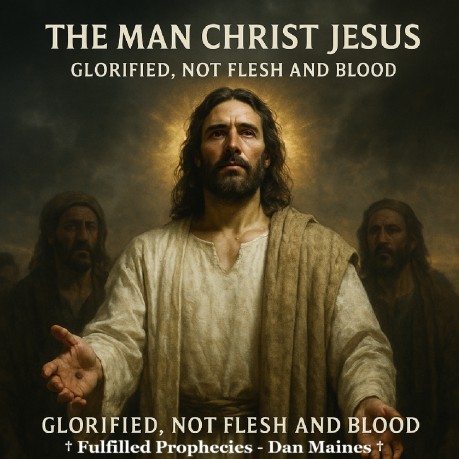
The Man Christ Jesus:
Glorified, Not Flesh and Blood John 1:14 † Jesus became a real man in flesh and blood.
He entered our world to share in our weakness and mortality. His
mission required true humanity so He could fulfill the law, suffer,
and die for mankind. His divinity didn't replace His humanity, it
joined with it perfectly (Philippians 2:7-8). Hebrews 2:14 † Jesus entered the same mortal condition we
live in so He could conquer death from within it. He took on flesh
and blood, not to remain in it forever, but to destroy the power that
ruled through it (Romans 6:9-10). Luke 24:39 † After the resurrection, Jesus still bore the
marks of His sacrifice. His body was real, but different, no longer
subject to death or decay. He showed continuity with His earthly
life, yet His body had been changed and glorified (Romans 6:9). Philippians 3:21 † Paul said Jesus' body was transformed, not
replaced. It was glorified, showing what humanity becomes when made
immortal (1 Corinthians 15:49). 1 Corinthians 15:42-45, 50 † Paul leaves no room for doubt, there's no
flesh and blood in heaven. The resurrection body is spiritual,
heavenly, and incorruptible. Jesus' glorified form shows the pattern
of that transformation. He became the life-giving Spirit, ruling in
immortal glory (Romans 8:29) (2 Corinthians 3:17). Acts 7:55-56 † Stephen saw the glorified Christ, not in
flesh, but in divine glory. The same Jesus who once walked the earth
was now exalted as the Son of Man in heaven, glorified in His
perfected humanity (Ephesians 1:20-21) (Hebrews 9:24, 1 Peter
3:22). Hebrews 1:3 † His ascension completed His redemptive work.
He now reigns as the glorified man, the perfect image of God, the
mediator between heaven and earth (Ephesians 1:22-23). Matthew 16:27-28 † Jesus promised a coming in glory within the
lifetime of His audience. That coming was fulfilled in AD70, when He
returned not in physical flesh, but in divine judgment and power,
marking the end of the Old Covenant world and the full establishment
of His kingdom (Matthew 24:30, 34) (Luke 21:20-22, Matthew 26:64). 1 Timothy 2:5 † Even now, He's called the man Christ Jesus.
His glorified body doesn't erase His humanity, it perfects it
(Hebrews 7:24-25) (Romans 8:34). Historical References How It Applies To Us Today † This is the fulfilled perspective we proclaim at
Fulfilled Prophecies † Source Index
By Dan Maines
And the Word became flesh, and
dwelt among us, and we saw His glory, glory as of the only begotten
from the Father, full of grace and truth.
†
The Word becoming flesh fulfilled what had been foretold from the
beginning, that God would dwell among His people (Isaiah 7:14,
Matthew 1:23). He took on the likeness of sinful flesh, yet without
sin (Romans 8:3).
† His glory was the visible
revelation of the invisible God, for in Him all the fullness of Deity
dwells bodily (Colossians 2:9).
Therefore, since the children
share in flesh and blood, He Himself likewise also partook of the
same, that through death He might render powerless him who had the
power of death, that is, the devil.
† He shared
in our weakness to make atonement possible, taking the curse upon
Himself and breaking its hold over humanity (Galatians 3:13).
†
By sharing our flesh, He identified fully with us, becoming our
faithful High Priest who understands our temptations (Hebrews 4:15).
See My hands and My feet, that it
is I Myself, touch Me and see, for a spirit does not have flesh and
bones as you see that I have.
†
His resurrected body was the same one that went into the tomb, but it
had been transformed, showing the power of God over mortality (John
20:27).
† His ability to appear and vanish at
will (Luke 24:31, John 20:19) shows it wasn't limited by natural
boundaries, a sign of its spiritual glorification (Luke 24:31, John
20:19).
Who will transform the body
of our humble state into conformity with the body of His glory, by
the exertion of the power that He has even to subject all things to
Himself.
† The same
power that transformed Him is working in us to change our mortal
nature into immortality (Romans 8:11).
† The
body of His glory shows God's purpose in Christ is to bring many sons
to glory, sharing in His divine nature (Hebrews 2:10, 2 Peter 1:4) (1
Corinthians 15:53-54).
So also is the
resurrection of the dead. It is sown a perishable body, it is raised
an imperishable body, it is sown in dishonor, it is raised in glory,
it is sown in weakness, it is raised in power, it is sown a natural
body, it is raised a spiritual body. If there is a natural body,
there is also a spiritual body. So also it is written, The first man,
Adam, became a living soul. The last Adam became a life-giving
spirit. Now I say this, brethren, that flesh and blood cannot inherit
the kingdom of God, nor does the perishable inherit the imperishable.
†
The contrast between Adam and Christ shows the change from mortality
to immortality, from dust to heavenly glory (Genesis 2:7, 1
Corinthians 15:47-49).
† Flesh and blood
symbolize the corruptible order of the old covenant, while the
spiritual body represents the new creation in Christ (2 Corinthians
5:17).
But being full of the Holy
Spirit, he gazed intently into heaven and saw the glory of God, and
Jesus standing at the right hand of God, and he said, Behold, I see
the heavens opened up and the Son of Man standing at the right hand
of God.
† This vision fulfills Daniel's
prophecy of the Son of Man receiving the everlasting kingdom (Daniel
7:13-14).
† The fact that Stephen still
called Him the Son of Man proves He retained His humanity even in
glorification (Revelation 1:13).
And He is the radiance of His
glory and the exact representation of His nature, and upholds all
things by the word of His power. When He had made purification of
sins, He sat down at the right hand of the Majesty on high.
†
Sitting down at the right hand of God shows His completed victory
over sin and death (Hebrews 10:12-13).
† He's
both fully divine and perfectly human, ruling with all authority in
heaven and on earth (Matthew 28:18).
For the Son of Man is going
to come in the glory of His Father with His angels, and will then
repay every man according to his deeds. Truly I say to you, there are
some of those who are standing here who will not taste death until
they see the Son of Man coming in His kingdom.
†
The coming in glory echoes Old Testament judgment language where God
came through historical events (Isaiah 19:1).
†
The Son of Man's coming in His kingdom fulfilled the promise of
Daniel 7:13-14, establishing His eternal reign.
For there is one God, and one
mediator also between God and men, the man Christ Jesus.
† The title
man shows that Christ's human identity continues forever in His
mediatorial role.
† He bridges the gap
between the mortal and the immortal, the temporal and the eternal,
forever uniting God and redeemed man (Colossians 1:19-20).
†
Justin Martyr taught that Christ remains in heaven until the time of
the final judgment of Israel.
† Irenaeus
affirmed that the same Jesus who suffered in flesh now reigns
glorified at the right hand of the Father.
†
Clement of Alexandria said Christ's resurrection made Him the
archetype of immortal humanity.
†
Our hope is the same transformation. We don't wait for a physical
resurrection, because Jesus has already shown what it means to be
raised in glory. His resurrection was the victory of immortality over
death (2 Timothy 1:10).
† We share in His
life now as citizens of the heavenly kingdom, not awaiting fleshly
renewal but walking in the reality of spiritual resurrection
(Ephesians 2:6, Hebrews 12:22-24).
† The man
Christ Jesus reigns forever, and through Him, humanity's been
glorified. Flesh and blood have no place in heaven, but the redeemed
body, spiritual and incorruptible, dwells with Him eternally
(Philippians 3:20, 1 Corinthians 15:54-57, John 5:24, John 11:25-26).
© Fulfilled Prophecies - Dan
Maines.
† All
Scripture references: John 1:14; Hebrews 2:14; Luke 24:39;
Philippians 3:21; 1 Corinthians 15:42-45, 50; Acts 7:55-56; Hebrews
1:3; Matthew 16:27-28; 1 Timothy 2:5; 2 Timothy 1:10; Ephesians 2:6;
Hebrews 12:22-24; Philippians 3:20; 1 Corinthians 15:54-57; John
5:24; John 11:25-26.
† Historical sources:
Justin Martyr, Dialogue with Trypho 32; Irenaeus, Against Heresies
3.19; Clement of Alexandria, Stromata 6.15.
Links