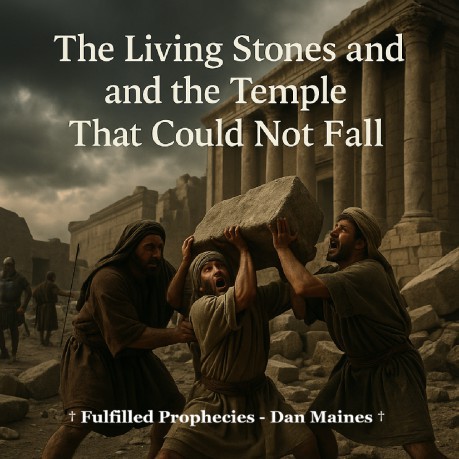
The Living Stones and the
Temple That Could Not Fall 1 Peter 2:4-6 † Peter presents a powerful image of transition
from a physical to a spiritual temple. In the old covenant, worship
centered around a building of stone, but in the new covenant, God's
dwelling is among His people. The believers became the structure, and
Christ Himself is the cornerstone that holds it together. (John
4:23-24 - Worship in spirit and truth; Ephesians 2:20 - Christ the
cornerstone) † The phrase "rejected by men" refers
to Israel's leaders who cast away the true cornerstone. When they
rejected Jesus, they unknowingly rejected the only foundation that
could give lasting life. The temple they honored would soon crumble,
but the spiritual house built on Christ would endure forever.
(Matthew 21:42 - The stone the builders rejected; Luke 20:17 - The
rejected stone became the chief cornerstone) † This passage shows the complete fulfillment
of God's plan to dwell with man. His Spirit no longer resides in a
building but in living hearts. Every believer is now a part of the
true holy priesthood, offering spiritual sacrifices through Christ,
not animal offerings under the law. (2 Corinthians 6:16 - God dwells
among His people; Hebrews 13:15 - Spiritual sacrifices of praise) Ephesians 2:19-22 † Paul confirms that the household of God was
already being formed in the first century. The foundation of this new
temple was the apostles and prophets, with Christ as the chief
cornerstone. This temple, made without hands, was rising while the
old one stood ready to fall. (1 Corinthians 3:10-11 - Christ the only
foundation; Acts 2:42 - Built on the apostles' teaching) † The phrase "growing into a holy temple"
shows that the structure was expanding as the gospel spread. Each
believer added by faith was another stone in the house of God. By AD
70, the foundation and structure of this temple were fully
established, and the old covenant house came down. (Isaiah 2:2-3 -
The mountain of the Lord's house established; Matthew 24:1-2 - Not
one stone left upon another) † The Spirit's indwelling in this temple was
permanent. God's glory once filled the temple of Solomon, but His
Spirit now fills the Church eternally. There will never again be a
veil or a separation between God and His people. (Hebrews 9:8-11 -
The veil signified the old system; 2 Corinthians 3:17-18 - Where the
Spirit is, there is liberty) Matthew 24:1-2 † The disciples admired the visible temple, but
Jesus prophesied its total destruction. His words were not about
distant ages but about the very structure before their eyes. The fall
of that temple would mark the end of the old covenant world. (Luke
21:6 - The days will come when not one stone will be left; Matthew
23:38 - Your house is left to you desolate) † Every stone that fell in AD 70 testified that
the shadow had passed. The sacrifices ceased, the priesthood ended,
and the physical structure that once represented God's presence was
gone forever. What remained was the true, eternal temple made of
living stones. (Hebrews 8:13 - What is becoming obsolete is ready to
disappear; John 2:19-21 - Destroy this temple and in three days I
will raise it up) † The destruction of the temple was not a
defeat, but a declaration that redemption was complete. Christ's
finished work had removed every barrier between God and man. The
presence that once filled the Holy of Holies now filled His people.
(Matthew 27:51 - The veil was torn; Hebrews 10:19-22 - We enter
through the veil, His flesh) 1 Corinthians 3:16-17 † Paul reminds the Corinthians that they
themselves were the temple. The Spirit that once filled a physical
sanctuary now indwelt them directly. The holiness once confined to
Jerusalem was now spread among all believers. (Romans 8:9-11 - The
Spirit dwells in you; Ephesians 3:17 - Christ dwells in your hearts
through faith) † The warning "If any man destroys the
temple" was directed at those who opposed the Church.
Persecution could not destroy what God had built. The true temple
could not be touched by fire, sword, or siege. (Matthew 16:18 - The
gates of Hades will not overpower it; Isaiah 54:17 - No weapon formed
against you shall prosper) † God's temple is not a building to be rebuilt
but a people to be revealed. Its foundation cannot crack, its walls
cannot fall, and its glory will never fade. The destruction of the
old temple only proved the permanence of the new. (Revelation 21:22 -
The Lord God and the Lamb are its temple; Daniel 2:44 - The kingdom
will never be destroyed) Hebrews 12:27-28 † The writer of Hebrews identifies the shaking
as the passing of the old covenant order. The heavens and earth of
that system were being removed so that the eternal kingdom would
stand unshaken. (Haggai 2:6-7 - I will shake the heavens and the
earth; Hebrews 8:6-7 - A better covenant established on better
promises) † The kingdom they were receiving was the same
unshakable structure Peter and Paul described. When the visible
temple fell, the invisible kingdom was revealed in full strength and
glory. (Daniel 7:27 - The kingdom given to the saints; Luke 1:33 -
His kingdom will have no end) † Gratitude should mark every believer who
understands this fulfillment. We no longer serve in fear of loss but
in confidence of permanence. The dwelling of God is with men, and it
cannot be shaken. (Revelation 21:3 - The tabernacle of God is among
men; Psalm 46:5 - God is in her midst, she will not be moved) Historical References How It Applies to Us Today † This is the fulfilled perspective we proclaim at
Fulfilled Prophecies † Source Index
By Dan Maines
And coming to Him as to a
living stone which has been rejected by men, but is choice and
precious in the sight of God, you also, as living stones, are being
built up as a spiritual house for a holy priesthood, to offer up
spiritual sacrifices acceptable to God through Jesus Christ. For this
is contained in Scripture: Behold, I lay in Zion a choice stone, a
precious corner stone, and he who believes in Him will not be
disappointed.
So then you are no longer
strangers and aliens, but you are fellow citizens with the saints,
and are of God's household, having been built on the foundation of
the apostles and prophets, Christ Jesus Himself being the corner
stone, in whom the whole building, being fitted together, is growing
into a holy temple in the Lord, in whom you also are being built
together into a dwelling of God in the Spirit.
Jesus came out from the
temple and was going away when His disciples came up to point out the
temple buildings to Him. And He said to them, "Do you not see
all these things? Truly I say to you, not one stone here will be left
upon another, which will not be torn down."
Do you not know that
you are a temple of God and that the Spirit of God dwells in you? If
any man destroys the temple of God, God will destroy him, for the
temple of God is holy, and that is what you are.
This expression, "Yet
once more," denotes the removing of those things which can be
shaken, as of created things, so that those things which cannot be
shaken may remain. Therefore, since we receive a kingdom which cannot
be shaken, let us show gratitude, by which we may offer to God an
acceptable service with reverence and awe.
Josephus recorded that
during the Roman siege of Jerusalem, the temple was set on fire and
its stones were torn apart, fulfilling Jesus' prophecy exactly.
Eusebius wrote that the early believers had fled to Pella, obeying
the Lord's warning, and saw the judgment on the old covenant city as
the end of that age. These historical witnesses confirm that the
physical temple fell, but the living temple endured.
We are the temple
of God. The Spirit does not dwell in temples made with hands but in
living people. The fall of the old temple was the final sign that
redemption was finished. Our worship is not tied to a place, a
building, or a ritual, but to the eternal presence of God in us. The
Church is the temple that cannot fall, and Christ is forever its
cornerstone.
© Fulfilled Prophecies - Dan
Maines.
† 1 Peter
2:4-6; Ephesians 2:19-22; Matthew 24:1-2; 1 Corinthians 3:16-17;
Hebrews 12:27-28
† Josephus, Wars of the
Jews, Book 6
† Eusebius, Ecclesiastical
History, Book 3
Links