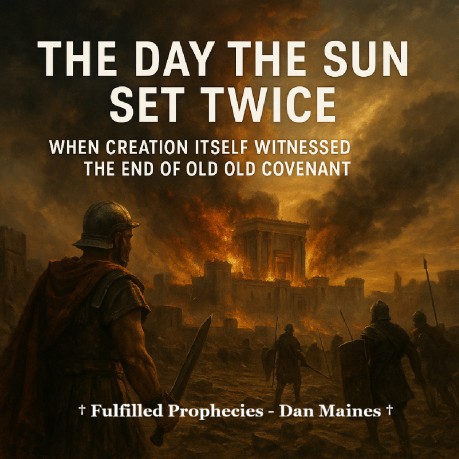
The Day the Sun Set Twice:
When Creation Itself Witnessed the End of the Old Covenant Matthew 24:29 † Jesus used prophetic symbolism already
familiar from Isaiah 13:10 and Ezekiel 32:7. The darkening of the
sun, moon, and stars was not literal, but described the end of a
covenantal world. Israel's leaders, priests, and rulers were the
lights of that order, and when Jerusalem fell, those lights went out
(Isaiah 13:10, Ezekiel 32:7, Luke 21:25-26). † The heavens represented the spiritual realm
of Israel's covenant relationship with God. When it was shaken, it
signified the removal of the Old Covenant structure (Hebrews
12:26-28). The new unshakable kingdom, the body of Christ, would now
remain forever (Daniel 2:44). † The shaking of heaven and earth did not mean
the destruction of creation, but the end of the age that Moses
governed (Hebrews 9:26). The system of law that could not perfect man
was replaced by the everlasting light of the Lamb (John 8:12,
Revelation 21:23). Genesis 1:16-18 † From the beginning, these lights symbolized
rule and authority. Joseph's dream in Genesis 37:9 identified his
father, mother, and brothers as the sun, moon, and stars. These
symbols later represented the governing bodies of Israel under the
Old Covenant (Genesis 37:9-10). † When Adam sinned, the light of his dominion
over creation faded. That was the first sunset, the fall of man, the
loss of covenantal order, and the introduction of death and darkness
(Romans 5:12, 1 Corinthians 15:21-22). † The second sunset occurred when Jerusalem
fell in AD 70. As Adam's fall ended the first creation, Jerusalem's
fall ended the old covenant creation. Out of that darkness came the
everlasting light of the new heaven and new earth, where the Lamb
Himself is the light (Revelation 21:23, 2 Peter 3:13, Isaiah 65:17,
Romans 8:19-21). 2 Corinthians 3:7-11 † Paul contrasted two glories, the fading light
of Moses and the everlasting light of Christ. The fading glory was
the sun of the old covenant setting, while the new light of Christ's
kingdom rose never to fade again (John 1:17, Hebrews 8:13). † The ministry engraved on stone represented
temporary light. It revealed sin but could not remove it (Romans
3:20). The ministry of the Spirit brought permanent light that
transformed hearts and minds (2 Corinthians 3:17-18). † When the temple fell in AD 70, the veil torn
at Christ's death was fully realized (Matthew 27:51). The glory that
once rested on stone and temple departed forever and returned to the
true temple, the body of Christ (1 Corinthians 3:16, Ephesians
2:21-22, Galatians 4:24-26). Revelation 21:23 † This fulfilled Isaiah 60:19, showing that
physical light was no longer needed to represent God's presence. The
New Jerusalem shines with the light of Christ alone, the Lamb who
reigns eternally (John 8:12, Revelation 22:5). † The new creation is not a distant hope but a
present reality. The old covenant world has passed away, and the
glory of God now fills His people (2 Corinthians 5:17, Hebrews
9:11-12). † The city of God, made of living stones,
shines brighter than the sun. Its light will never be darkened
because the Lamb is its lamp and His kingdom has no end (1 Peter 2:5,
Luke 1:33). Historical References How it applies to us today † This is the fulfilled perspective we proclaim at
Fulfilled Prophecies † Source Index
By Dan Maines
But immediately after the
tribulation of those days the sun will be darkened, and the moon will
not give its light, and the stars will fall from the sky, and the
powers of the heavens will be shaken.
God made the two great
lights, the greater light to govern the day, and the lesser light to
govern the night. He made the stars also. God placed them in the
expanse of the heavens to give light on the earth.
But if the ministry of
death, in letters engraved on stones, came with glory, so that the
sons of Israel could not look intently at the face of Moses because
of the glory of his face, fading as it was, how will the ministry of
the Spirit fail to be even more with glory.
And the city has no need of
the sun or of the moon to shine on it, for the glory of God has
illumined it, and its lamp is the Lamb.
†
Josephus recorded that signs appeared in the heavens before
Jerusalem's destruction, seen by priests as omens of judgment (Wars
6.5.3).
† Tacitus confirmed in Histories 5.13
that strange phenomena were seen over Judea, symbolizing divine
judgment upon the nation.
† Eusebius, in
Ecclesiastical History 3.8, recognized that Jerusalem's fall
fulfilled Christ's prophecies, ending the old world and establishing
His eternal kingdom.
† Suetonius also wrote
of omens and heavenly signs before Vespasian's rise and Jerusalem's
fall, affirming the fulfillment of divine prophecy (Lives of the
Caesars, Vespasian 4:5).
†
The day the sun set twice shows that God's promises are precise and
fulfilled. The first sunset began with Adam's fall, and the second
ended the dominion of death through Christ's victory (Romans 5:17, 1
Corinthians 15:57). We now live in the eternal day that never ends
(John 11:26).
† The world did not end,
darkness did. The light of the new covenant will never fade, and the
kingdom of Christ will never be shaken (Hebrews 12:28, Revelation
11:15).
† We no longer wait for light to
come. The Lamb reigns, His city shines, and we walk in the brightness
of His fulfilled kingdom (Ephesians 5:8, Colossians 1:13).
© Fulfilled Prophecies - Dan
Maines.
† Isaiah
13:10, Ezekiel 32:7, Genesis 37:9, Malachi 4:2, Hebrews 12:26-28,
Revelation 21:23, Romans 8:19-21, Galatians 4:24-26
†
Josephus, Wars 6.5.3
† Tacitus, Histories
5.13
† Eusebius, Ecclesiastical History 3.8
†
Suetonius, Lives of the Caesars, Vespasian 4:5
Links