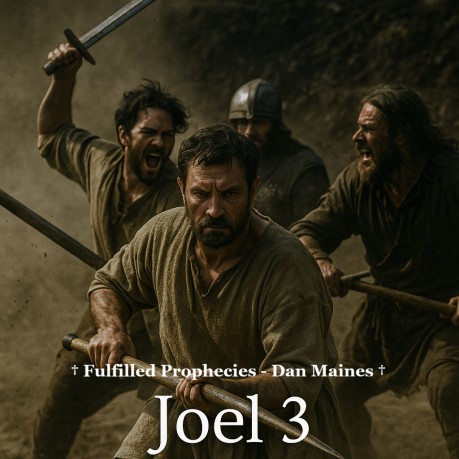
Joel 3 Joel 3:1-2 † God declares a coming restoration for His
people and judgment upon the nations that oppressed them. Joel 3:3-4 † The nations' cruelty reveals their contempt
for God's covenant people. Joel 3:5-6 † The plundering of God's treasures symbolizes
spiritual robbery against His covenant. Joel 3:7-8 † Divine justice repays every act of
oppression. Joel 3:9-10 † The nations are summoned for divine
confrontation. Joel 3:11-12 † God's courtroom imagery reveals His sovereign
authority over all nations. Joel 3:13-14 † The harvest and wine press imagery symbolize
judgment and separation. Joel 3:15-16 † The darkening of celestial bodies marks
covenantal upheaval. Joel 3:17-18 † The prophecy concludes with the image of the
restored, spiritual Jerusalem. Joel 3:19-21 † Egypt and Edom represent all hostile nations
brought to ruin. How it applies to us today † Joel 3 reveals the certainty of divine
justice and the completion of prophecy. † This is the fulfilled perspective we proclaim at
Fulfilled Prophecies † Source Index
By Dan Maines
For behold, in those days and at
that time, when I restore the fortunes of Judah and Jerusalem, I will
gather all the nations and bring them down to the valley of
Jehoshaphat. Then I will enter into judgment with them there on
behalf of My people and My inheritance, Israel, whom they have
scattered among the nations, and they have divided up My land.
†
Historically, this occurred when God avenged the Jews' bloodshed
through the downfall of their persecutors.
†
Prophetically, this valley of judgment points to the covenantal
reckoning that culminated in AD 70.
† Jerome
interpreted the valley of Jehoshaphat as symbolic of divine justice
rather than a geographic location.
† In the
fulfilled kingdom, judgment is complete, and God's people now live
restored in spiritual Zion.
They have also cast lots for My
people, traded a boy for a harlot and sold a girl for wine that they
may drink. Moreover, what are you to Me, O Tyre, Sidon and all the
regions of Philistia? Are you rendering Me a recompense? But if you
do recompense Me, swiftly and speedily I will return your recompense
on your head.
† Historically,
neighboring nations sold Jews into slavery during invasions.
†
Prophetically, this represents the world's rebellion against God's
covenant purpose.
† Jerome said that the
recompense promised here was fulfilled when those very nations
suffered Roman conquest.
† In the fulfilled
kingdom, every injustice has been repaid, and righteousness now
prevails forever.
Since you have taken My silver
and My gold, brought My precious treasures to your temples, and sold
the sons of Judah and Jerusalem to the Greeks in order to remove them
far from their territory.
†
Historically, many captives were taken and sold throughout the
Greco-Roman world.
† Prophetically, these
acts were avenged when God overturned the oppressors' kingdoms.
†
Eusebius noted that the dispersion of the Jews fulfilled this
prophecy literally.
† In the fulfilled
kingdom, the true treasure is the presence of Christ within His
people.
Behold, I am going to arouse them
from the place where you have sold them, and return your recompense
on your head. Also I will sell your sons and your daughters into the
hand of the sons of Judah, and they will sell them to the Sabeans, to
a distant nation, for the Lord has spoken.
† Historically, Judah's enemies
were conquered and enslaved in turn.
†
Prophetically, this reversal signifies the triumph of the covenant
community through Christ.
† Jerome said that
God's justice perfectly balances mercy and retribution.
†
In the fulfilled kingdom, vengeance is complete, and all nations now
bow to the King of kings.
Proclaim this among the nations:
Prepare a war! Rouse the mighty men! Let all the soldiers draw near,
let them come up! Beat your plowshares into swords and your pruning
hooks into spears; let the weak say, I am a mighty man.
† Historically, this describes
the mobilization of armies against God's covenant people.
†
Prophetically, it portrays the gathering of nations in rebellion
before their downfall.
† Eusebius viewed this
as fulfilled in the gathering of the Roman legions against
Jerusalem.
† In the fulfilled kingdom, the
call to war has ceased, for Christ's peace reigns forever.
Hasten and come, all you
surrounding nations, and gather yourselves there. Bring down, O Lord,
Your mighty ones. Let the nations be aroused and come up to the
valley of Jehoshaphat, for there I will sit to judge all the
surrounding nations.
† Historically,
the valley represents the decisive moment of divine intervention.
†
Prophetically, this depicts the judgment of the nations at the end of
the old covenant age.
† Jerome said that “the
valley of Jehoshaphat” means “the Lord judges,” symbolizing
covenant justice.
† In the fulfilled kingdom,
God's judgment has been executed, and His reign is righteous and
eternal.
Put in the sickle, for the
harvest is ripe. Come, tread, for the wine press is full; the vats
overflow, for their wickedness is great. Multitudes, multitudes in
the valley of decision! For the day of the Lord is near in the valley
of decision.
† Historically, this
reflects the slaughter and bloodshed during the Jewish War.
†
Prophetically, it matches Revelation 14:19, fulfilled in the first
century.
† Jerome wrote that the valley of
decision represents God's irreversible verdict against rebellion.
†
In the fulfilled kingdom, the harvest of judgment has passed, and the
harvest of righteousness endures.
The sun and moon grow dark and
the stars lose their brightness. The Lord roars from Zion and utters
His voice from Jerusalem, and the heavens and the earth tremble. But
the Lord is a refuge for His people and a stronghold to the sons of
Israel.
† Historically, this was
fulfilled in Jerusalem's fall and the end of the temple system.
†
Prophetically, it mirrors the apocalyptic signs Jesus foretold in
Matthew 24:29.
† Eusebius said that God's
roar from Zion symbolized the proclamation of His gospel power.
†
In the fulfilled kingdom, believers stand secure in the refuge of
Christ, the eternal Zion.
Then you will know that I am
the Lord your God, dwelling in Zion, My holy mountain. So Jerusalem
will be holy, and strangers will pass through it no more. And in that
day the mountains will drip with sweet wine, and the hills will flow
with milk, and all the brooks of Judah will flow with water; and a
spring will go out from the house of the Lord to water the valley of
Shittim.
†
Historically, physical Jerusalem was destroyed, but spiritual Zion
arose in its place.
† Prophetically, the
flowing waters represent the life of the Spirit proceeding from
Christ.
† Jerome saw this river as the living
water Jesus promised in John 7:38.
† In the
fulfilled kingdom, the saints dwell eternally in the presence of the
Lord, never defiled again.
Egypt will become a waste, and
Edom will become a desolate wilderness, because of the violence done
to the sons of Judah, in whose land they have shed innocent blood.
But Judah will be inhabited forever and Jerusalem for all
generations. And I will avenge their blood which I have not avenged,
for the Lord dwells in Zion.
† Historically, these
nations were subdued under divine judgment.
†
Prophetically, this points to the destruction of all who opposed
God's covenant kingdom.
† Eusebius and Jerome
both identified this as the final fulfillment of God's vengeance in
history.
† In the fulfilled kingdom,
Jerusalem is the eternal city of peace where the Lord dwells forever.
† The
nations' judgment and Jerusalem's restoration were fulfilled in the
first century.
† God's dwelling is now with
His people in the spiritual Zion.
† The
valley of decision has passed; the kingdom of peace remains
forever.
† We now live in the reality of the
fulfilled kingdom where the Lord reigns eternally.
† The Holy
Bible, NASB
† Josephus, The Wars of the Jews,
Book 6
† Eusebius, Ecclesiastical History,
Book 3
† Jerome, Commentary on Joel
†
Clement of Rome, 1 Clement
† Tertullian,
Against Marcion, Book 4
† Hippolytus,
Commentary on Joel
Links