Daniel 10 Daniel 10:1 † This vision came after Cyrus allowed the Jews
to return to Jerusalem, showing that Daniel stayed in Persia for
God's continued purpose. Daniel 10:2-3 † Daniel's mourning and fasting reveal deep
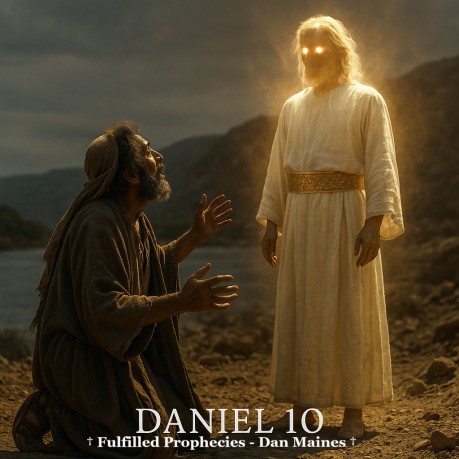
concern for his people rebuilding Jerusalem. Daniel 10:4-6 † Daniel's encounter by the Tigris introduces
his final and greatest revelation. Daniel 10:7-9 † Daniel's companions fled, unable to endure
divine glory, while he fell powerless before it. Daniel 10:10-12 † The touch restores Daniel's strength,
symbolizing divine empowerment. Daniel 10:13-14 † The conflict with the prince of Persia
represents spiritual opposition behind earthly powers. Daniel 10:15-17 † Daniel's weakness again shows human frailty
before divine presence. Daniel 10:18-19 † The repeated touch and words of peace show
divine encouragement to continue. Daniel 10:20-21 † The messenger reveals ongoing angelic warfare
shaping earthly empires. How it applies to us today † Daniel 10 displays unseen spiritual realities
guiding history toward fulfillment in Christ. † This is the fulfilled perspective we proclaim at
Fulfilled Prophecies † Source Index
By Dan Maines
In the third year of Cyrus king
of Persia, a message was revealed to Daniel, who was named
Belteshazzar, and the message was true and one of great conflict, but
he understood the message and had an understanding of the vision.
† Historically, this
took place around 536 BC, just as temple reconstruction began.
†
Prophetically, the message of great conflict reveals the spiritual
struggle behind earthly kingdoms.
† Jerome
said Daniel's understanding reflected divine favor granted only to
the faithful.
† In the fulfilled kingdom,
conflict is understood spiritually, pointing to the triumph of
Christ's eternal reign.
In those days, I, Daniel, had
been mourning for three entire weeks. I did not eat any tasty food,
nor did meat or wine enter my mouth, nor did I use any ointment at
all until the entire three weeks were completed.
†
Historically, this period aligns with Passover, a time of reflection
and repentance.
† Prophetically, the three
weeks symbolize perseverance and divine preparation before
revelation.
† Jerome wrote that Daniel's
fasting reflected readiness to receive heavenly knowledge.
†
In the fulfilled kingdom, mourning gives way to revelation through
the completed work of Christ.
On the twenty-fourth day of
the first month, while I was by the bank of the great river, that is,
the Tigris, I lifted my eyes and looked, and behold, there was a
certain man dressed in linen, whose waist was girded with a belt of
pure gold of Uphaz. His body also was like beryl, his face had the
appearance of lightning, his eyes were like flaming torches, his arms
and feet like the gleam of polished bronze, and the sound of his
words like the sound of a tumult.
†
Historically, linen garments represented purity, worn by priests and
angels alike.
† Prophetically, the man in
linen points to Christ appearing in glory.
†
Hippolytus said the golden belt symbolized righteousness and divine
authority.
† In the fulfilled kingdom,
Christ's radiant presence reveals divine majesty and judgment.
Now I, Daniel, alone saw the
vision, while the men who were with me did not see it; nevertheless,
a great dread fell on them, and they ran away to hide themselves. So
I was left alone and saw this great vision; yet no strength was left
in me, for my natural color turned to a deathly pallor, and I
retained no strength. But I heard the sound of his words, and as soon
as I heard the sound of his words, I fell into a deep sleep on my
face, with my face to the ground.
†
Historically, this reveals the holiness of God's presence and human
weakness.
† Prophetically, the collapse shows
flesh silenced before spiritual revelation.
†
Clement observed that divine glory exposes man's frailty but prepares
him for renewal.
† In the fulfilled kingdom,
God's glory still humbles yet strengthens His servants.
Then behold, a hand touched
me and set me trembling on my hands and knees. He said to me, "O
Daniel, man of high esteem, understand the words that I am about to
tell you and stand upright, for I have now been sent to you."
And when he had spoken this word to me, I stood up trembling. Then he
said to me, "Do not be afraid, Daniel, for from the first day
that you set your heart on understanding this and on humbling
yourself before your God, your words were heard, and I have come in
response to your words."
†
Historically, this marks the angel's reassurance that his prayer was
heard from the start.
† Prophetically, it
reveals that heavenly forces respond to the faithful immediately.
†
Jerome said Daniel's esteem shows how humility gains divine favor.
†
In the fulfilled kingdom, God hears and answers through Christ our
intercessor.
"But the prince of the
kingdom of Persia was withstanding me for twenty-one days; then
behold, Michael, one of the chief princes, came to help me, for I had
been left there with the kings of Persia. Now I have come to give you
an understanding of what will happen to your people in the latter
days, for the vision pertains to the days yet future."
†
Historically, Michael is identified as Israel's guardian archangel.
†
Prophetically, this unveils the unseen struggle preceding covenant
fulfillment.
† Hippolytus linked this to the
transition from Persian to Greek dominion foretold later.
†
In the fulfilled kingdom, Christ's victory ensures no power can
resist His reign.
When he had spoken to me
according to these words, I turned my face toward the ground and
became speechless. And behold, one who resembled a human being was
touching my lips; then I opened my mouth and spoke and said to him
who was standing before me, "O my lord, as a result of the
vision anguish has come upon me, and I have retained no strength. For
how can such a servant of my lord talk with such as my lord? As for
me, there remains just now no strength in me, nor has any breath been
left in me."
† Historically,
prophets often lost strength when faced with heavenly glory.
†
Prophetically, this moment reveals the need for divine empowerment to
comprehend revelation.
† Jerome explained
that the touch of the lips signified purification and readiness to
speak truth.
† In the fulfilled kingdom,
believers are strengthened to declare the finished work of Christ.
Then this one with human
appearance touched me again and strengthened me. He said, "O man
of high esteem, do not be afraid. Peace be with you; take courage and
be courageous!" Now as he spoke to me, I received strength and
said, "May my lord speak, for you have strengthened me."
†
Historically, such reassurances echo throughout prophetic
encounters.
† Prophetically, the peace
offered prefigures the peace of Christ given to His kingdom.
†
Clement said that God's servants are emboldened through divine
comfort, not human effort.
† In the fulfilled
kingdom, peace and courage are the fruit of Christ's everlasting
presence.
Then he said, "Do you
understand why I came to you? But I shall now return to fight against
the prince of Persia; so I am going forth, and behold, the prince of
Greece is about to come. However, I will tell you what is inscribed
in the writing of truth. Yet there is no one who stands firmly with
me against these forces except Michael your prince."
† Historically, this
anticipates Persia's fall and Greece's rise under Alexander the
Great.
† Prophetically, it shows heaven's
sovereignty over history leading to Christ's dominion.
†
Eusebius interpreted this as the final preparation for the Messiah's
coming.
† In the fulfilled kingdom, all
nations are subject to the rule of the risen Christ.
†
The messenger's struggle reflects the divine orchestration of
kingdoms for redemptive purpose.
† The peace
and strength Daniel received prefigure the confidence believers have
in Christ.
† Every conflict in history serves
the plan already accomplished in the cross.
†
We now live under the everlasting peace of the fulfilled kingdom.
© Fulfilled Prophecies - Dan
Maines.
† The Holy
Bible, NASB
† Josephus, Antiquities of the
Jews, Book 10
† Eusebius, Ecclesiastical
History, Book 9
† Tertullian, Against
Marcion, Book 4
† Clement of Rome, 1
Clement
† Jerome, Commentary on Daniel
†
Theodotion, Greek Version of Daniel
†
Hippolytus, Commentary on Daniel
Links