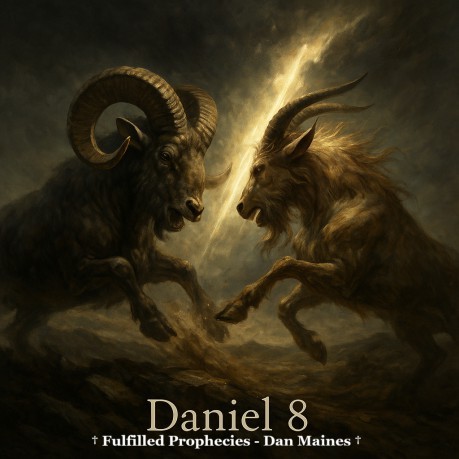
Daniel 8 Daniel 8:1-2 † This vision came two years after the one in
chapter 7, giving more detail about the coming empires. Daniel 8:3-4 † The ram with two horns represents the
Medo-Persian Empire, one horn higher showing Persia's dominance. Daniel 8:5-7 † The male goat represents Greece under
Alexander the Great, whose speed of conquest is seen in "not
touching the ground." Daniel 8:8 † The breaking of the horn represents
Alexander's sudden death at the height of his power. Daniel 8:9-12 † The small horn represents Antiochus IV
Epiphanes of the Seleucid Empire. Daniel 8:13-14 † The 2,300 days represent roughly six and a
half years of temple defilement and struggle. Daniel 8:15-17 † The angel Gabriel is introduced here for the
first time, revealing divine interpretation directly. Daniel 8:18-22 † Gabriel confirms the historical identities of
the ram and goat, removing all ambiguity. Daniel 8:23-25 † This describes Antiochus Epiphanes again,
called "insolent" for his pride against God. Daniel 8:26-27 † Daniel's exhaustion shows the weight of
divine revelation and its long-term fulfillment. How it applies to us today † Daniel 8 demonstrates God's control over the
rise and fall of empires. † This is the fulfilled perspective we proclaim at
Fulfilled Prophecies † Source Index
By Dan Maines
In the third year of the reign
of Belshazzar the king, a vision appeared to me, Daniel, subsequent
to the one which appeared to me previously. I looked in the vision,
and while I was looking I was in the citadel of Susa, which is in the
province of Elam, and I looked in the vision and I myself was beside
the Ulai Canal.
†
Historically, Susa later became the capital of the Persian Empire,
showing this prophecy's accuracy.
†
Prophetically, God revealed these kingdoms before they rose, proving
His sovereign foreknowledge.
† Jerome said
Daniel's presence at Susa foreshadowed Persia's rise over Babylon.
†
In the fulfilled kingdom, God's plan is always revealed before its
completion in Christ.
Then I lifted my eyes and
looked, and behold, a ram which had two horns was standing in front
of the canal. Now the two horns were long, but one was longer than
the other, with the longer one coming up last. I saw the ram butting
westward, northward, and southward, and no other beasts could stand
before him nor was there anyone to rescue from his power, but he did
as he pleased and magnified himself.
†
Historically, this empire conquered westward (Babylon), northward
(Lydia), and southward (Egypt).
†
Prophetically, the ram's pride foreshadows human kingdoms that exalt
themselves before God's judgment.
† Josephus
confirmed this symbol's fulfillment in Cyrus and Darius' dual rule.
†
In the fulfilled kingdom, Christ overthrows all self-exalting powers
by humility and truth.
While I was observing, behold,
a male goat was coming from the west over the surface of the whole
earth without touching the ground, and the goat had a conspicuous
horn between his eyes. He came up to the ram that had the two horns,
which I had seen standing in front of the canal, and rushed at him in
his mighty wrath. I saw him come beside the ram, and he was enraged
at him, and he struck the ram and shattered his two horns, and the
ram had no strength to withstand him.
† Historically,
Alexander's fury against Persia fulfilled this prophecy perfectly.
†
Prophetically, this shows how temporary human glory is compared to
the eternal dominion of Christ.
† Jerome
wrote that the goat's charge symbolized swift vengeance ordained by
God.
† In the fulfilled kingdom, the power of
the nations falls before the everlasting kingdom of Christ.
Then the male goat magnified
himself exceedingly. But as soon as he was mighty, the large horn was
broken, and in its place there came up four conspicuous horns toward
the four winds of heaven.
†
Historically, his empire split among four generals, Cassander,
Lysimachus, Seleucus, and Ptolemy.
†
Prophetically, this division reveals the instability of all kingdoms
apart from God's rule.
† Eusebius noted that
the "four winds" show the scattering of human power after
pride.
† In the fulfilled kingdom, Christ's
dominion cannot be divided or overthrown.
Out of one of them came forth
a rather small horn which grew exceedingly great toward the south,
toward the east, and toward the Beautiful Land. It grew up to the
host of heaven and caused some of the host and some of the stars to
fall to the earth, and it trampled them down. It even magnified
itself to be equal with the Commander of the host, and it removed the
regular sacrifice from Him, and the place of His sanctuary was thrown
down.
†
Historically, he desecrated the Jerusalem temple and stopped daily
sacrifices around 167 BC.
† Prophetically,
this foreshadowed the persecution and corruption of the covenant
before Christ's kingdom arrived.
† Jerome
said Antiochus' arrogance prefigured those who exalt themselves
against God's true temple.
† In the fulfilled
kingdom, no earthly power can again profane the true spiritual
sanctuary of Christ.
Then I heard a holy one
speaking, and another holy one said to that particular one who was
speaking, "How long will the vision about the regular sacrifice
apply, while the transgression causes horror, so as to allow both the
holy place and the host to be trampled?" He said to me, "For
2,300 evenings and mornings, then the holy place will be properly
restored."
†
Historically, this was fulfilled from Antiochus' desecration to the
Maccabean restoration.
† Prophetically, this
foretells the end of temple worship before the coming of the true
temple, Christ.
† Hippolytus explained that
"evenings and mornings" symbolize continual offerings ended
and renewed.
† In the fulfilled kingdom,
worship is restored forever in spirit and truth.
When I, Daniel, had seen the
vision, I sought to understand it, and behold, standing before me was
one who looked like a man. And I heard the voice of a man between the
banks of Ulai, and he called out and said, "Gabriel, give this
man an understanding of the vision." So he came near to where I
was standing, and when he came I was frightened and fell on my face,
but he said to me, "Son of man, understand that the vision
pertains to the time of the end."
†
Historically, "time of the end" referred to the close of
the old covenant age, not the end of the world.
†
Prophetically, Gabriel's explanation affirms that God interprets His
own mysteries for His people.
† Theodotion
identified this encounter as the beginning of the apocalyptic
unveiling completed in Christ.
† In the
fulfilled kingdom, understanding is given through the Spirit who
reveals all truth.
Now while he was talking with
me, I sank into a deep sleep with my face to the ground, but he
touched me and made me stand upright. He said, "Behold, I am
going to let you know what will occur at the final period of the
indignation, for it pertains to the appointed time of the end. The
ram which you saw with the two horns represents the kings of Media
and Persia. The shaggy goat represents the kingdom of Greece, and the
large horn that is between his eyes is the first king. The broken
horn and the four horns that arose in its place represent four
kingdoms which will arise from his nation, although not with his
power."
†
Historically, each empire rose and fell exactly as prophesied.
†
Prophetically, this prepares the way for the coming of God's eternal
dominion in Christ.
† Jerome emphasized that
"not with his power" shows how human greatness fades
quickly.
† In the fulfilled kingdom, the only
enduring power is Christ's eternal reign.
"In the latter period of
their rule, when the transgressors have run their course, a king will
arise, insolent and skilled in intrigue. His power will be mighty,
but not by his own power, and he will destroy to an extraordinary
degree and prosper and perform his will, he will destroy mighty men
and the holy people. And through his shrewdness he will cause deceit
to succeed by his influence, and he will magnify himself in his
heart, and he will destroy many while they are at ease. He will even
oppose the Prince of princes, but he will be broken without human
agency."
†
Historically, he died suddenly from disease while planning another
attack on Jerusalem.
† Prophetically, "broken
without human agency" foreshadows divine judgment beyond human
cause.
† Eusebius wrote that this
demonstrates God's sovereignty in bringing down the proud.
†
In the fulfilled kingdom, all opposition to Christ's reign ends by
His divine power.
"The vision of the
evenings and mornings which has been told is true, but keep the
vision secret, for it pertains to many days in the future." Then
I, Daniel, was exhausted and sick for days. Then I got up again and
carried on the king's business, but I was astounded at the vision,
and there was none to explain it.
†
Historically, the events took centuries to unfold precisely as
predicted.
† Prophetically, secrecy pointed
to a mystery later unveiled in Christ's completed kingdom.
†
Clement said Daniel's faithfulness in serving the king even after the
vision teaches endurance under revelation.
†
In the fulfilled kingdom, we now understand what Daniel saw from
afar, the full establishment of God's reign.
† History confirms
every detail, proving prophecy's perfect fulfillment.
†
The "Prince of princes" has already conquered every earthly
power.
† We now live in the kingdom Daniel
foresaw, where Christ reigns forever.
† God's
sovereignty and faithfulness remain unbroken from age to age.
© Fulfilled Prophecies - Dan
Maines.
† The Holy
Bible, NASB
† Josephus, Antiquities of the
Jews, Book 10
† Eusebius, Ecclesiastical
History, Book 9
† Tertullian, Against
Marcion, Book 4
† Clement of Rome, 1
Clement
† Jerome, Commentary on Daniel
†
Theodotion, Greek Version of Daniel
†
Hippolytus, Commentary on Daniel
Links