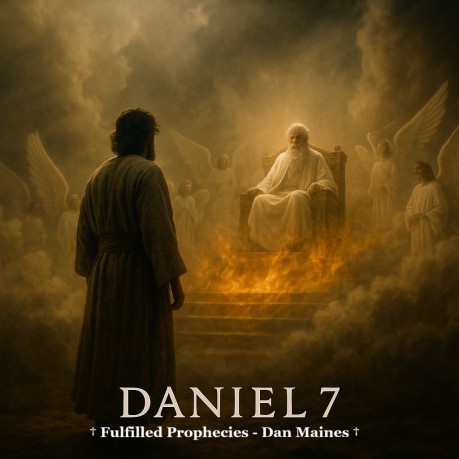
Daniel 7 Daniel 7:1-2 † Daniel's vision begins during Belshazzar's
reign, showing God's revelation before Babylon's fall. Daniel 7:3-4 † The lion with eagle's wings represents
Babylon, symbolizing strength and swiftness in conquest. Daniel 7:5 † The bear represents the Medo-Persian Empire,
raised on one side to show Persia's dominance over Media. Daniel 7:6 † The leopard signifies Greece, swift in
conquest under Alexander the Great. Daniel 7:7-8 † The fourth beast represents Rome, unmatched
in power, cruelty, and scope. Daniel 7:9-10 † The Ancient of Days represents God's eternal
judgment and holiness. Daniel 7:11-12 † The destruction of the fourth beast
represents the end of Rome's persecuting power. Daniel 7:13-14 † The Son of Man is Christ, receiving His
kingdom after His ascension. Daniel 7:15-18 † Daniel's distress shows the weight of
revelation concerning earthly turmoil and divine sovereignty. Daniel 7:19-22 † The persecution of the saints refers to
Nero's brutal campaign against believers. Daniel 7:23-27 † The fourth beast is Rome, the blasphemous
horn its Caesar persecutors. Daniel 7:28 † Daniel's fear shows the gravity of the
vision, yet its fulfillment brings us peace. How it applies to us today † Daniel 7 proves that Christ reigns now as the
Son of Man with everlasting dominion. † This is the fulfilled perspective we proclaim at
Fulfilled Prophecies † Source Index
By Dan Maines
In the first year of Belshazzar
king of Babylon Daniel saw a dream and visions in his mind as he lay
on his bed; then he wrote the dream down and related the following
summary of it. Daniel said, "I was looking in my vision by
night, and behold, the four winds of heaven were stirring up the
great sea."
†
Historically, turbulent seas symbolized the nations in chaos under
human rule.
† Prophetically, this introduces
the transition from earthly kingdoms to God's everlasting one.
†
Jerome identified the "four winds" as the forces by which
God stirs nations to fulfill His purpose.
†
In the fulfilled kingdom, Christ calms the chaos of the nations
through His eternal peace.
And four great beasts were
coming up from the sea, different from one another. The first was
like a lion and had the wings of an eagle. I kept looking until its
wings were plucked, and it was lifted up from the ground and made to
stand on two feet like a man; a human mind also was given to it.
†
Historically, winged lions adorned Babylonian palaces, marking its
power.
† Prophetically, the plucking of wings
points to Nebuchadnezzar's humbling and restoration.
†
Hippolytus taught that the transformation to a man prefigured
repentance and divine mercy.
† In the
fulfilled kingdom, all prideful rulers are humbled before the King of
heaven.
And behold, another beast, a
second one resembling a bear. And it was raised up on one side, and
three ribs were in its mouth between its teeth; and thus they said to
it, "Arise, devour much meat!"
†
Historically, its three ribs symbolize Lydia, Babylon, and Egypt,
which Persia conquered.
† Prophetically, this
empire prepared the way for Israel's return and temple restoration.
†
Josephus confirmed Persia's dual nature under Darius and Cyrus.
†
In the fulfilled kingdom, God uses even earthly powers to accomplish
His redemptive plan.
After this I kept looking, and
behold, another one, like a leopard, which had on its back four wings
of a bird; the beast also had four heads, and dominion was given to
it.
†
Historically, the four heads represent the division of his empire
among his generals.
† Prophetically, this
shows how rapid expansion led to fragmentation and decline.
†
Jerome wrote that divine sovereignty "gave" dominion,
proving no empire rises apart from God's will.
†
In the fulfilled kingdom, dominion belongs permanently to Christ
alone.
After this I kept looking in
the night visions, and behold, a fourth beast, dreadful and
terrifying and extremely strong; and it had large iron teeth. It
devoured and crushed and trampled down the remainder with its feet;
and it was different from all the beasts that were before it, and it
had ten horns. While I was contemplating the horns, behold, another
horn, a little one, came up among them, and three of the first horns
were pulled out by the roots before it; and behold, this horn
possessed eyes like the eyes of a man and a mouth uttering great
boasts.
† Historically,
its ten horns symbolize the governors and client kings under Roman
authority.
† Prophetically, the little horn
refers to the Caesars who exalted themselves as gods.
†
Eusebius linked the "boastful mouth" to Nero's blasphemous
persecution of the saints.
† In the fulfilled
kingdom, Christ judged Rome's arrogance through His completed reign.
I kept looking until thrones
were set up, and the Ancient of Days took His seat; His vesture was
like white snow and the hair of His head like pure wool. His throne
was ablaze with flames, its wheels were a burning fire. A river of
fire was flowing and coming out from before Him; thousands upon
thousands were attending Him, and myriads upon myriads were standing
before Him; the court sat, and the books were opened.
† Historically,
imagery of divine fire symbolized purity and judgment in Jewish
apocalyptic thought.
† Prophetically, this
describes the heavenly court convening for covenantal judgment in AD
70.
† Hippolytus wrote that the opening of
the books revealed the record of the nations' deeds.
†
In the fulfilled kingdom, Christ reigns from this fiery throne as
Judge and Redeemer.
Then I kept looking because
of the sound of the boastful words which the horn was speaking; I
kept looking until the beast was slain, and its body was destroyed
and given to the burning fire. As for the rest of the beasts, their
dominion was taken away, but an extension of life was granted to them
for an appointed period of time.
†
Historically, this occurred as the empire declined and Jerusalem's
judgment was fulfilled.
† Prophetically, the
burning of the beast reflects the covenantal end of the old age.
†
Jerome said the "extension of life" refers to nations
continuing under God's temporal rule.
† In
the fulfilled kingdom, the true dominion remains forever in Christ's
hands.
"I kept looking in the
night visions, and behold, with the clouds of heaven One like a Son
of Man was coming, and He came up to the Ancient of Days and was
presented before Him. And to Him was given dominion, glory and a
kingdom, that all the peoples, nations and men of every language
might serve Him. His dominion is an everlasting dominion which will
not pass away; and His kingdom is one which will not be destroyed."
† Historically,
Jesus applied this verse to Himself before the Sanhedrin (Matthew
26:64).
† Prophetically, this marks the
transfer of dominion from earthly empires to Christ's eternal
reign.
† Eusebius proclaimed this as the
fulfillment seen in the destruction of Jerusalem and Rome's
submission.
† In the fulfilled kingdom, all
nations serve the Son of Man, whose rule never ends.
"As for me, Daniel, my
spirit was distressed within me, and the visions in my mind kept
alarming me. I approached one of those who were standing by and began
asking him the exact meaning of all this. So he told me and made
known to me the interpretation of these things: 'These great beasts,
which are four in number, are four kings who will arise from the
earth. But the saints of the Highest One will receive the kingdom and
possess the kingdom forever, for all ages to come.'"
†
Historically, the four kingdoms correspond to Babylon, Medo-Persia,
Greece, and Rome.
† Prophetically, the
saints' possession of the kingdom points to the church inheriting
spiritual dominion.
† Clement affirmed that
the saints now reign with Christ in the fulfilled kingdom.
†
In the fulfilled kingdom, believers live in the eternal reality
Christ established.
Then I desired to know the
exact meaning of the fourth beast... I kept looking, and that horn
was waging war with the saints and overpowering them until the
Ancient of Days came and judgment was passed in favor of the saints
of the Highest One, and the time arrived when the saints took
possession of the kingdom.
†
Historically, this ended with the fall of Jerusalem and the death of
the persecutors.
† Prophetically, the
judgment in favor of the saints marks the vindication of the faithful
in AD 70.
† Hippolytus viewed this as the
moment the church inherited Christ's everlasting dominion.
†
In the fulfilled kingdom, judgment has been rendered, and the saints
reign with Christ.
"Thus he said: 'The
fourth beast will be a fourth kingdom on the earth... He will speak
out against the Most High and wear down the saints of the Highest
One... But the court will sit for judgment, and his dominion will be
taken away, annihilated and destroyed forever. Then the sovereignty,
the dominion and the greatness of all the kingdoms under the whole
heaven will be given to the people of the saints of the Highest One;
His kingdom will be an everlasting kingdom, and all the dominions
will serve and obey Him.'"
† Historically,
Nero and his successors fulfilled this prophecy through their war on
the saints.
† Prophetically, this declares
the final transfer of all authority to Christ and His saints.
†
Jerome and Eusebius identified this as the establishment of Christ's
universal dominion.
† In the fulfilled
kingdom, all rule is under Christ, and His people reign in spiritual
victory.
"At this point the
revelation ended. As for me, Daniel, my thoughts were greatly
alarming me and my face grew pale, but I kept the matter to myself."
†
Historically, the vision spanned centuries until Christ's completed
work.
† Prophetically, the fulfillment of
these visions confirms God's absolute sovereignty.
†
Theodotion wrote that Daniel's silence prefigured the mystery
revealed later through Christ.
† In the
fulfilled kingdom, the mystery once hidden is now fully revealed in
Christ's eternal reign.
† The
saints already possess the kingdom, living in its spiritual
reality.
† The beasts represent temporary
empires, all replaced by the eternal rule of Christ.
†
We live in the peace and authority of that fulfilled kingdom.
†
Every earthly power bows before the unshakable kingdom of God.
© Fulfilled Prophecies - Dan
Maines.
† The Holy
Bible, NASB
† Josephus, Antiquities of the
Jews, Book 10
† Eusebius, Ecclesiastical
History, Book 9
† Tertullian, Against
Marcion, Book 4
† Clement of Rome, 1
Clement
† Jerome, Commentary on Daniel
†
Theodotion, Greek Version of Daniel
†
Hippolytus, Commentary on Daniel
Links