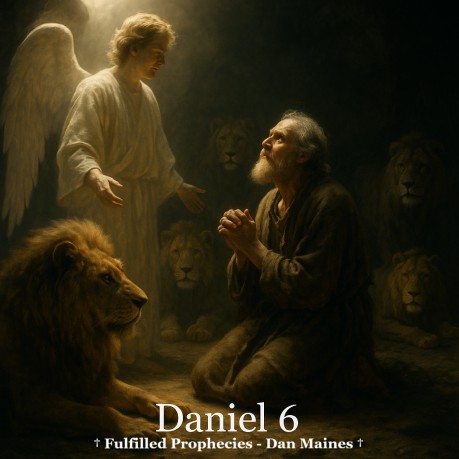
Daniel 6 Daniel 6:1-2 † Daniel's promotion under Darius shows that
faithfulness brings favor even in foreign dominions. Daniel 6:3-4 † Daniel's excellence made him a target of
jealousy, but his integrity exposed their sin. Daniel 6:5-6 † The enemies of truth always seek to twist
devotion into guilt. Daniel 6:7-9 † The law of man was used as a snare against
God's servant. Daniel 6:10 † Daniel did not change his devotion when
threatened, proving faith above fear. Daniel 6:11-13 † The conspirators turned obedience to God into
a crime. Daniel 6:14-16 † The king's compassion revealed his respect
for Daniel's faith, though bound by law. Daniel 6:17-18 † The sealed stone echoes the burial of Christ,
a temporary triumph of man's authority. Daniel 6:19-22 † Daniel's deliverance demonstrates divine
intervention in response to unwavering faith. Daniel 6:23-24 † God's justice vindicated Daniel and destroyed
his enemies. Daniel 6:25-27 † The decree of Darius echoed Nebuchadnezzar's
earlier confession, magnifying God's universal rule. Daniel 6:28 † Daniel's longevity revealed the sustaining
power of God's faithfulness. How it applies to us today † Daniel 6 reminds believers that loyalty to
God brings deliverance, even in persecution. † This is the fulfilled perspective we proclaim at
Fulfilled Prophecies † Source Index
By Dan Maines
It seemed good to Darius to
appoint 120 satraps over the kingdom, that they would be in charge of
the whole kingdom, and over them three commissioners, of whom Daniel
was one, that these satraps might be accountable to them, and that
the king might not suffer loss.
†
Historically, the Medo-Persian administration divided the empire into
satrapies for order and efficiency.
†
Prophetically, Daniel's role as overseer reflects God's people
reigning in spiritual authority in His kingdom.
†
Jerome noted that Daniel's integrity caused envy among corrupt men,
just as righteousness provokes the world.
†
In the fulfilled kingdom, believers are entrusted with spiritual
oversight under Christ, the eternal King.
Then this Daniel began
distinguishing himself among the commissioners and satraps because he
possessed an extraordinary spirit, and the king planned to appoint
him over the entire kingdom. Then the commissioners and satraps began
trying to find a ground of accusation against Daniel in regard to
government affairs; but they could find no ground of accusation or
evidence of corruption, inasmuch as he was faithful, and no
negligence or corruption was to be found in him.
†
Historically, envy in royal courts often led to conspiracies and
false accusations.
† Prophetically, this
foreshadows Christ, against whom no fault was found, yet He was
condemned unjustly.
† Clement admired
Daniel's blamelessness as an example of holy service.
†
In the fulfilled kingdom, believers must walk in purity and
faithfulness, reflecting Christ's character.
Then these men said, "We
will not find any ground of accusation against this Daniel unless we
find it against him with regard to the law of his God." Then
these commissioners and satraps came by agreement to the king and
spoke to him as follows: "King Darius, live forever!"
† Historically, Persian
rulers were easily swayed by flattery and political manipulation.
†
Prophetically, this mirrors how the religious elite turned the law
against Christ and His followers.
† Eusebius
compared these accusers to those who sought Christ's death under
false pretense.
† In the fulfilled kingdom,
faithfulness to God always exposes the schemes of the unrighteous.
"All the commissioners of
the kingdom, the prefects and the satraps, the high officials and the
governors have consulted together that the king should establish a
statute and enforce an injunction that anyone who makes a petition to
any god or man besides you, O king, for thirty days, shall be cast
into the lions' den. Now, O king, establish the injunction and sign
the document, so that it may not be changed, according to the law of
the Medes and Persians, which may not be revoked." Therefore
King Darius signed the document, that is, the injunction.
† Historically, Persian laws
were unchangeable once sealed with the king's signet.
†
Prophetically, this represents the binding traditions that Christ
later freed mankind from.
† Theodotion
emphasized the contrast between the law of man and the eternal law of
God.
† In the fulfilled kingdom, no earthly
decree can silence true worship or divine authority.
Now when Daniel knew that the
document was signed, he entered his house (now in his roof chamber he
had windows open toward Jerusalem); and he continued kneeling on his
knees three times a day, praying and giving thanks before his God, as
he had been doing previously.
†
Historically, facing Jerusalem symbolized hope in God's covenant and
His presence.
† Prophetically, this points to
steadfast worship even under persecution.
†
Jerome said Daniel's open prayer displayed holy defiance rooted in
faith, not rebellion.
† In the fulfilled
kingdom, prayer remains the believer's lifeline, unaffected by
threats of men.
Then these men came by
agreement and found Daniel making petition and supplication before
his God. Then they approached and spoke before the king about the
king's injunction... "Daniel, who is one of the exiles from
Judah, pays no attention to you, O king, or to the injunction which
you signed, but keeps making his petition three times a day."
† Historically, Daniel's accusers
exploited the unchangeable law to trap the king.
†
Prophetically, this reveals how legal systems can be corrupted
against the righteous.
† Clement noted that
Daniel's faith proved that loyalty to God outweighs loyalty to men.
†
In the fulfilled kingdom, believers face similar accusations but
remain justified before God.
Then, as soon as the king
heard this statement, he was deeply distressed and set his mind on
delivering Daniel... Then the king gave orders, and Daniel was
brought in and cast into the lions' den. The king spoke and said to
Daniel, "Your God whom you constantly serve will Himself deliver
you."
†
Historically, lions' dens were royal execution pits used for
spectacle and punishment.
† Prophetically,
this represents persecution against the faithful by worldly
systems.
† Hippolytus compared the lions' den
to Christ's tomb, where deliverance triumphed over death.
†
In the fulfilled kingdom, the faithful trust in divine protection no
matter the danger.
A stone was brought and laid
over the mouth of the den; and the king sealed it with his own signet
ring and with the signet rings of his nobles, so that nothing would
be changed in regard to Daniel. Then the king went off to his palace
and spent the night fasting, and no entertainment was brought before
him; and his sleep fled from him.
†
Historically, sealing ensured that the decree could not be tampered
with.
† Prophetically, this foreshadows the
resurrection, when divine power breaks human seals.
†
Jerome saw in Darius a symbol of conscience tormented by injustice.
†
In the fulfilled kingdom, even the seals of kings cannot restrain the
purposes of God.
Then the king arose at dawn,
at the break of day, and went in haste to the lions' den. When he had
come near the den to Daniel, he cried out with a troubled voice. The
king spoke and said to Daniel, "Daniel, servant of the living
God, has your God, whom you constantly serve, been able to deliver
you from the lions?" Then Daniel spoke to the king, "O
king, live forever! My God sent His angel and shut the lions' mouths
and they have not harmed me, inasmuch as I was found innocent before
Him; and also toward you, O king, I have committed no crime."
†
Historically, lions were starved to ensure savagery, proving the
miracle genuine.
† Prophetically, the angel's
presence reveals God's protection over His faithful in every age.
†
Eusebius and Hippolytus both saw this as a type of Christ's victory
over death.
† In the fulfilled kingdom, no
weapon formed against God's people can prosper.
Then the king was very
pleased and gave orders for Daniel to be taken up out of the den...
The king then gave orders, and they brought those men who had
maliciously accused Daniel, and they cast them, their children, and
their wives into the lions' den; and they had not reached the bottom
of the den before the lions overpowered them and crushed all their
bones.
† Historically, Persian law
allowed punishment of families involved in conspiracy.
†
Prophetically, this event signifies the final judgment of those who
oppose the righteous.
† Jerome wrote that
divine justice always restores balance when human law fails.
†
In the fulfilled kingdom, God's protection and judgment are both
perfect and complete.
Then Darius the king wrote to
all the peoples, nations, and men of every language who were living
in all the land: "May your peace abound! I make a decree that in
all the dominion of my kingdom men are to fear and tremble before the
God of Daniel; for He is the living God and enduring forever, and His
kingdom is one which will not be destroyed, and His dominion will be
forever."
†
Historically, Persian kings often issued empire-wide proclamations in
written form.
† Prophetically, this
announcement declares the everlasting kingdom fulfilled in Christ.
†
Clement and Eusebius both identified this as symbolic of the gospel
reaching all nations.
† In the fulfilled
kingdom, all authority confesses the eternal reign of God through
Christ.
So this Daniel enjoyed success
in the reign of Darius and in the reign of Cyrus the Persian.
† Historically,
Daniel's service spanned multiple empires, demonstrating divine favor
beyond nations.
† Prophetically, this
symbolizes the enduring kingdom that transcends all earthly powers.
†
Hippolytus said Daniel's survival through empires proves that truth
outlasts tyrants.
† In the fulfilled kingdom,
faithfulness endures while worldly thrones rise and fall.
†
The lions' den reveals that divine power is greater than human
decree.
† The sealed stone mirrors Christ's
triumph over death and the world's judgment.
†
Those who trust in God stand secure, for His kingdom rules over
all.
† In the fulfilled kingdom, faith
remains unshakable because Christ has already overcome.
© Fulfilled Prophecies - Dan
Maines.
† The Holy
Bible, NASB
† Josephus, Antiquities of the
Jews, Book 10
† Eusebius, Ecclesiastical
History, Book 9
† Tertullian, Against
Marcion, Book 4
† Clement of Rome, 1
Clement
† Jerome, Commentary on Daniel
†
Theodotion, Greek Version of Daniel
†
Hippolytus, Commentary on Daniel
Links