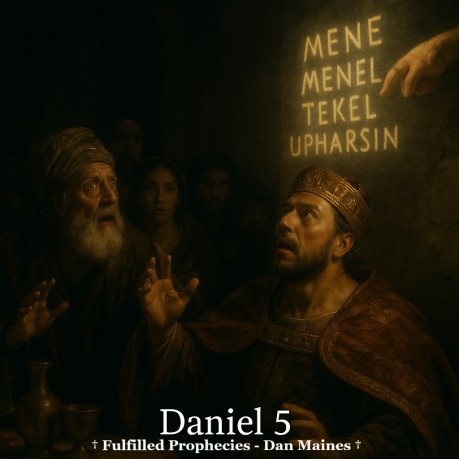
Daniel 5 Daniel 5:1–2 † Belshazzar's feast represents arrogance
against God, as sacred vessels were defiled for drunken pleasure. Daniel 5:3–4 † The vessels symbolized God's presence, and
their misuse mocked the holiness of His name. Daniel 5:5–6 † The sudden hand of God broke through the
king's pride and drunkenness. Daniel 5:7–9 † The king's desperation showed how powerless
human wisdom was against divine revelation. Daniel 5:10–12 † The queen remembered Daniel, showing that
God's servant was still honored even when forgotten by men. Daniel 5:13–16 † Belshazzar recognized Daniel's reputation but
treated him as a captive rather than a prophet. Daniel 5:17 † Daniel refused reward, showing that God's
message cannot be bought. Daniel 5:18–21 † Daniel reminded Belshazzar of his father's
humbling, showing that he had ignored history's lesson. Daniel 5:22–23 † Daniel condemned Belshazzar's willful
defiance despite knowing God's past dealings. Daniel 5:24–28 † God's message was brief but final, showing
the precision of divine justice. Daniel 5:29–31 † Daniel received honor, but the kingdom
perished the same night. How it applies to us today † Daniel 5 reminds us that God's judgment is
sure, and pride leads to downfall. † This is the fulfilled perspective we proclaim at
Fulfilled Prophecies † Source Index
By Dan Maines
Belshazzar the king held a
great feast for a thousand of his nobles, and he was drinking wine in
the presence of the thousand. When Belshazzar tasted the wine, he
gave orders to bring the gold and silver vessels which Nebuchadnezzar
his father had taken out of the temple which was in Jerusalem, so
that the king and his nobles, his wives, and his concubines might
drink from them.
†
Historically, this event occurred the night Babylon fell to the Medes
and Persians in 539 BC.
† Prophetically, this
shows how divine judgment falls suddenly on the proud and
irreverent.
† Josephus confirmed that
Belshazzar's feast occurred during the empire's final hours.
†
In the fulfilled kingdom, this reminds us that the misuse of what is
holy brings swift correction.
Then they brought the gold
vessels that had been taken out of the temple, the house of God which
was in Jerusalem; and the king and his nobles, his wives, and his
concubines drank from them. They drank the wine and praised the gods
of gold and silver, of bronze, iron, wood and stone.
†
Historically, Belshazzar's act of idolatry was a direct insult to the
God of Israel.
† Prophetically, this scene
mirrors how Israel misused God's blessings before judgment fell.
†
Jerome noted that their blasphemy against the sacred led to their
swift downfall.
† In the fulfilled kingdom,
all glory and worship belong to Christ alone, not to the works of
men.
Suddenly the fingers of a
man's hand emerged and began writing opposite the lampstand on the
plaster of the wall of the king's palace, and the king saw the back
of the hand that did the writing. Then the king's face grew pale and
his thoughts alarmed him, and his hip joints went slack and his knees
began knocking together.
† Historically,
ancient palaces were lit by oil lamps that made the divine writing
visible to all.
† Prophetically, this reveals
God's immediate judgment upon those who defile what is holy.
†
Theodotion described Belshazzar's terror as the collapse of false
confidence.
† In the fulfilled kingdom, God
still exposes pride and reveals the writing of truth on every heart.
The king called aloud to
bring in the conjurers, the Chaldeans, and the diviners. The king
spoke and said to the wise men of Babylon, "Any man who can read
this inscription and explain its interpretation to me shall be
clothed with purple and have a necklace of gold around his neck, and
have authority as third ruler in the kingdom." Then all the
king's wise men came in, but they could not read the inscription or
make known its interpretation to the king. Then King Belshazzar was
greatly alarmed, his face grew even paler, and his nobles were
perplexed.
†
Historically, Babylon's scholars used various languages, but none
could interpret the heavenly message.
†
Prophetically, this points to the silence of false religion before
God's final judgment.
† Eusebius wrote that
the confusion of the wise revealed the superiority of God's
prophets.
† In the fulfilled kingdom, only
those who know the Spirit's voice can discern divine truth.
The queen entered the
banquet hall because of the words of the king and his nobles; the
queen spoke and said, "O king, live forever! Do not let your
thoughts alarm you or your face be pale. There is a man in your
kingdom in whom is a spirit of the holy gods; and in the days of your
father, illumination, insight, and wisdom like the wisdom of the gods
were found in him... Now let Daniel be summoned and he will declare
the interpretation."
†
Historically, this queen was likely the widow of Nebuchadnezzar or
the mother of Belshazzar.
† Prophetically,
Daniel represents the voice of truth that reappears in times of
apostasy.
† Jerome said that Daniel's
enduring reputation showed that divine wisdom never fades.
†
In the fulfilled kingdom, God's faithful messengers are always raised
up in moments of judgment.
Then Daniel was brought in
before the king. The king spoke and said to Daniel, "Are you
that Daniel who is one of the exiles from Judah, whom my father the
king brought from Judah? Now I have heard about you that a spirit of
the gods is in you... But I personally have heard about you that you
are able to give interpretations and solve difficult problems. Now if
you can read the inscription and make its interpretation known to me,
you will be clothed with purple and have a gold necklace around your
neck, and you will have authority as the third ruler in the kingdom."
†
Historically, Daniel had served under multiple kings, showing his
long-standing faithfulness.
† Prophetically,
this parallels how Israel's prophets were often honored too late.
†
Clement remarked that Daniel sought no earthly reward but gave truth
freely.
† In the fulfilled kingdom, true
servants of God speak truth without seeking earthly honor.
Then Daniel answered and said
before the king, "Keep your gifts for yourself or give your
rewards to someone else; however, I will read the inscription to the
king and make the interpretation known to him."
† Historically,
prophets rejected bribes to preserve the integrity of divine
revelation.
† Prophetically, Daniel's
boldness foreshadows the apostolic courage of the first-century
witnesses.
† Jerome noted that Daniel spoke
freely because he feared God, not men.
† In
the fulfilled kingdom, truth is proclaimed for God's glory, not for
human gain.
"O king, the Most High
God granted sovereignty, grandeur, glory, and majesty to
Nebuchadnezzar your father... but when his heart was lifted up and
his spirit became so proud that he behaved arrogantly, he was deposed
from his royal throne and his glory was taken away from him... until
he recognized that the Most High God is ruler over the realm of
mankind and that He sets over it whomever He wishes."
†
Historically, Babylon's pride reached its peak under Belshazzar.
†
Prophetically, this speech warned that rebellion against divine
authority leads to destruction.
† Hippolytus
wrote that Daniel's reminder exposed the blindness of those who
inherit power but not wisdom.
† In the
fulfilled kingdom, remembrance of God's justice keeps pride from
rising again.
"Yet you, his son,
Belshazzar, have not humbled your heart, even though you knew all
this, but you have exalted yourself against the Lord of heaven; and
they have brought the vessels of His house before you, and you and
your nobles, your wives and your concubines have been drinking wine
from them; and you have praised the gods of silver and gold... but
the God in whose hand are your life-breath and your ways, you have
not glorified."
†
Historically, this moment sealed Babylon's fate.
†
Prophetically, this mirrors Israel's rejection of God's warnings
before judgment in AD 70.
† Jerome declared
that willful sin after knowledge is the most dangerous form of
pride.
† In the fulfilled kingdom, all who
exalt themselves are humbled before Christ's authority.
"Then the hand was
sent from Him and this inscription was written out: MENE, MENE,
TEKEL, UPHARSIN. This is the interpretation of the message: MENE, God
has numbered your kingdom and put an end to it. TEKEL, you have been
weighed on the scales and found deficient. PERES, your kingdom has
been divided and given over to the Medes and Persians."
†
Historically, these Aramaic words were both numerical and moral
judgments.
† Prophetically, this foreshadowed
the end of all earthly dominions before Christ's eternal kingdom.
†
Eusebius explained that the numbering and division of Babylon
symbolized the passing of the old order.
† In
the fulfilled kingdom, every human kingdom has fallen, and Christ's
reign endures forever.
Then Belshazzar gave
orders, and they clothed Daniel with purple and put a necklace of
gold around his neck, and issued a proclamation concerning him that
he now had authority as the third ruler in the kingdom. That same
night Belshazzar the Chaldean king was slain. So Darius the Mede
received the kingdom at about the age of sixty-two.
† Historically,
Babylon fell swiftly to Cyrus's army without resistance.
†
Prophetically, this shows the sudden end of all who exalt themselves
against God's authority.
† Josephus confirmed
that Babylon’s fall came exactly as Daniel foretold.
†
In the fulfilled kingdom, God's sovereignty stands unshaken as every
earthly power fades away.
† Earthly
kingdoms rise and fall, but the fulfilled kingdom endures forever.
†
The writing on the wall warns all who dishonor God's holiness.
†
Believers must walk humbly, knowing that God weighs every heart in
truth.
† In Christ's eternal kingdom,
righteousness and reverence are our lasting foundation.
© Fulfilled Prophecies - Dan
Maines.
† The Holy
Bible, NASB
† Josephus, Antiquities of the
Jews, Book 10
† Eusebius, Ecclesiastical
History, Book 9
† Tertullian, Against
Marcion, Book 4
† Clement of Rome, 1
Clement
† Jerome, Commentary on Daniel
†
Theodotion, Greek Version of Daniel
†
Hippolytus, Commentary on Daniel
Links