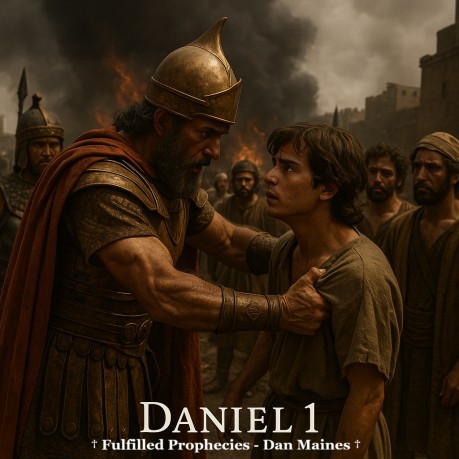
Daniel 1 Daniel 1:1 † This marks the beginning of the Babylonian
captivity, fulfilling the warnings given by the prophets because
Judah continued in rebellion. Daniel 1:2 † God's sovereignty is clear here, He delivered
Jehoiakim, showing that judgment came by divine appointment, not
Babylonian power. Daniel 1:3 † Babylon sought to train Israel's best youths
to serve its empire, blending them into pagan culture. Daniel 1:4 † These chosen men represent the finest of
Judah, showing that Babylon desired to reshape Israel's wisdom. Daniel 1:5 † Babylon's training aimed to conform their
identity to the empire's image through luxury and influence. Daniel 1:6 † These four young men symbolize the faithful
remnant preserved by God even in captivity. Daniel 1:7 † Changing their names was an attempt to
redefine their identity under Babylon's gods. Daniel 1:8 † Daniel's resolve to stay pure shows spiritual
courage and commitment to covenant law even under pressure. Daniel 1:9 † God's providence worked even in captivity to
give Daniel influence and protection. Daniel 1:10 † The official's fear shows the absolute
authority of Babylon's king, whose word meant life or death. Daniel 1:11–13 † Daniel requested a fair test of faith,
trusting that obedience would prove God's faithfulness. Daniel 1:14–15 † God vindicated Daniel's faith through visible
blessing. Daniel 1:16 † Daniel's example influenced others, showing
how one person's faith can shift the actions of leaders. Daniel 1:17 † God rewarded faithfulness with divine wisdom,
setting them apart in Babylon. Daniel 1:18–19 † These young men rose to prominence because of
God's favor and excellence of spirit. Daniel 1:20–21 † God's wisdom surpassed all the false wisdom
of Babylon's magicians. How it applies to us today † Daniel's integrity shows how faithfulness to
God overcomes the pressure of worldly conformity. † This is the fulfilled perspective we proclaim at
Fulfilled Prophecies † Source Index
By Dan Maines
In the third year of the reign of
Jehoiakim king of Judah, Nebuchadnezzar king of Babylon came to
Jerusalem and besieged it.
† Historically,
Babylon invaded Jerusalem around 605 BC, taking many captives
including young nobles from the royal line.
†
Prophetically, this judgment symbolized the fading glory of the old
covenant nation, soon to be replaced by God's greater kingdom.
†
Josephus confirms that Nebuchadnezzar's invasion fulfilled Jeremiah's
prophecies of Jerusalem's desolation.
† In
the fulfilled kingdom, this reminds us that disobedience leads to
captivity, but Christ has freed us from bondage through His finished
work.
The Lord gave Jehoiakim king of
Judah into his hand, along with some of the vessels of the house of
God, and he brought them to the land of Shinar, to the house of his
god; and he brought the vessels into the treasury of his god.
† The taking of temple
vessels symbolized the desecration of God's house and the departure
of His presence from the physical temple.
†
This foreshadows the first-century judgment on Jerusalem when Christ
declared the temple "desolate."
†
Eusebius records that Israel's repeated idolatries brought these very
fulfillments upon them.
† Today, believers
are God's living temple, where His Spirit dwells forever, not in
physical structures made by hands.
Then the king ordered Ashpenaz,
the chief of his officials, to bring in some of the sons of Israel,
including some of the royal family and of the nobles.
†
Historically, this practice was common for ancient conquerors who
used educated captives for administration.
†
Spiritually, this mirrors how the covenant people were scattered, yet
God preserved a remnant who would remain faithful.
†
Clement of Rome wrote that God always kept faithful servants amid
corruption, just as Daniel and his friends endured.
†
In Christ's kingdom, believers serve as royal priests in a foreign
world, maintaining faithfulness amid spiritual Babylon.
Youths in whom was no defect, who
were good-looking, showing intelligence in every branch of wisdom,
endowed with understanding and discerning knowledge, and who had
ability for serving in the king's court; and he ordered him to teach
them the literature and language of the Chaldeans.
†
The Chaldean language and learning were deeply rooted in astrology
and pagan philosophy.
† This foreshadows the
early church's conflict with worldly wisdom versus spiritual truth.
†
Tertullian, in "Against Marcion," argued that worldly
knowledge cannot save, only the revelation of Christ.
†
In the fulfilled kingdom, true wisdom comes from the Spirit, not from
earthly systems or philosophies.
The king appointed for them a
daily ration from the king's choice food and from the wine which he
drank, and appointed that they should be educated three years, at the
end of which they were to enter the king's personal service.
†
Historically, this three-year training reflects the full process of
assimilation for royal servants.
†
Prophetically, it points to the world's attempt to reshape God's
people, which Christ later overcame by forming a new spiritual
kingdom.
† Josephus notes that Daniel's
refusal of the king's food displayed loyalty to God above earthly
authority.
† In the fulfilled kingdom,
believers must remain spiritually separate, feeding on the Word
rather than worldly indulgence.
Now among them from the sons of
Judah were Daniel, Hananiah, Mishael, and Azariah.
†
Each name carried a meaning that honored the God of Israel, which
Babylon sought to erase.
† Their
steadfastness prefigures those in the first century who held fast to
Christ despite persecution.
† Early church
writers praised Daniel as a model of holiness and courage under
pressure.
† Today, the faithful stand firm in
the completed kingdom, reflecting loyalty to Christ amid spiritual
compromise.
Then the commander of the
officials assigned new names to them; and to Daniel he assigned the
name Belteshazzar, to Hananiah Shadrach, to Mishael Meshach, and to
Azariah Abed-nego.
†
Historically, each new name contained a reference to Babylonian
deities, erasing the memory of Israel's God.
†
Spiritually, this represents how the world tries to rename God's
people, yet their true identity remains with Him.
†
Eusebius affirmed that faithful men under persecution never lost
their divine calling despite worldly pressure.
†
In the fulfilled kingdom, believers bear Christ's name, not the
world's, sealed by His eternal covenant.
But Daniel made up his mind that
he would not defile himself with the king's choice food or with the
wine which he drank; so he sought permission from the commander of
the officials that he might not defile himself.
†
Historically, Babylonian food was often offered to idols, which made
it ceremonially unclean.
† Prophetically,
this separation points forward to Christ's call for spiritual
holiness apart from worldly compromise.
†
Clement of Rome admired those who, like Daniel, resisted defilement
and stood firm in righteousness.
† In the
fulfilled kingdom, believers must also refuse spiritual corruption
and remain devoted to Christ alone.
Now God granted Daniel favor and
compassion in the sight of the commander of the officials.
†
Historically, divine favor often preserved faithful servants within
foreign courts, such as Joseph in Egypt.
†
This foreshadows how God granted favor to His apostles under Roman
rule during the gospel's expansion.
† Early
Christian writings affirm that those who walk faithfully often find
God's favor in unlikely places.
† In the
fulfilled kingdom, God's grace continues to open doors of influence
for those who walk in integrity.
And the commander of the
officials said to Daniel, "I am afraid of my lord the king, who
has appointed your food and your drink; for why should he see your
faces looking more haggard than the youths who are your own age? Then
you would make me forfeit my head to the king."
†
Historically, Babylonian rulers demanded total obedience and feared
rebellion, even in small matters.
†
Prophetically, this reflects the oppression of worldly powers that
ruled until the everlasting kingdom arrived in Christ.
†
Eusebius noted that earthly fear often blinds rulers to God's higher
purpose.
† In the fulfilled kingdom, perfect
love casts out fear, because Christ reigns as the true King.
But Daniel said to the
overseer whom the commander of the officials had appointed over
Daniel, Hananiah, Mishael, and Azariah, "Please test your
servants for ten days, and let us be given some vegetables to eat and
water to drink. Then let our appearance be observed in your presence
and the appearance of the youths who are eating the king's choice
food; and deal with your servants according to what you see."
†
Historically, the ten-day test demonstrated the physical blessing of
living according to God's law.
† Spiritually,
it points to endurance and faithfulness under trial, just as the
early believers proved faithful through testing.
†
Clement and other fathers saw Daniel's faith as a model for trusting
God's provision.
† In the fulfilled kingdom,
the believer's faith is still tested, revealing the strength of
spiritual conviction.
So he listened to them in
this matter and tested them for ten days. At the end of ten days
their appearance seemed better and they were fatter than all the
youths who had been eating the king's choice food.
† Historically, this miracle proved
that obedience brought strength beyond human reasoning.
†
Prophetically, this showed that those who remained faithful to God
would be sustained even under foreign dominion.
†
Tertullian taught that divine favor sustains the righteous far beyond
natural means.
† In the fulfilled kingdom,
spiritual nourishment from Christ strengthens the believer's life and
witness.
So the overseer continued to
withhold their choice food and the wine they were to drink, and kept
giving them vegetables.
†
Historically, this obedience became a quiet resistance to idolatry
within Babylon.
† Spiritually, it foreshadows
the early church's steadfastness under persecution.
†
Eusebius recorded similar examples of believers who maintained purity
under Roman control.
† In the fulfilled
kingdom, faithful living influences others toward righteousness and
truth.
As for these four youths, God
gave them knowledge and intelligence in every branch of literature
and wisdom; Daniel even understood all kinds of visions and dreams.
†
Historically, dreams were a key form of communication in the ancient
Near East, but Daniel's understanding came from God alone.
†
Prophetically, this anticipates the Spirit's revelation given to the
apostles in the first century.
† Early church
writers saw Daniel as a type of the prophets and apostles who
discerned divine mysteries.
† In the
fulfilled kingdom, God's Spirit continues to grant wisdom and
understanding through His Word.
Then at the end of the days
which the king had specified for presenting them, the commander of
the officials presented them before Nebuchadnezzar. The king talked
with them, and out of them all not one was found like Daniel,
Hananiah, Mishael, and Azariah; so they entered the king's personal
service.
†
Historically, their rise fulfilled God's promise to exalt those who
honor Him.
† Prophetically, this prefigures
the elevation of Christ's faithful ones in His kingdom.
†
Clement and Eusebius both recognized that God uses faithfulness to
influence kings and nations.
† In the
fulfilled kingdom, those who walk in truth reign with Christ in
spiritual authority.
As for every matter of
wisdom and understanding about which the king consulted them, he
found them ten times better than all the magicians and conjurers who
were in all his realm. And Daniel continued until the first year of
Cyrus the king.
† Historically,
Daniel's success endured through multiple empires, showing God's
enduring faithfulness.
† Prophetically, this
points to the triumph of divine wisdom in Christ over all earthly
power.
† Early writers saw Daniel's longevity
as proof that truth outlasts tyranny.
† In
the fulfilled kingdom, the wisdom of Christ reigns eternally, never
to be overthrown.
†
Just as Babylon sought to reprogram Israel's youth, today's world
pressures believers to compromise truth for comfort.
†
The story of Daniel demonstrates that obedience always brings favor
and spiritual strength.
† The fulfilled
kingdom calls us to stand firm, knowing Christ reigns and all
prophecy is complete in Him.
† We live in the
same spiritual victory Daniel foreshadowed, walking in righteousness
in the everlasting kingdom.
© Fulfilled Prophecies - Dan
Maines.
† The Holy
Bible, NASB
† Josephus, Antiquities of the
Jews, Book 10
† Eusebius, Ecclesiastical
History, Book 9
† Tertullian, Against
Marcion, Book 4
† Clement of Rome, 1 Clement
Links