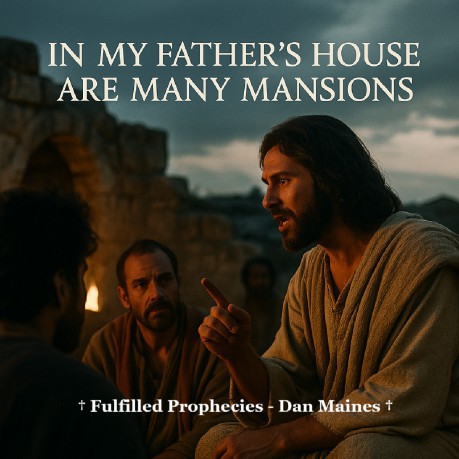
In My Father's House Are Many
Mansions Scripture: John 14:2-6; Revelation 21:2; John
2:15-16; Ephesians 2:6 John 14:2-6 † The phrase "My Father's house"
appears only twice in the New Testament, in John 2:16 and John 14:2.
When Jesus used it the first time, He was speaking of the temple in
Jerusalem, saying, Take these things away, do not make My Father's
house a house of merchandise. When He used it again, He did not
change its meaning. He was revealing the coming transition from the
physical temple to the spiritual temple that would soon be
established through His death, resurrection, and ascension. † The Greek word translated "mansions"
(monai) means dwelling places or abodes. This same word is used again
in John 14:23 where Jesus said, We will come to him and make Our home
with him. This shows that the dwelling places He prepared were not
houses in heaven, but abiding places within His people. He was
preparing access into the household of God, not physical structures
in another realm. † When Jesus said, I go to prepare a place for
you, He was speaking of the cross. His death opened the way into the
presence of God, removing the separation caused by sin. Through His
resurrection and ascension, He entered the true Holy Place and
secured eternal redemption for His people (Hebrews 9:24). † The prepared place is the prepared people,
formed by the cross and filled by the Spirit. Jesus was not preparing
furniture in a distant city, but a spiritual temple built of living
stones. His body is that temple (John 2:19-21), and all who are in
Him become its dwelling places (1 Peter 2:5). † When Jesus said, I will come again and
receive you to Myself, He was not speaking of a future rapture or
physical removal from earth. He was describing His covenantal coming
to establish His kingdom and dwell with His people through the
Spirit. That coming was realized in their generation when the old
temple was judged and the new temple stood complete in Christ
(Matthew 16:27-28, Matthew 24:30-34). † The house of God was never meant to remain a
building made with hands. Paul said, Do you not know that you are the
temple of God and that the Spirit of God dwells in you? (1
Corinthians 3:16). God's plan was always to dwell within His people,
not in stone walls. The New Covenant fulfills that purpose. † Revelation 21:2-3 confirms this fulfillment.
John saw the holy city, New Jerusalem, coming down out of heaven from
God, prepared as a bride adorned for her husband. The city did not
remain in heaven, it came down. And the voice declared, Behold, the
tabernacle of God is among men, and He will dwell among them. The
Bride, the Church, is the Father's house with many dwelling places. † The phrase, that where I am, there you may be
also, speaks of union, not relocation. Jesus explained it plainly in
John 14:20, In that day you will know that I am in My Father, and you
in Me, and I in you. This is the spiritual reality of being in Him,
the union of heaven and earth realized in the believer's relationship
with Christ. † When Jesus spoke of coming again, He tied it
directly to Pentecost. He said, I will not leave you orphans, I will
come to you (John 14:18). Through the indwelling Spirit, He returned
to abide with His people, fulfilling the promise that where He is,
they may be also. † Those who came to the Father through Christ
were no longer separated by the veil. They became citizens of the
heavenly kingdom even while living on earth. Paul wrote, He raised us
up with Him and seated us with Him in the heavenly places in Christ
Jesus (Ephesians 2:6). This is a present reality, not a postponed
hope. How Jesus Prepared the Place † When Jesus said, "I go to prepare a
place for you" (John 14:2), He was about to face the cross. The
preparation wasn't construction work in heaven, it was the completion
of redemption. He prepared the way by His sacrifice, tearing down the
barrier between God and man (Hebrews 10:19-20). † On the cross, He removed the curse of sin
that had separated mankind from God since Adam. When He cried out,
"It is finished" (John 19:30), that was the moment the way
into the Father's presence was prepared. † His descent into Hades (Acts 2:27, Ephesians
4:8-10) fulfilled the prophetic work of reclaiming the righteous dead
who were waiting for redemption. He proclaimed victory over death and
opened the way for the righteous to enter the presence of God, a
realm that had been closed until His blood atonement was made. † His resurrection and ascension completed that
preparation. As Hebrews 9:24 says, "For Christ did not enter a
holy place made with hands, a mere copy of the true one, but into
heaven itself, now to appear in the presence of God for us." His
entrance there as the High Priest secured our place in the true Holy
of Holies, the Father's house. † The preparation happened through His
suffering, death, descent, resurrection, and ascension, the entire
redemptive process. That's how He made it possible for believers to
dwell in the Father's house as living temples, and to continue in His
presence beyond physical death. What It Truly Is † It is about leaving behind the pain,
corruption, and decay of this world and entering fully into the
Father's presence, both now and forever. It's not that heaven doesn't
exist, it's that heaven is far greater than people have imagined. The
heaven Jesus spoke of is not far away, it is the life and glory of
God shared with His people. Through His death and resurrection, He
opened that heavenly realm so we could live in it now, and continue
in it when our earthly life ends. Heaven is not less real, it is more
real, life without sorrow, decay, or distance from Him. This is the
hope we have, and the joy of knowing that when this world fades, we
will still be alive in His glory, never to suffer again. What It Is Not † It is not about building luxury homes in
heaven. The Greek word for mansions means abodes or dwelling places,
referring to spiritual habitation, not literal houses. Jesus was
preparing a covenantal relationship, not a physical city. † It is not about a postponed future kingdom.
The kingdom came when heaven and earth were joined through Christ's
completed work and when the New Jerusalem descended. The house of God
was established when the old temple fell. † It is not limited to the apostles alone. It
extends to all who come to the Father through Christ. Every believer
becomes a dwelling place of God's Spirit, a living stone in the
Father's house. † It is not about escaping the earth but about
transforming it. The Father's house was brought here when God made
His dwelling among men. As Revelation 21:3 declares, the tabernacle
of God is with men, not waiting above them. Heaven: Two Real Places in God's Design † The Bible speaks of heaven in two ways.
First, there is the eternal heaven, the unseen realm where God
dwells, where His throne is, and where the redeemed go at death
(Revelation 4:1-2, Hebrews 12:22-24). This is the Father's house, the
higher dimension of creation beyond the physical universe. † Second, there is the heavenly kingdom now
revealed on earth through Christ. When heaven and earth were joined
in the new covenant, God's dwelling came among His people (Revelation
21:2-3). That doesn't replace the heavenly realm, it extends its
reality to us through the Spirit. † So heaven is both the eternal dwelling of God
and the living presence of His kingdom now within and among
believers. The two are connected, one unseen and eternal, the other
revealed on earth through the fulfillment of His promise. When we
die, we step fully into the heavenly place that Christ opened, and
when we live by His Spirit, we walk in the heavenly life that has
already begun. † Jesus taught us to pray, Your kingdom come,
Your will be done, on earth as it is in heaven (Matthew 6:10). That
prayer was fulfilled when heaven's order and presence came to earth
through the finished work of Christ. God's will now reigns in the
hearts of His people just as it does in heaven. Revelation 21:3
confirms this, saying, Behold, the tabernacle of God is with men, and
He will dwell with them. Heaven's presence has come, not to make
earth heaven, but to fill it with the rule and glory of the One who
sits on the throne. Clarification on Heaven and Fulfillment † When Jesus spoke of the Father's house, He
was not pointing His disciples to a distant heaven, but to the new
covenant dwelling of God with His people on earth. That promise has
already been fulfilled. Yet when a believer's physical life ends, our
spirit continues in that same presence, only without the limits of
the body. Heaven is not a separate destination, it is the unveiled
reality of being fully in Him. † When we are saved, we are indeed seated with
Christ in heavenly places (Ephesians 2:6). That position is
spiritual, not physical, meaning that while we live on earth, we
share His authority, His fellowship, and His presence through the
Spirit. † Being seated with Him gives us spiritual
perception. Paul said, we look not at the things which are seen, but
at the things which are not seen, for the things which are seen are
temporary, but the things which are not seen are eternal (2
Corinthians 4:18). The Spirit opens our eyes to see the reality of
the heavenly realm operating now within and around us. † When our physical bodies die, our spirit
continues to live in Christ. Paul said, to be absent from the body is
to be present with the Lord (2 Corinthians 5:8). There is no
interruption of life, no gap, and no sleep of the soul. We simply
move from faith to sight, from the limited physical world into the
full awareness of His presence. † Yes, it is heaven, but not in the sense of a
distant physical place. It is the spiritual dimension of God's
presence that surrounds and sustains all creation. In that state, we
will perceive spiritual reality as vividly as we once perceived
physical reality, but without corruption or decay. † Scripture reveals that the spiritual realm is
greater and beyond our current senses. Paul described it as a
building from God, a house not made with hands, eternal in the
heavens (2 Corinthians 5:1). Moving into that existence is like
walking from one room into another, leaving behind mortality and
stepping fully into immortality. † Those looking for a physical kingdom miss the
entire point of what it means to be in Christ. Jesus said, The
kingdom of God does not come with observation, nor will they say, See
here or see there, for indeed the kingdom of God is within you (Luke
17:20-21). Common Objection: The Hope of Heaven † We are not removing the hope of heaven, we
are revealing that heaven has already been opened through Christ. Our
hope was never to depart this world, but to live eternally in His
presence. That began the moment redemption was finished. † Physical death does not end that fellowship.
When we leave the body, we do not fall into sleep or silence. We pass
fully into the spiritual reality already present in Christ, free from
the weakness of the flesh. Paul said, to be absent from the body is
to be at home with the Lord (2 Corinthians 5:8). † The spiritual realm is not shadowy or
distant, it is more real than the physical. The visible world passes
away, but the unseen is eternal (2 Corinthians 4:18). What we know
now in part, we will know in full when all that hinders is removed. † When believers die physically, they continue
in the same covenantal presence of God that was already opened to us.
We join the great cloud of witnesses (Hebrews 12:22-24), living in
the same life we already share through Christ. † The fulfilled view does not take away heaven,
it removes the delay. We are not waiting for eternal life to begin,
we are walking in it now. Jesus said, He who believes in Me will
never die (John 11:26). That is the promise of uninterrupted
fellowship with God. † The spiritual realm is not less tangible than
this one. In that state there is no decay, no darkness, and no
distance from the Lord. It is life without end, light without shadow,
and joy without separation. † We are citizens of heaven (Philippians 3:20)
now, and when we pass from this life, we simply step fully into what
has already begun. The same life we live by faith becomes sight in
His presence. How it applies to us today Historical References Closing Reflection † This is the fulfilled perspective we proclaim at
Fulfilled Prophecies † Source Index
By Dan Maines
2 In My Father's house are many
mansions; if it were not so, I would have told you. I go to prepare a
place for you.
3 And if I go and prepare a place for you, I will
come again and receive you to Myself, that where I am, there you may
be also.
4 And where I go you know, and the way you know.
5
Thomas said to Him, Lord, we do not know where You are going, and how
can we know the way?
6 Jesus said to him, I am the way, the
truth, and the life. No one comes to the Father except through Me.
†
We are not waiting for a mansion in heaven, we are living in the
Father's house now.
† Through Christ, God
dwells in us, and we dwell in Him.
† The New
Jerusalem has already come down, and the promise has been fulfilled.
God now lives among His people, and His presence is permanent.
†
Our hope is not in leaving this world, but in walking daily in the
reality of His finished work. The separation that once existed is
gone, and the dwelling place of God is with His people.
†
Understanding this truth brings rest. We no longer strive to reach
heaven, because heaven has already reached us in Christ.
†
When Jesus said, I am the way, the truth, and the life, He was
showing that the only path to the Father is through Him, and that
this relationship is not distant but present.
†
The believer's life is now lived inside the Father's house. We are
the living stones of His spiritual temple, joined together in unity,
built upon Christ, and sealed by His Spirit.
†
Eusebius wrote that after the destruction of Jerusalem, the Church
became the living temple of God, where His presence remained
forever.
† Clement of Alexandria said, The
temple of God is the congregation of the faithful, built together in
Christ, the eternal dwelling of the Father.
†
Tertullian stated, The Church is the house and temple of God, built
not with hands, but of the faithful.
† Justin
Martyr described believers as the true Israel, the habitation of the
Holy One, and the spiritual fulfillment of God's dwelling among His
people.
† Irenaeus wrote that Christ gathered
together the scattered sons of God into one house, fulfilling the
promises spoken through the prophets.
†
Heaven is not a distant dream or a hope delayed, it is the living
presence of God that began to dwell with His people when Christ
fulfilled His promise. The place He prepared is not waiting to be
built, it is finished. Those who belong to Him now walk in the
reality of that kingdom and will one day step fully into His glory,
free from pain, corruption, and death. The Father's house is real,
eternal, and complete, and in Christ, we already dwell within its
walls.
© Fulfilled Prophecies - Dan
Maines.
† John
14:2-6, 14:18-23; John 2:15-21; Revelation 21:2-3, 9-10; Ephesians
2:6, 2:19-22; 1 Corinthians 3:16; 2 Corinthians 4:18, 5:1, 5:8;
Hebrews 3:6, 9:24, 10:19-20, 12:22-24; 1 Peter 2:5; Luke 17:20-21;
Matthew 6:10, 16:27-28, 24:30-34; Acts 2:27; Ephesians 4:8-10; John
19:30; John 11:26
† Eusebius, Ecclesiastical
History, Book 3
† Clement of Alexandria,
Stromata, Book 7
† Tertullian, Against
Marcion, Book 3
† Justin Martyr, Dialogue
with Trypho
† Irenaeus, Against Heresies,
Book 5
Links