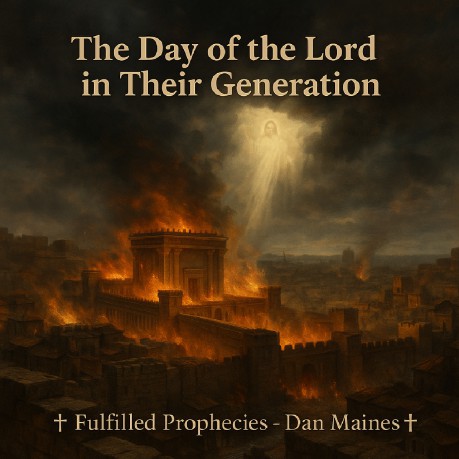
The
Day of the Lord in Their Generation Matthew
24:34 †
Jesus
spoke these words directly to His disciples, not to a distant future
audience. The phrase "this generation" consistently refers
to the people living at that time (Matthew 11:16, 12:41-42). He was
describing the events that would unfold before that generation ended,
culminating in the destruction of Jerusalem in AD 70. †
In
Scripture, the "Day of the Lord" always refers to God's
intervention in judgment against a nation or people who have broken
covenant with Him. It wasn't a single global event, but a repeated
pattern throughout history. The prophets spoke of many "Days of
the Lord", against Babylon (Isaiah 13:6, 9), Egypt (Ezekiel
30:2-4), Edom (Obadiah 15), and Israel itself (Joel 1:15; Amos 5:18).
Each time, it meant national judgment, destruction, and covenant
transition. †
The
final Day of the Lord, spoken of by Jesus and the apostles, was the
climactic judgment against Old Covenant Israel. It ended the temple
sacrifices, the priesthood, and the entire Mosaic system, making way
for the everlasting New Covenant kingdom where righteousness dwells
(Hebrews 8:13; 12:26-28). †
God
never made a coming in judgment in bodily form, every time it was
spiritual. His presence was revealed through divine acts, historical
events, and covenantal change, never by physical appearance. Just as
He "came down" on Egypt (Isaiah 19:1) riding on a cloud in
judgment, so Christ "came" in judgment upon Jerusalem in AD
70. These comings were spiritual manifestations of divine authority,
not physical returns. †
The
Day of the Lord in this context wasn't about the end of the physical
world but the end of the Old Covenant world. This marked the closing
of the Mosaic age and the full establishment of the New Covenant
kingdom. Matthew
16:27-28 †
These
verses confirm that Jesus' coming in judgment and kingdom glory was
imminent for that generation. Some of those standing with Him would
live to see it. This was fulfilled when Christ came in power through
the Roman armies in AD 70 to execute judgment on the covenant
breakers (Matthew 22:7). †
The
"coming of the Son of Man" described here is the same
coming spoken of in Matthew 24. It wasn't a physical descent to earth
but a covenantal coming in judgment, fulfilling the imagery of Daniel
7:13-14, where the Son of Man comes before the Ancient of Days to
receive dominion and a kingdom. Matthew
10:23 †
This
verse strengthens the time frame of fulfillment. Jesus told His
disciples that they wouldn't even finish going through all the cities
of Israel before His coming. This aligns perfectly with the promise
that the coming would occur in their generation, not thousands of
years later. Matthew
23:36-38 †
Jesus
directly identified Jerusalem as the target of judgment. The "house"
being left desolate referred to the temple, which was destroyed in AD
70. This was the Day of the Lord against Israel's corrupt system,
fulfilling what the prophets had warned (Isaiah 13:6, Zephaniah
1:14). †
This
passage ties together the rejection of the prophets, the rejection of
Christ, and the resulting desolation. The covenant curse that Moses
warned of in Deuteronomy 28 had reached its climax. Luke
21:20-22 †
Luke
records the same prophecy from Jesus, showing clearly that the Day of
the Lord was tied to the Roman siege of Jerusalem. These were the
days of vengeance, fulfilling all that had been written. The
believers recognized these signs and escaped, just as history
confirms. 1
Thessalonians 5:2-4 †
Paul
warned the Thessalonians of the same impending judgment. The phrase
"thief in the night" speaks of suddenness, not delay. Those
who were awake and watching (faithful believers) weren't overtaken,
but those who trusted in the temple and Jewish system were destroyed. †
The
faithful remnant recognized the signs Jesus gave in Matthew 24:15-16
and fled to Pella, escaping the judgment that came on Jerusalem. The
unbelieving nation was caught unaware, fulfilling this warning
precisely. 2
Peter 3:10 †
Peter
used apocalyptic language drawn from Old Testament prophecy. "Heavens
and earth" symbolized the covenantal order of Israel, not the
physical universe (Isaiah 51:15-16). The "elements" were
the principles of the Old Covenant system (Galatians 4:3, 9). The
burning signified the complete removal of that system through divine
judgment. †
This
covenantal fire made way for "new heavens and a new earth"
where righteousness dwells, representing the New Covenant world in
Christ (2 Peter 3:13). Hebrews
10:37 †
This
statement was written just before the destruction of Jerusalem and
confirms that the coming of the Lord was near. There was no delay or
gap. The inspired writer emphasized "a very little while",
perfectly fitting the fulfilled timing of AD 70. How
it applies to us today †
The
fulfillment of the Day of the Lord proves that Jesus' words never
fail. It confirms that every prophecy was completed within the time
He specified. This strengthens our faith in the trustworthiness of
Scripture and the finished work of Christ. †
We
now live in the New Covenant age where God dwells with His people.
There's no future day of wrath awaiting believers. The Day of the
Lord came upon that generation, but for us, it's a reminder of His
faithfulness and victory. †
Understanding
this frees us from fear and motivates us to live as citizens of the
fulfilled kingdom, spreading the message of reconciliation and
righteousness that already reigns through Christ. Historical
Writers †
Josephus
recorded that divine signs preceded Jerusalem's fall, including a
star resembling a sword and a voice saying, "Let us remove
hence." (Wars 6.5.3). † This
is the fulfilled perspective we proclaim at Fulfilled Prophecies † Source
Index
By Dan Maines
Truly
I say to you, this generation will not pass away until all these
things take place.
For
the Son of Man is going to come in the glory of His Father with His
angels, and will then repay every man according to his deeds. Truly I
say to you, there are some of those who are standing here who will
not taste death until they see the Son of Man coming in His kingdom.
But
whenever they persecute you in one city, flee to the next; for truly
I say to you, you will not finish going through the cities of Israel
until the Son of Man comes.
Truly
I say to you, all these things will come upon this generation.
Jerusalem, Jerusalem, who kills the prophets and stones those who are
sent to her! How often I wanted to gather your children together, the
way a hen gathers her chicks under her wings, and you were unwilling.
Behold, your house is being left to you desolate!
But
when you see Jerusalem surrounded by armies, then recognize that her
desolation is near. Then those who are in Judea must flee to the
mountains, and those who are in the midst of the city must leave, and
those who are in the country must not enter the city; because these
are days of vengeance, so that all things which are written will be
fulfilled.
For
you yourselves know full well that the day of the Lord will come just
like a thief in the night. While they are saying, "Peace and
safety!" then destruction will come upon them suddenly like
labor pains upon a woman with child, and they will not escape. But
you, brethren, are not in darkness, that the day would overtake you
like a thief.
But
the day of the Lord will come like a thief, in which the heavens will
pass away with a roar and the elements will be destroyed with intense
heat, and the earth and its works will be burned up.
For
yet in a very little while, He who is coming will come, and will not
delay.
†
Tacitus confirmed similar omens and a great disturbance among the
Jews, aligning with Jesus' prediction that great signs would appear
before the end (Histories 5.13).
†
Eusebius wrote that the Christians in Jerusalem, being warned by an
oracle, fled to Pella and were saved from destruction (Ecclesiastical
History 3.5).
©
Fulfilled Prophecies - Dan Maines.
†
Matthew 10:23; Matthew 16:27-28; Matthew 23:36-38; Matthew 24:34;
Luke 21:20-22; 1 Thessalonians 5:2-4; 2 Peter 3:10; Hebrews 10:37
†
Isaiah 13:6, 9; Isaiah 19:1; Isaiah 51:15-16; Ezekiel 30:2-4; Joel
1:15; Amos 5:18; Obadiah 15; Zephaniah 1:14; Daniel 7:13-14;
Deuteronomy 28; Galatians 4:3, 9; Hebrews 8:13; 12:26-28
†
Josephus, Wars of the Jews 6.5.3; Tacitus, Histories 5.13; Eusebius,
Ecclesiastical History 3.5
Links