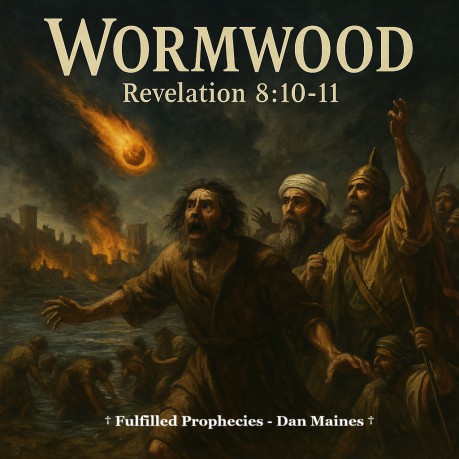
Wormwood – Revelation
8:10-11 Revelation 8:10-11 † The third trumpet describes a falling star
named Wormwood. In the symbolic language of Revelation, stars often
represent rulers or leaders (Isaiah 14:12, Daniel 8:10). This star
falling from heaven points to a great leader or authority figure
who'd bring bitterness and corruption upon the people through false
teaching, apostasy, or judgment (Revelation 1:20, Matthew 24:11-12, 2
Peter 2:1-3, Jude 12-13). † The term "wormwood" in Scripture
always signifies bitterness and divine judgment. In Jeremiah 9:15 God
says, Therefore thus says the Lord of hosts, the God of Israel,
Behold, I will feed them, this people, with wormwood and give them
poisoned water to drink. The same imagery appears in Lamentations
3:15 and Amos 5:7. Wormwood was a symbol of moral decay and the
bitterness of divine retribution (Jeremiah 9:15, Jeremiah 23:15,
Lamentations 3:15, Amos 5:7, Deuteronomy 29:18, Proverbs 5:4). † From the fulfilled perspective, the third
trumpet corresponds to the period following the Jewish revolt (AD
66-70) as corruption spread within both the Jewish leadership and the
apostate church. This "star" that fell can be seen as a
symbolic representation of those in spiritual authority who turned
away from the truth, spreading bitterness through false doctrine and
rebellion against God (Revelation 8:10-11, Acts 20:29-30, 2
Thessalonians 2:3, Matthew 24:10-13). † Josephus records how the zealot leaders
defiled the temple, shed innocent blood, and deceived the people.
This caused a bitterness throughout the nation as moral order
collapsed. The spiritual waters of Israel, their teachers and
priests, had become polluted. The result was death, not life. The
Wormwood star represents this poisoning of Israel's spiritual life
before her destruction (Isaiah 1:21-23, Hosea 4:1-9, Ezekiel
22:26-28, Malachi 2:7-8). † Historically, the trumpet judgments symbolize
successive stages of judgment upon Israel leading up to AD 70. The
first trumpet burned the land, the second struck the sea, and the
third poisoned the rivers, the internal corruption spreading through
every part of their society. Wormwood captures that inner rot that
preceded their physical destruction (Revelation 8:7-11). † The name Wormwood also points to the bitter
consequences of rejecting Christ. When Israel refused the living
water offered by the Messiah (John 4:14, 7:38), their remaining
waters became poison. The light of the world had come, but they
preferred darkness. The fall of this great star marks the moral and
spiritual fall of Israel's leaders, which brought ruin to the people
they guided (Jeremiah 2:13, John 4:14, John 7:37-38, John 3:19-20,
Matthew 23:37-38). What Wormwood Is Not † Wormwood isn't a literal asteroid or comet
crashing into Earth as some futurists claim. Revelation's language is
symbolic, describing spiritual judgment, not physical space events
(Revelation 1:1, Revelation 1:20, Revelation 12:4). Jesus spoke of
His coming in symbolic terms that represented judgment upon that
generation, not cosmic disasters (Matthew 24:29-34). † Wormwood isn't a modern disaster like nuclear
fallout, as some interpret from the word "Chernobyl"
meaning wormwood. The text of Revelation deals with first-century
Israel and Rome, not twentieth-century politics. The trumpet
judgments align with the events leading to Jerusalem's fall (Luke
21:20-22, Revelation 8:7-13). † Wormwood isn't Satan's fall. While Satan's
called a fallen star in Luke 10:18, the context here shows judgment
upon Israel's leaders and false prophets, not the original fall of
Lucifer. This "fall" represents apostasy among those who
were once in spiritual light but turned to darkness (Matthew
23:13-16, 2 Peter 2:1-3, Jude 12-13). † Wormwood isn't a future global poisoning of
literal waters. In prophetic language, "waters" represent
people, nations, and teachings (Revelation 17:15, Isaiah 8:6-7,
Jeremiah 2:13). The "bitterness" refers to spiritual
corruption that spread through Israel before her end (Amos 8:11-12,
Hosea 4:1-3). Historical References † Josephus, Wars of the Jews, Book 4, records
the corruption, deceit, and infighting among the zealots, priests,
and rulers within Jerusalem before its destruction. How it applies to us today † Wormwood warns us of the danger of turning
the pure water of God's Word into bitterness by mixing it with human
traditions or self-righteousness. Whenever spiritual leaders fall,
when truth's corrupted for personal gain, or when pride replaces
humility, the same poison flows (Mark 7:8-13, Galatians 1:6-9, 2
Timothy 4:3-4, Hebrews 12:15, Ephesians 4:14-15). † The judgment of Wormwood reminds believers
that God's truth must stay pure. When we reject His living water,
bitterness follows. The lesson's eternal, only by abiding in Christ,
the true source of living water, can we stay free from the corruption
that destroys nations and hearts alike (John 15:4-5, Psalm 1:1-3,
Proverbs 13:14, Revelation 22:1-2). † This is the fulfilled perspective we proclaim at
Fulfilled Prophecies † Source Index
By Dan Maines
And the third angel
sounded, and a great star fell from heaven, burning like a torch, and
it fell on a third of the rivers and on the springs of waters. The
name of the star is called Wormwood, and a third of the waters became
wormwood, and many men died from the waters, because they were made
bitter.
†
Tacitus, Histories 5.12-13, describes the same period as one of
internal madness and bitterness that brought ruin from within.
†
Clement of Rome, 1 Clement 1-2, laments the envy and strife that led
to the downfall of many within the early community, a spiritual
reflection of this same bitterness.
© Fulfilled Prophecies - Dan
Maines.
† Revelation
8:10-11; Isaiah 14:12; Jeremiah 9:15; Lamentations 3:15; Amos 5:7;
John 4:14; John 7:38
† Josephus, Wars of the
Jews, Book 4
† Tacitus, Histories 5.12-13
†
Clement of Rome, 1 Clement 1-2
Links