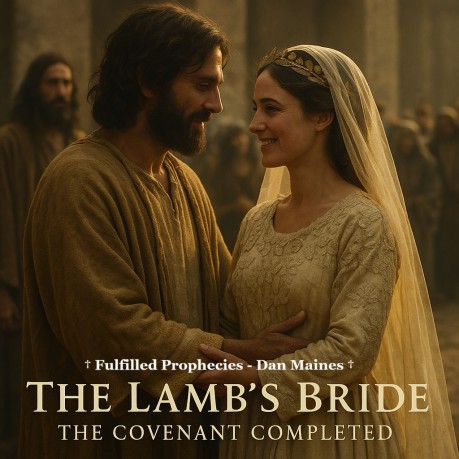
The Lamb's Bride: The
Covenant Completed Revelation 21:2 † John's vision shows the fulfillment of all
covenant promises, the marriage between Christ and His people. Ephesians 5:25-27 † Paul described the purpose of Christ's love,
to prepare His bride through sanctification and cleansing. Isaiah 62:4-5 † Isaiah prophesied of the covenant's renewal
long before its fulfillment in Christ. Hosea 2:19-20 † Hosea's prophetic marriage to Gomer
symbolized Israel's unfaithfulness, yet also God's promise to
restore. Revelation 19:7-8 † The marriage supper of the Lamb represents
the final union of covenant and fulfillment. Matthew 22:2-3 † Jesus used this parable to show that the
covenant invitation was first sent to Israel. John 3:29 † John the Baptist recognized his role as
witness, not groom, his joy was seeing the union completed. How it applies to us today † This is the fulfilled perspective we proclaim at
Fulfilled Prophecies † Source Index
By Dan Maines
And I saw the holy city, new
Jerusalem, coming down out of heaven from God, made ready as a bride
adorned for her husband.
†
The New Jerusalem is not a physical city, but the redeemed community
of believers, the Bride herself.
† "Coming
down out of heaven" reveals the union of heaven and earth
through the completed redemption.
† The
bride's adornment represents righteousness and glory given by the
Lamb, not earned by works.
Husbands, love your wives,
just as Christ also loved the church and gave Himself up for her, so
that He might sanctify her, having cleansed her by the washing of
water with the word, that He might present to Himself the church in
all her glory, having no spot or wrinkle or any such thing, but that
she would be holy and blameless.
†
The "washing of water with the word" points to the inner
transformation by truth and Spirit.
† The
church's beauty is not external but spiritual, the perfection of
holiness through union with Him.
† The
presentation of the church "in all her glory" is the
marriage scene completed in Revelation.
It will no longer be said to
you, "Forsaken," nor to your land will it any longer be
said, "Desolate"; but you will be called, "My delight
is in her," and your land, "Married"; for the Lord
delights in you, and to Him your land will be married. For as a young
man marries a virgin, so your sons will marry you; and as the
bridegroom rejoices over the bride, so your God will rejoice over
you.
† The
once-forsaken Jerusalem now becomes "Married", the restored
relationship between God and His people.
†
The Lord's delight in His bride expresses eternal satisfaction and
completion.
† What was once desolation under
the old covenant is now joy under the new.
I will betroth you to Me
forever; yes, I will betroth you to Me in righteousness and in
justice, in lovingkindness and in compassion, and I will betroth you
to Me in faithfulness. Then you will know the Lord.
† The "betrothal forever"
finds its fulfillment in the eternal covenant sealed by Christ's
blood.
† This marriage is built not on law
but on righteousness, compassion, and faithfulness.
†
Knowing the Lord in this context means intimate, covenantal
relationship, the full restoration of communion.
Let us rejoice and be glad
and give the glory to Him, for the marriage of the Lamb has come and
His bride has made herself ready. It was given to her to clothe
herself in fine linen, bright and clean; for the fine linen is the
righteous acts of the saints.
†
The bride's readiness shows that redemption had reached completion,
no further preparation required.
† The "fine
linen" given to her signifies the imputed righteousness and
faithful witness of the saints.
† This is the
moment creation awaited, heaven and earth joined as one in the
eternal kingdom.
The kingdom of heaven may be
compared to a king who gave a wedding feast for his son, and he sent
out his slaves to call those who had been invited to the wedding
feast, and they were unwilling to come.
†
Those who refused represented the unbelieving nation that rejected
their Messiah.
† The invitation later went to
all nations, fulfilling the prophecy that "many will come from
east and west."
† The feast symbolizes
the joy and completion of covenant relationship in the new creation.
He who has the bride is the
bridegroom; but the friend of the bridegroom, who stands and hears
him, rejoices greatly because of the bridegroom's voice. So this joy
of mine has been made full.
†
The "bridegroom's voice" represents the announcement of
fulfilled promise.
† His joy being "made
full" mirrors the completion of all expectation in Christ.
†
Once the bridegroom came, the new covenant marriage began in full
glory.
†
We live as the bride of the Lamb, joined forever in an unbreakable
covenant.
† Our relationship with Christ is
not distant but intimate, built on love, truth, and eternal unity.
†
Every believer shares in this marriage joy, clothed in righteousness
and peace.
† The old covenant has passed; the
new covenant stands complete, radiant, and everlasting.
†
The marriage of the Lamb is not a future event, it is the reality we
now live in daily.
© Fulfilled Prophecies - Dan
Maines.
† Revelation
21:2; Ephesians 5:25-27; Isaiah 62:4-5; Hosea 2:19-20; Revelation
19:7-8; Matthew 22:2-3; John 3:29
†
Athanasius, On the Incarnation, ch. 56
†
Eusebius, Ecclesiastical History, Book 3
Links