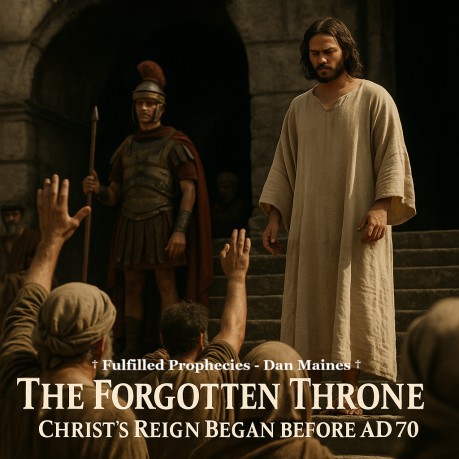
The Forgotten Throne:
Christ's Reign Began Before AD 70 Psalm 110:1-2 † This psalm is the foundation of Christ's
kingship. David saw the Messiah exalted to God's right hand, not to
wait for future enthronement, but to reign until every enemy was
subdued. Acts 2:30-31 † Peter connects the resurrection directly to
kingship. Christ's resurrection placed Him on David's throne. Acts 2:33-36 † Peter's sermon on Pentecost declares Christ's
reign as a present reality, not a future hope. 1 Corinthians 15:24-25 † Paul affirms that Christ's reign was active
and ongoing when he wrote these words. Revelation 3:21 † Jesus states clearly that He was already
seated on His Father's throne at the time of Revelation's writing. Daniel 7:13-14 † The Son of Man did not come down to earth in
this vision, He came up to the Father to receive His kingdom. Hebrews 1:3 † The moment purification was finished, the
King sat down. His reign began the instant His work was done. How it applies to us today † This is the fulfilled perspective we proclaim at
Fulfilled Prophecies † Source Index
By Dan Maines
The Lord says to my Lord: "Sit
at My right hand until I make Your enemies a footstool for Your
feet." The Lord will stretch forth Your strong scepter from
Zion, saying, "Rule in the midst of Your enemies."
† "Sit at My right hand"
reveals that His reign began upon His ascension, when He took His
seat in heavenly authority.
† The phrase
"rule in the midst of Your enemies" shows that His reign
began while opposition still existed — He reigned through conflict,
not after it.
† Zion here represents the
heavenly seat of rule, not the earthly city that would later fall.
And so, because he was a
prophet and knew that God had sworn to him with an oath to seat one
of his descendants on his throne, he looked ahead and spoke of the
resurrection of the Christ, that He was neither abandoned to Hades,
nor did His flesh suffer decay.
†
The throne was not earthly, but spiritual, the heavenly rule over the
new creation.
† The oath to David was
fulfilled at the resurrection, proving the Messiah was already
reigning long before the destruction of Jerusalem.
†
This removes any idea that His kingdom began after AD 70. His
enthronement was immediate, and His reign ongoing.
Therefore having been exalted
to the right hand of God, and having received from the Father the
promise of the Holy Spirit, He has poured forth this which you both
see and hear. For it was not David who ascended into heaven, but he
himself says: "The Lord said to my Lord, Sit at My right hand,
until I make Your enemies a footstool for Your feet." Therefore
let all the house of Israel know for certain that God has made Him
both Lord and Christ, this Jesus whom you crucified.
†
The pouring out of the Spirit was proof that the King had taken His
throne.
† The resurrection, ascension, and
Spirit's outpouring all confirmed that Christ was already reigning
from heaven.
† His enemies were being made a
footstool, and that process reached completion with the fall of
Jerusalem.
Then comes the end,
when He hands over the kingdom to the God and Father, when He has
abolished all rule and all authority and power. For He must reign
until He has put all His enemies under His feet.
† The
"end" referred to here is not the end of His kingdom but
the end of the old covenant system.
† Christ
reigned during the forty-year transition period, conquering His
enemies, sin, death, and the law.
† When that
reign reached its fullness in AD 70, the kingdom was delivered to the
Father as complete, not as beginning.
He who overcomes, I will
grant to him to sit down with Me on My throne, as I also overcame and
sat down with My Father on His throne.
†
The overcomers share in His victory, joining His reign, not waiting
for it.
† The imagery of shared rule
signifies that believers participate in His kingdom now.
†
His throne was never forgotten by heaven, only misunderstood by those
who look for an earthly rule.
I kept looking in the night
visions, and behold, with the clouds of heaven One like a Son of Man
was coming, and He came up to the Ancient of Days and was presented
before Him. And to Him was given dominion, glory, and a kingdom, that
all the peoples, nations, and men of every language might serve Him.
†
Dominion and glory were given to Him at His ascension, not at the end
of time.
† The nations serving Him began with
the spread of the gospel from Pentecost onward.
†
This was the fulfillment of Daniel's vision, a heavenly coronation,
not a postponed kingdom.
When He had made purification of
sins, He sat down at the right hand of the Majesty on high.
†
The throne of majesty is not an event to come; it is the seat He took
when He finished redemption.
† The letter to
the Hebrews confirms that the enthronement preceded the fall of the
temple.
† Christ reigned before judgment fell
and that judgment proved His rule.
†
Christ's throne is not waiting to be established; it has never been
empty.
† We serve a reigning King, not one
still waiting to begin His rule.
† His
kingdom authority continues through His body, the Church, seated with
Him in heavenly places.
† The forgotten
throne is forgotten only by those who still look for what has already
come.
† His kingdom began at the ascension
and endures eternally, unshaken and victorious.
©
Fulfilled Prophecies - Dan Maines.
† Psalm
110:1-2; Acts 2:30-36; 1 Corinthians 15:24-25; Revelation 3:21;
Daniel 7:13-14; Hebrews 1:3
† Clement of
Rome, 1 Clement 36
† Eusebius, Ecclesiastical
History, Book 2
Links